
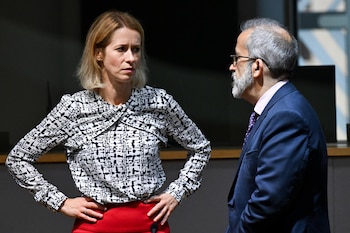
The high representative of the Union for Foreign Affairs and Security Policy , Kaja Kallas, acknowledged on Saturday the serious division within the European Union (EU) regarding sanctions against Israel for its ongoing offensive in Gaza . This division is viewed as a critical challenge for the EU’s role as a global actor.
Speaking ahead of the informal meeting of EU Foreign Ministers in Copenhagen, Denmark , Kallas expressed disappointment over the failure of various initiatives intended to place restrictions on Israel, including the proposed suspension from the Horizon European Research Fund . “The option we proposed was quite indulgent, and even there we obtained the necessary qualified majority. However, I am not overly optimistic about garnering support from those countries that have been resistant thus far,” Kallas stated.
Among these non-supportive countries is Germany , whose foreign minister, Johann Wadephul, reiterated their stance by asserting that Germany would not back any sanctions against Israel at this time. Berlin has paused some of its arms shipments to Israel but has yet to endorse the widespread sanctions suggested by Brussels.
Kallas emphasized that this internal division significantly hampers the EU’s ability to project a unified voice on international matters. “When we are divided, we do not speak with a singular voice. Without unity, we lose our global voice ,” she commented. The agenda also includes discussions surrounding a recent decision by the United States to block the entry of Palestinian President Mahmud Abbas and another 80 Palestinian officials into the United Nations in September.
“First, we must clarify the facts. We will undoubtedly discuss this matter today, and we support the principle that the United Nations is a platform for all nations with status,” Kallas concluded.
The Complexity of Sanctions Approval
According to EU protocols, any sanctions against Israel require a qualified majority , meaning at least 15 out of the 27 EU member states must agree, representing a minimum of 65% of the bloc’s population. This gives Germany, with its population of 83.5 million , significant leverage in negotiations.
While some countries like Germany and Austria are hesitant to adopt sanctions, others, including Denmark , Spain , and Ireland , push for a more proactive stance. Danish Foreign Minister Lars Lokke Rasmussen declared that “it is crucial to transition from rhetoric to action .” He expressed that while Denmark views Israel as a friend, the actions of its current government present challenges.
Rasmussen further elaborated, stating, “Denmark is prepared to restrict trade with Israel, prohibit products from Israeli settlements in the West Bank , and potentially impose sanctions on Israeli ministers.” However, he acknowledged that achieving consensus on these measures appears unlikely, illustrating this sentiment with a nautical metaphor: “The slower ship in the convoy sets the pace.”
The Importance of Unified Action
The current political climate underscores the necessity for a unified approach within the EU regarding international relations and sanctions. The evident fractures raise questions about the bloc’s effectiveness and credibility as a cohesive entity. The varying positions of member states present both an internal and external challenge, necessitating dialogue and potential compromise.
The meeting in Copenhagen aims to dissect these complexities and explore pathways for a consolidated EU strategy, particularly concerning advocacy for Palestinian rights and diplomatic relations with Israel. This dialogue is crucial not only for maintaining regional stability in the Middle East but also for ensuring that the EU can assert its values and principles on the global stage.
Images available at Europa Press Television
Download URL: https://www.europapress.tv/politica/1004775/1/kallas-recocice-gran-problema-division-ue-santes-contra-israel
Contact phone: 91 345 44 06