

Exploring the Global Phenomenon of K-pop
Despite only 80 million people speaking Korean, making it the 13th most spoken language in the world, this has not hindered products like K-dramas or K-pop from dominating the global entertainment market. K-pop has evolved into a highly competitive industry, where dozens of groups debut annually, with only a select few achieving lasting success.
Beyond the $12 million that K-pop contributes to South Korea each year, as reported by Forbes, the Korean music industry aims for expansion. Its strategy involves not only captivating audiences through audio but also engaging their visual senses—using vibrant colors in music videos, synchronized choreography, and the striking appearance of the idols (artists).
K-pop in the Social Media Age
Today, it’s commonplace to browse social media and encounter trends in Hangul (the Korean alphabet). K-pop stars feature in major advertising campaigns and grace the covers of renowned magazines like Vogue and Rolling Stone. These artists also participate in prominent award shows like Billboard and the Grammys, which demonstrates their growing influence in the music world.
Various streaming platforms have embraced K-pop, with iTunes offering a dedicated section for “Top K-pop Songs Charts.” This list showcases the most downloaded songs globally, with availability in countries like Mexico, Colombia, Argentina, and Peru, and it updates daily.
Current K-pop Hits
Here are the latest trending K-pop songs according to the iTunes charts:
- Killin’ It Girl (Solo Version) – Artist: j-hope
- Lemon Drop – Artist: ATEEZ
- Don’t Say You Love Me – Artist: Jin
- i wonder.. – Artist: j-hope & Jung Kook
- 00:00 (Zero O’Clock) – Artist: BTS
- MONA LISA – Artist: j-hope
- Hollow – Artist: Stray Kids
- Dimple – Artist: BTS
- Love You With All My Heart – Artist: Crush
- Trigger (DINO Solo) – Artist: SEVENTEEN
K-pop’s Growing Popularity in Mexico
The Korean music phenomenon in Mexico is currently experiencing explosive growth. Evidence from platforms like YouTube and Spotify, along with market activity, indicates that Mexico has the highest K-pop consumption and fandom in Latin America. In fact, it ranks as the seventh region globally in streaming, trailing only major markets like Japan, the United States, and Indonesia.
Cities like Mexico City, Puebla, Monterrey, Tijuana, and Mérida stand out for their high streaming volumes of popular artists such as BTS and BlackPink. The immense passion and support from Mexican fans have transformed the country into a significant destination for international K-pop tours. The concert and event calendar is rapidly expanding, embodying the strength and reach of this cultural phenomenon.
Esteemed artists that have performed in Mexico include BlackPink in 2023, Twice in 2024, and Stray Kids in 2025. BTS made their first visit to the country in 2014, long before their global fame skyrocketed.
The Origins and Evolution of K-pop
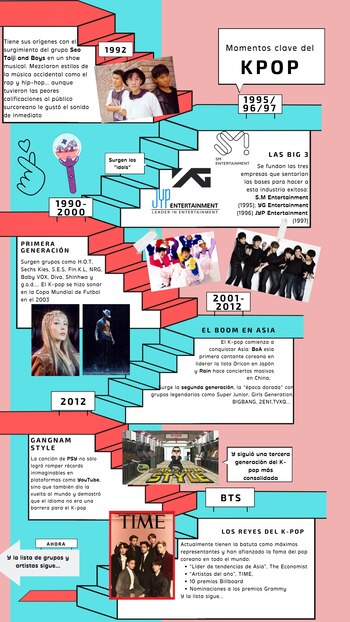
K-pop, or Korean pop, traces its modern roots back to the 1990s with the emergence of the popular group Seo Taiji and Boys in 1992. This group was groundbreaking in blending western musical styles like rap, hip-hop, rock, jazz, and electronic music in their songs.
Seo Taiji, Yang Hyun-suk, and Lee Juno debuted with the hit song “Nan Arayo”, which left the judges speechless on a talent show. Despite receiving low scores, the track’s success on the airwaves was undeniable, paving the way for a new era in Korean music.
In 1995, Lee Soo Man founded S.M. Entertainment, one of the major companies still influential today. This was soon followed by YG Entertainment (established by Yang Hyun Suk in 1996) and JYP Entertainment (founded by Park Jin Young in 1997). These companies formed the “Big 3,” dedicated to training the upcoming generation of idols to meet the growing demand from the Korean audience for younger artists.
The Rise of the Idols
One of the first bands to debut under this new wave was H.O.T, leading to the emergence of the first generation of K-pop, which included acts like Sechs Kies, S.E.S, and Fin.K.L. As the millennium began, some idol groups experienced inactivity, while others like Baby Vox flourished throughout Asia. Their song “Coincidence” gained massive traction during the 2003 World Cup, marking a significant milestone in the industry.
Simultaneously, solo artists like BoA, who became the first Korean singer to top the Oricon chart in Japan, and Rain, who captivated an audience of 40,000 in Beijing, began to make waves, solidifying K-pop’s international presence.
In conclusion, K-pop has grown into a cultural behemoth that transcends geographical boundaries, making its mark around the globe through innovative music, captivating visuals, and passionate fan engagement. As it continues to evolve, there’s little doubt that the K-pop phenomenon will remain a key player in shaping the future of the global music scene.