
INE Imposes Economic Sanctions on Election Candidates
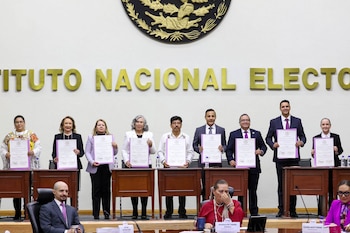
The General Council of the National Electoral Institute (INE) has made a significant decision by approving the Application of economic sanctions against candidates who appeared in the controversial “Acordeons” during the recent Judicial election. This ruling affects candidates who achieved some positions thanks to their allegedly compromised electoral campaigns. The decision stirred a divided plenary, ultimately approving varying discounts on fines based on each individual’s economic circumstance.
In its recent resolution, the General Council sanctioned a total of 121 candidates at the federal level who “benefited from the accordions” despite winning in the elections. Among the sanctioned candidates are 9 Ministers and Ministers from the new Supreme Court of Justice of the Nation (SCJN).
Divided Opinions Within the Council
The vote on the adjustment stirred differing opinions within the Council. Notable opposition came from Guadalupe Taddei, the president of the agency, as well as commissioners Norma Irene de la Cruz, Rita Bell López, and Jorge Montaño. Taddei openly criticized the ruling, asserting that the decision lacked legality and could lead to invalidation by the Electoral Tribunal of the Judicial Power of the Federation (TEPJF).
Details of the Sanction and Public Warnings
The imposed sanctions dictate that those affected must pay an amount corresponding to 10% of the maximum limit of personal campaign expenses. Each fine will be adjusted to reflect the economic capacity of the candidates, indicating that wealthier individuals will face stiffer penalties.
For instance, those within the newly formed SCJN will face fines totaling approximately MXN 146,000. Notably, the largest individual fine will be levied on Loretta Ortiz, who must pay MXN 127,058.78. Others include Yasmín Esquivel, with a penalty of MXN 95,490.16, Sara Irene Herrerías, who must pay MXN 69,015.40, and María Estela Ríos, facing a fine of MXN 62,905.84.
Furthermore, the resolution noted that 184 individuals who appeared in the election but did not secure victory will receive a public warning as part of their punishment.

Controversy Over Election Regulations
President of the Supervisory Commission, Carla Humphrey Jordan, defended the ruling, suggesting it aligns with the jurisprudence established by the TEPJF concerning irregular campaign expenses. She perceived the ruling as essential to uphold electoral integrity. Nonetheless, Taddei’s dissent in the council highlights significant discord regarding the legality and appropriateness of this resolution.
Taddei articulated her concerns, stating, “There is probative sufficiency to prove that the facts investigated are a result of the actions of a third party, not of the candidacies. This is not a matter of assumptions or mere speculation but requires concrete evidence.” Her remarks resonate with those skeptical of the penalties, suggesting that imposing small fines may not constitute an effective or fair response to the alleged misconduct.
The INE’s decision emphasizes the importance of maintaining electoral integrity while navigating the complexities of electoral regulations and candidate conduct. As debates continue and different opinions unfold within the council, the outcome of these sanctions may set a critical precedent for future electoral practices in the country.
General News – 2