
One of the biggest obstacles to a mission to Mars is not the distance or travel time . It is the fuel . To send a manned ship, NASA estimates that dozens of Cryogenic propellant tons must be stored for weeks or months. However, those liquids do not behave like they do on Earth; in a vacuum, exposed to heat, and without gravity, they are slowly evaporating even if the tank is perfectly sealed.
This phenomenon, known as Boil-off, forces the release of generated gas to prevent dangerously high pressure inside the tank. This constant loss can mean tons of fuel escaping into space during a long-term mission. Therefore, developing tanks capable of preserving this propellant at safe pressure, without losses—a technology known as zero evaporation —has become a technical requirement for missions beyond low Earth orbit.
Zero Evaporation: The Technical Challenge that Separates Low Orbit from the Rest of the Solar System
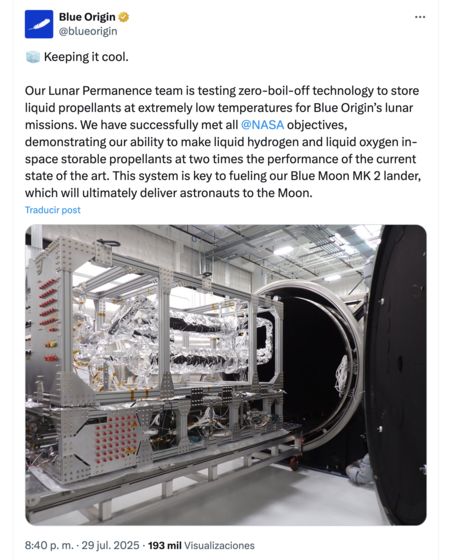
Blue Origin claims to have made significant advancements in tackling this problem. Jeff Bezos’ company has managed to maintain liquid oxygen and hydrogen in stable conditions, without evaporation, using a hardware flight prototype in ground tests. The Blue Origin CEO, Dave Clean, announced that they have met all NASA’s objectives in this area.
The results are significant: conserving hydrogen at 20 Kelvin and oxygen at 90 Kelvin during extended periods represents the first time a private company has publicly confirmed a zero evaporation condition in cryogenic propellants. This achievement stands as the most tangible advance so far toward developing tanks that can store liquid fuel without losses, which is critical for operating spacecraft on the Moon or Mars.
Storing fuel without losses in space is not merely a question of good materials. It is a constant battle against physics . Even the best thermal insulation eventually succumbs. Thus, the journey to zero evaporation necessitates active solutions that chill the tank from within. NASA has explored two methods: sub-surface jets and microdroplet injection , both of which help to reduce steam temperature and control internal pressure.
Blue Origin has not specified which of these methods they employ, but it is likely to be the sub-surface jet , the only method thus far tested in microgravity by NASA. This technique directs a very cold liquid jet to where steam accumulates. By condensing it, pressure is prevented from rising, eliminating the need to vent gas. Although technically complex, it has demonstrated greater efficacy and stability under testing conditions.
Long before Blue Origin revealed its advancements, NASA had already began testing these systems in space . The ZBOT program, carried out aboard the International Space Station, allowed researchers to study how a microgravity propellant tank functions. One of its primary discoveries was that the interaction between the sub-surface jet and steam does not adhere to the classic rules we understand on Earth.
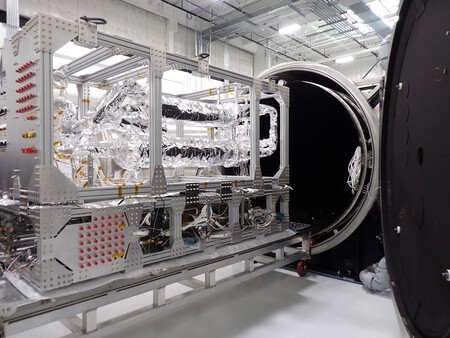
The Blue Origin cryogenic system during ground tests of its zero evaporation technology
In ZBOT-1, researchers not only successfully controlled internal pressure with active mixture, but also discovered unexpected phenomena, such as cavitation , sudden bubble formation, and flow alterations that might destabilize the system. This data—gathered using sensors, cameras, and laser measurement systems—has been invaluable for firms like Blue Origin in designing tanks that can operate stably in extreme environments.
SpaceX has not yet announced a solution explicitly classified as zero evaporation. Nevertheless, this does not imply that they aren’t working on it. In collaboration with NASA, the company has developed cryogenic architecture aimed at reduced evaporation, validated through flight tests. As of March 2025, Starship executed an internal transfer of liquid oxygen in space, demonstrating the ability to move fuel and manage pressure without excessive losses.
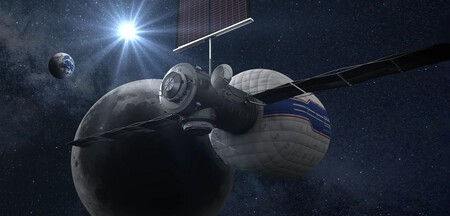
NASA Artistic Recreation
Though SpaceX and Blue Origin are tackling the same fundamental challenge of storing propellants in space without losses, they are not working with the same types of fuels or facing identical thermal difficulties. SpaceX focuses on liquid methane and liquid oxygen , whereas Blue Origin specializes in liquid hydrogen and liquid oxygen .
This distinction is crucial. Liquid hydrogen must be maintained at a much lower temperature than methane or even that of oxygen. Additionally, hydrogen is less dense, more likely to escape, and harder to isolate. Achieving zero evaporation conditions with hydrogen poses a significant technical challenge. Hence, the advancement announced by Blue Origin is notable not just for its outcome, but also for the type of fuel involved.

When discussing a mission to Mars, attention often falls on rockets, habitats, or space suits. However, one of the most serious bottlenecks lies in a more basic concern: the conservation of fuel. In a long-lasting mission, propellant is not simply used at once. It must be stored, transferred, and frequently maintained for weeks without being lost to evaporation.
This makes zero evaporation technology a key component for both future interplanetary missions and the Artemis program to return to the Moon.
Images | Blue Origin (1, 2) | NASA | Xataka with Grok
As we gear up for future space exploration, the innovations in cryogenic fuel storage will be critical to the success of these ambitious missions. With advancements from companies like Blue Origin and SpaceX, the prospect of sustaining human presence on Mars and beyond becomes increasingly feasible, showing the potential for human ingenuity to overcome even the most significant challenges in space exploration.