
The Mysteries of Venus Unveiled
In 2016, Japan’s Akatsuki mission made an intriguing discovery: a massive disturbance in the atmosphere of Venus, which puzzled scientists for years. Recent research from the University of Tokyo has shed light on this anomaly, linking it surprisingly to something as mundane as your kitchen sink.
What is the Hydraulic Jump?
Understanding the Phenomenon
Researchers utilized atmospheric simulations and fluid dynamics models to uncover a phenomenon known as hydraulic jump, which is also observed in household practices. When you turn on your sink, water flows quickly and in a thin layer where it strikes the basin. As it spreads out, it forms a circular pattern where the outer layers flow much more slowly due to friction.
In essence, as fast-moving water collides with the sink, it abruptly slows down, causing an increase in height and creating a deeper layer of unstable flow.
The Disturbance Observed on Venus
A Closer Look at the Data
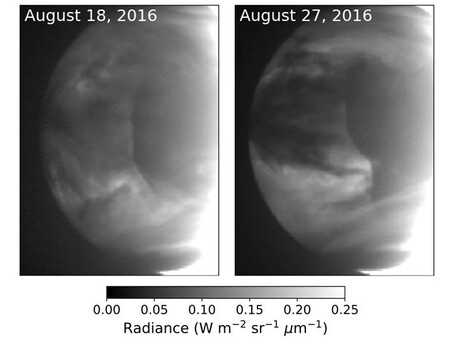
In the same year, the Akatsuki mission documented a 6,000-kilometer-wide disturbance around the equator of Venus. This disturbance traveled through the planet’s clouds, leaving behind a dark aperture of denser clouds, presenting an exciting puzzle for scientists to solve.
The Composition and Behavior of Venusian Clouds
An Atmospheric Enigma
The clouds swirling around Venus are predominantly composed of sulfuric acid and rotate at speeds approximately 60 times faster than the planet itself, akin to a Formula 1 car racing around a bicycle. The clouds are made up of three layers, the outermost of which is well-studied, while the two inner layers remain shrouded in mystery.
Unstable Kelvin Waves
Inside one of these layers, Kelvin waves are produced, which move eastward quickly until they become unstable. This instability mirrors the situation in your sink when water starts to build up—a thicker layer forms and leads to powerful upward air currents. These currents push sulfuric acid vapor up into the atmosphere, condensing to form the dense wall of clouds observed by the Akatsuki probe.
The Bigger Picture: Are Other Planets Next?
The discovery of this hydraulic jump phenomenon on Venus marks the largest of its kind observed in our solar system. Researchers believe that similar models could uncover hydraulic jumps on other planets, including Mars. Understanding these atmospheric mysteries is essential for future colonization efforts, especially as Mars captures the interest of scientists seeking to establish a human presence beyond Earth.
Conclusion
The link between Venus’s atmospheric behavior and everyday household phenomena opens up new avenues for understanding the complexities of planetary atmospheres. As researchers continue to explore these mysteries, the knowledge gained may not only expand our understanding of Venus but also provide essential insights into potential future missions to Mars and beyond.