
As the spotlight shines on the B-2 bombers , other deployed aircraft often go unnoticed: the KC-135 Stratotanker . With over six decades of service, these veterans have returned to operations in the Middle East precisely as the United States attacks several nuclear facilities in Iranian territory , including Fordow, amid an increased military presence in the region amidst escalating tensions with Israel. While they do not launch missiles or participate in direct attacks, their role is crucial: they enable fighter jets, bombers, and reconnaissance aircraft to maintain extended flights without the need to land.
In the military deployment the United States is executing in the Middle East, the KC-135 Stratotanker is not a mere footnote. It is part of the logistical core that ensures the aerial machinery keeps functioning without interruption. According to outlets like Reuters and BBC , at least 30 tanker aircraft have been mobilized, mostly of this model, to accompany F-16s, F-22s, F-35s, and other air assets deployed in the region.
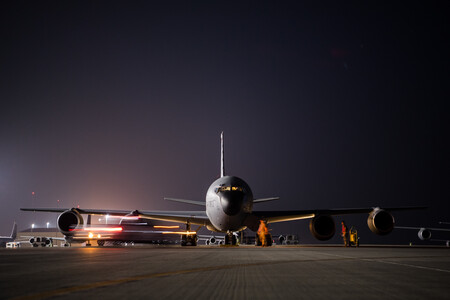
At first glance, its function may seem secondary, but it has direct strategic implications: by refueling in flight , the KC-135 removes the need for aircraft to interrupt their mission for ground refueling. This results in operational continuity and greater tactical autonomy. It is not just support for fighters; it also sustains bombers, reconnaissance aircraft, medical units, and, when necessary, allied forces.
A Beast With Over 60 Years of History (And Still Going Strong)
When the KC-135 first flew in 1956 , the world was a different place. The Cold War dominated military strategy, and the United States required a fleet capable of maintaining its air power on a global scale. Boeing offered a solution: a military variant of the model 367-80 , the prototype that would also give rise to the legendary 707. Thus, the Stratotanker was born, beginning to arrive at air bases in 1957, and against all odds, it continues to serve in 2025.
Of the more than 700 units built, many have undergone radical modernization processes. The most visible change: the engines. The old ones were replaced with CFM56 engines, which are more efficient, powerful, and quieter. Thanks to these, the KC-135R—the most common version today— consumes 25% less , costs 25% less to operate, and is nearly 96% quieter than the original model, according to official data from the U.S. Air Force.
But not everything has been mechanical. Over the decades, the KC-135 has also been adapted for various tasks: air command, surveillance, experimental testing, or even missions under the Open Skies Treaty. Few platforms have demonstrated such versatility and endurance over time.
How In-Flight Refueling Works
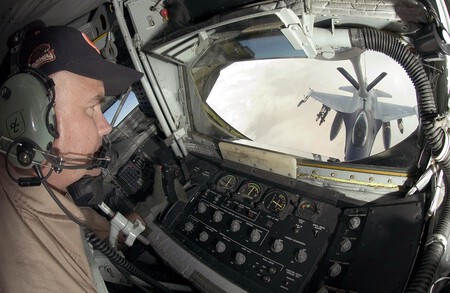
From the outside, it may seem like a simple maneuver: two aircraft flying close, one transferring fuel and everything continues as usual. However, in reality, aerial refueling is an extremely delicate operation requiring perfect coordination between pilots and the operator. In the KC-135, this task falls to the so-called boom operator, a crew member who lies prone in the back of the aircraft, with a direct view of the recipient and full control over the extendable refueling boom.
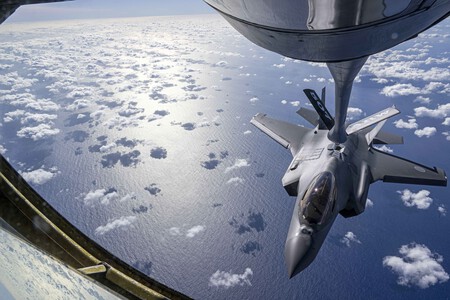
This articulated arm (flying boom) is the main tool of the KC-135 for transferring fuel in flight. Its design allows for precise connections between aircraft flying at high speeds and altitudes. The connection requires absolute concentration: the operator guides the contact and maintains it stable even in turbulent conditions or during maneuvers.
In addition to the boom system, some KC-135s are equipped with an additional system: the drogue, an aerodynamic funnel that allows refueling of aircraft with probes, such as helicopters or European fighters . Furthermore, there are models equipped with pods on the wings that allow refueling two aircraft simultaneously. All these features make the Stratotanker a flexible platform, capable of adapting to multiple configurations depending on the mission.
A Key Player in Modern Warfare
Behind its austere silhouette and plain gray paint, the KC-135 hides a machine optimized for efficiency. It is powered by four high-thrust engines, capable of reaching speeds close to 850 km/h and operating at altitudes of up to 15,240 meters. It is not designed for agility or combat, but it meets an unmovable premise: to be there when needed.
It can take off with a maximum weight of 146 tons and carry over 90 tons of fuel to transfer to other aircraft. If the mission requires, it can also carry up to 37 passengers or about 38,000 kilos of cargo on the upper deck, right above the refueling system. All of this in a 41.5-meter-long structure, with a wingspan close to 40 meters.
Regarding its range, it can cover more than 2,400 km with 68 tons of transferable fuel onboard. On ferry missions , without external cargo, it can exceed 17,700 km, allowing for non-stop intercontinental flights.
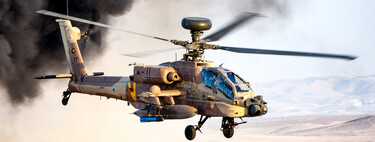
In medical evacuation missions, the KC-135 transforms into a kind of airborne ICU. Thanks to special pallets, it can transport patients on stretchers with a specific medical crew. This versatility is what has made the Stratotanker a challenging asset to replace.
The KC-135 continues to serve actively more than six decades after its first flight. Although the KC-46 Pegasus has begun to take over some of its functions, the Stratotanker remains one of the main refueling platforms of the U.S. Air Force. Its maintenance, successive modernizations, and proven capacity in multiple scenarios explain its constant presence in long-range operations.
Images | U.S. Air Force | Master Sgt. Vincent De Groot | U.S. Department of Defense
In conclusion, the KC-135 Stratotanker has become an indispensable component of modern aerial warfare, seamlessly integrating as a backbone of the U.S. Air Force. Its combination of versatility and operational efficiency ensures that it continues to play a vital role in missions around the globe, demonstrating that even after decades of service, it remains an invaluable asset in the air. As global tensions evolve, the importance of such refueling capabilities will undoubtedly remain crucial for maintaining tactical superiority.