
SpaceX’s Strategic Move: The Acquisition of xAI
At the end of January, SpaceX took a significant step by acquiring xAI, the artificial intelligence company founded by Elon Musk. This acquisition is more than just a business deal; it signifies a broader ambition, merging the strengths of space exploration with cutting-edge AI technology. The newly combined entities have resulted in a rising valuation, leading analysts to speculate that SpaceX is gearing up for a remarkable IPO.
The Largest Takeover Bid in History
The anticipated IPO has the potential to become one of the largest in history. With a current valuation estimated at around $1.75 trillion, SpaceX aims to raise approximately $75 billion—far surpassing the earlier projections of $50 billion. This ambitious target places SpaceX on track to potentially break the record currently held by Saudi Aramco, which raised $29.4 billion in its IPO back in 2019.
Dizzying Figures and Future Predictions
Industry analysts predict that, if forecasts hold true, SpaceX’s market capitalization, including xAI, could reach about $1.5 trillion by 2025. This would be a staggering 94 times what the company raised in its previous funding rounds. Some reputable sources even claim that the total valuation could exceed the initial target, reaching up to $1.75 trillion.
Exodus of Talent at xAI
However, this acquisition comes at a noteworthy time as several original co-founders of xAI have left the company in recent weeks. Elon Musk acknowledged these departures, stating that xAI was reorganized to enhance execution speed. Notable figures such as Tony Wu, Greg Yang, and Jimmy Ba have exited, raising concerns about the effectiveness of xAI in competing with industry heavyweights like OpenAI and Anthropic.
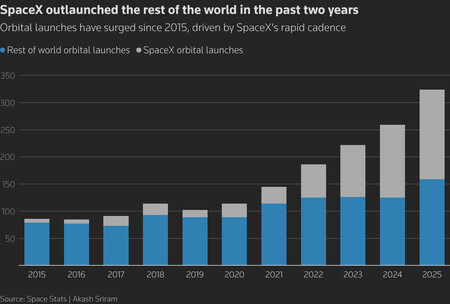
SpaceX’s pace of orbital launches is so astonishing that it already surpasses the rest of the world combined.
The Power of Reusable Rockets
SpaceX, founded in 2002, has quickly become the largest private space company in the United States. The company conducts more launches annually than any of its competitors, thanks largely to its innovative Falcon 9 reusable rockets and the ambitious Starship program. This revolutionary technology has not only transformed the aerospace industry but has also stifled competition, making SpaceX a dominant player in space exploration.
Riding the Wave of Space Enthusiasm
The timing of the IPO aligns perfectly with SpaceX’s prominent role in several strategic areas. The company’s projected revenue is around $16 billion in 2025, largely driven by successful Starlink operations. Furthermore, the decreasing costs associated with launching satellites present immense opportunities—not just in communications but also in Musk’s vision of establishing data centers in space.
Capitalizing on Global Turmoil
As global conflicts rise, SpaceX has seized the moment to position Starlink as a pivotal contingency option when traditional communication systems falter. This strategy has generated interest in Starlink’s capabilities and services, reinforcing the company’s proactive approach in turbulent times.
In conclusion, the acquisition of xAI marks a pivotal moment for SpaceX. The potential of this merging, along with the anticipated IPO, not only underscores SpaceX’s ambitious business strategies but also showcases Elon Musk’s vision for the future—an era where space exploration and artificial intelligence intertwine seamlessly in an increasingly connected world.