
In recent years, video games have emerged as the dominant form of entertainment, surpassing traditional sectors such as cinema and music in revenue. According to industry forecasts, the global gaming market is projected to generate approximately $185 billion in 2024 alone. This remarkable growth has placed video games at the center of digital entertainment, challenging patterns entrenched in decades of film and music industry dominance. Interestingly, one pivotal aspect of this market landscape is the dominance of China , which is set to become the most lucrative gaming market worldwide.
This graph illustrates the remarkable statistics supporting these claims:
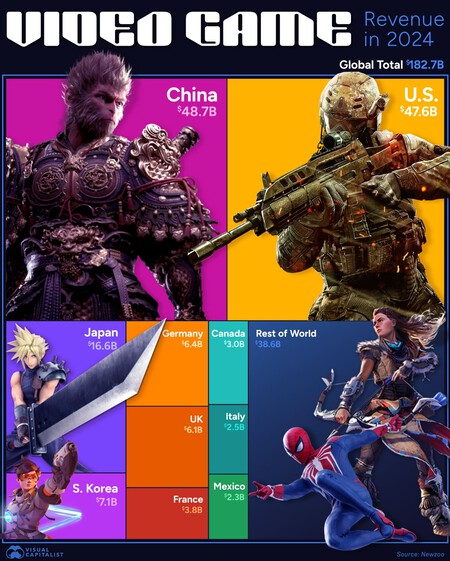
According to a graph prepared by Visual Capitalist, which utilizes data from Newzoo, it’s evident that two countries dominate this market. In fact, of the total estimated revenue of $182.7 billion in 2024, over half is generated by China and the United States . China is predicted to generate around $48.8 billion , representing 26.7% of the market, while the United States follows closely with about $47.6 billion , amounting to 26.1% of the total.
These two markets are strikingly different in how they engage with gaming. The U.S. market is comparable to those in Europe and other Western countries with a fair mix of platform usage, including consoles , PCs , and mobile devices . While audiences may perceive the U.S. as the largest market due to the prevalence of news regarding traditional gaming, it’s crucial to note that mobile gaming plays a significant role in these statistics. In fact, industry estimates suggest that mobile games alone accounted for about 51% of the total U.S. gaming revenue in 2024.
In sharp contrast, China’s gaming market is overwhelmingly mobile-centric. Estimates indicate that from the $48.8 billion generated in 2024, more than $32 billion will come from mobile games. Titles such as ‘Honor of Kings’ and ‘Peace Elite’ (the Chinese equivalent of ‘PUBG’) dominate the landscape, bolstered by microtransactions and player-driven streaming cultures.
Moving to Japan , the third largest gaming market, it may be smaller compared to the giants of China and the U.S., but it still generated around $16.6 billion in 2024. Japan’s rich gaming culture contributes significantly to its market stability, supported by local giants like Nintendo and PlayStation . The impressive success of devices like the Nintendo Switch and thriving franchises further solidifies Japan’s impact within the global market.
Despite competing with influential markets like China and the U.S., Japan’s love for mobile technology is evident, with mobile games accounting for around 70% of the total revenue. Interestingly, Japan’s PC gaming segment has shown growth recently but still lags behind both consoles and mobile entries.
South Korea represents another fascinating chapter in this narrative. Although the nation lacks the extensive development industry of other countries, it excelled in the gaming arena, driven principally by competitive gaming on PC and mobile platforms. Titles like ‘Starcraft’ and ‘League of Legends’ are not just games; they are cultural phenomena that resonate deeply within South Korean society.
Meanwhile, Europe continues to present a united front in the gaming landscape, with significant contributions from countries like Germany , the United Kingdom , and France . Even though their shares range from 2% to 4% of total revenues, the continental market remains robust due to collaborative efforts and diverse offerings across multiple languages.
With China’s gradual opening towards the global gaming scene and the influence of major companies such as Tencent and the emergence of ambitious titles like ‘Black Myth: Wukong’, future perspectives for the gaming market are quite optimistic. Industry forecasts suggest that the global market could surge to between $500 billion and $733 billion in the coming years, underscoring the pivotal role that mobile games and emerging technologies like cloud gaming will play.
The gaming industry’s trajectory indicates that technological innovation coupled with evolving consumer preferences will continuously elevate its status in the entertainment landscape. The expanding user base, particularly with the adoption of mobile and competitive games, will further solidify its role as a cornerstone of global entertainment.