

Understanding the Challenges of Modern Workplace Dynamics
The rise of telecommuting has fundamentally altered the landscape of work-life balance. One significant issue menacing workers is the blurred boundary between work and leisure time. A recent study conducted by Microsoft underscores this phenomenon, revealing that workers in traditional office settings are increasingly beginning to feel that their workday never ends. This sense of an “infinite workday” places immense pressure on employees, making real disconnection feel like an unattainable luxury.
The Grip of Burnout
A staggering 33% of employees are finding themselves on the brink of burnout. This statistic highlights that one in three workers is struggling to keep pace with the relentless tempo established in the workplace over the last five years, regardless of their work hours. The findings from Microsoft’s extensive study, which draws on vast amounts of anonymized data from Microsoft 365, indicate that we are increasingly trapped in an endless work cycle. This burgeoning environment not only hampers daily productivity but also exacerbates feelings of exhaustion and anxiety among workers.
A Tsunami of Emails
In the age of digital communication, the volume of emails that employees deal with is staggering. According to Microsoft’s findings, approximately 40% of employees start their day by checking emails as early as 6 A.M. On average, each worker receives 117 emails daily, with most replies being processed in less than 60 seconds. This sheer volume signifies that much of the information being communicated may not be particularly relevant to employees, leading to overwhelmed inboxes and attention fatigue.
Moreover, mass emails sent to more than 20 recipients have surged by 7% in the past year, while personalized conversations have dwindled by 5%. This shift signals an increase in digital noise that complicates effective communication and diminishes employees’ ability to focus.
Meetings at the Most Inopportune Times
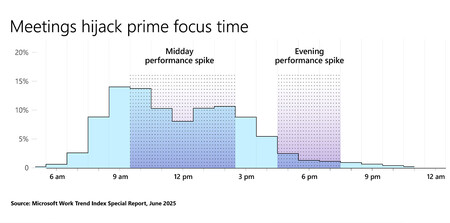
The intensity of the modern workday is further compounded by poor meeting management. Microsoft’s study reveals that 50% of meetings are scheduled during crucial hours — specifically between 9-11 A.M. and 1-3 P.M., which are the peak productivity times for many individuals according to previous research published in Harvard Business Review. This scheduling anomaly wastes the most productive segments of the day on tasks that often contribute little value.
Surprisingly, the study notes that Tuesdays have become the most overloaded with meetings, accounting for 23% of all weekly meetings, while Fridays see only 16%. Furthermore, 57% of these meetings are arranged spontaneously, with 10% being scheduled at the eleventh hour.
The Triple Peak Day Phenomenon
The continual interruptions experienced during the workday give rise to what Microsoft has termed the “Triple Peak Day”—a pattern of multiple productivity spikes throughout the day. The study highlights distinct productivity peaks around 10 A.M., 3 P.M., and again at 8 P.M.. The trend of scheduling meetings post-8 P.M. has notably increased by 16% in the last year, as employees increasingly seek quiet moments at the end of their workday to focus on their essential tasks without the typical distractions.
An Ever-present Need to Check Emails
The compulsive need to remain accessed is alarming, with nearly 20% of employees checking their work emails before noon on weekends. More than 5% even revisit their emails after 6 P.M. on Sundays or holidays, extending their workweek into traditionally designated days off. Microsoft’s telemetry reveals a similar trend: as employees leverage weekends to work in uninterrupted environments, it reflects a troubling reality—many are forced to utilize personal time to catch up.
In a world where the lines between work and personal life have become obscured, the implications are far reaching. The modern employee is caught in a cycle where the concept of downtime has drastically changed. The need to be constantly connected leads to the shadow of overwork hanging over their heads, evoking feelings of helplessness about truly disconnecting from their professional responsibilities.
As we delve deeper into understanding these dynamics and their impact on workers, it becomes crucial to address how organizations can mitigate these challenges. This involves not just reevaluating email and meeting practices, but creating an environment where employees can engage in productive and meaningful work without compromising their well-being.
Balancing the demands of the workplace with personal time is not merely a challenge; it requires a cultural shift that prioritizes employee mental health and productivity in a digital age marked by constant connectivity.