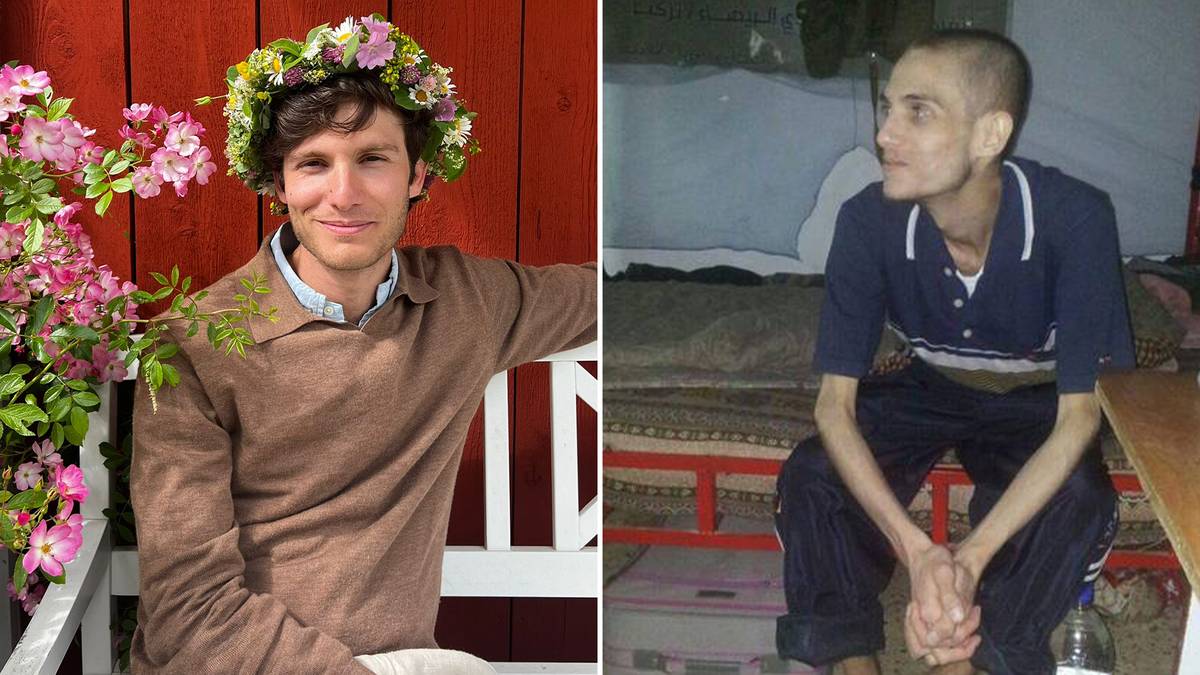
When President Bashar al-Assad was overthrown at the weekend, the cell doors in Sednaya were thrown wide open, and thus also the doors to some of the Syrian regime’s darkest secrets. For the first time, people were allowed to go inside and see the infamous prison. With dogs and flashlights, search crews and family members navigated the dark, labyrinthine corridors. First they looked for survivors. So after dead. From Sweden, Omar Alshogre followed the videos that were shared on social media. For ten years he has had a picture in his head, which he has painted himself, of what the prison looked like. The image does not originate from what he himself saw, but from how he moved around in what came to be known as Assad’s “human slaughterhouse”. – You are either blindfolded, your hands in front of your eyes or your eyes closed. So you see nothing when you get to Sednaya. You only see your room, says Alshogre to news. Omar Alshogre in June 2015. Photo: Private – It smells like blood The 29-year-old burst into tears of joy when he saw the pictures of the prisoners who ran into freedom after being released. That was after rebels, led by the Islamist group Tahrir Hayat al-Sham (HTS), had seized power in the country. Nine years have passed since Alshogre himself was smuggled out of prison. After three years in political captivity, he weighed only 34 kilograms. A large crowd had gathered at the Sednaya prison three miles north of the Syrian capital Damascus on 9 December. Photo: OMAR HAJ KADOUR / AFP Although he didn’t know much about what Sednaya looked like, beyond the cell where he sat, there are other things Alshogre remembers well. Like the smell. – It is not difficult to remember what it smells like in Sednaya. Because it smells like blood. It was torture daily. The guards came and killed people daily, says Alshogre. A man breaks the lock of a cell in the Sednaya prison on December 9. Photo: Hussein Malla / AP He says that men, women and children were tortured. When the prison was opened, videos showed that even young children had lived there in captivity. – But first of all, several times a week, it smelled like burnt bodies. For the regime burned the dead bodies of those killed in Sednaya, Alshogre continues. Searching among the bodies Family members have flocked to the prison in recent days in the hope of finding their loved ones alive. On Tuesday, the search for more survivors ended. Videos shared by Reuters showed people searching among burned and disfigured bodies found at the prison in a desperate attempt to perhaps identify a missing family member. Many of the bodies showed signs of torture. People are trying to recognize their loved ones among burnt corpses found in Sednaya. The bodies are believed to be former prisoners. Photo: Mohamed Azakir / Reuters Alshogre also remembers the sound from Sednaya. That is, he remembers the silence. The prisoners were not allowed to talk to each other. So they sat in the dark and listened for the guards. – If we talked, we could be punished, he says. People walk through the dark corridors of Sednaya on December 9. Photo: Hussein Malla / AP People could, for example, be refused food. It could be a death sentence for a person who, after several years in Sednaya, was already on the brink of starvation. – The alternative was physical torture. They came in and beat and executed people if we talked, says Alshogre. Sednaya is located three miles north of Syria’s capital, Damascus. A new life in Sweden It took two years of treatment in Sweden before Alshogre recovered. But he believes he was lucky. He received help and support from other prisoners he was imprisoned with, doctors, psychologists, teachers and lawyers. Syria’s political prisoners were “Syria’s best people”, says Alshogre. They helped him, and in return he was able to find meaning in life by helping the people around him. Now the 29-year-old lives what he calls a good life in Stockholm. He works in a transport company and with the Syrian Emergency Task Force, a resistance movement to the Assad regime. But the sister, and her children, have been in Syria all along. Alshogre has not met them in over twelve years. Two women who had family members imprisoned in Sednaya hug each other outside the prison on December 9. Photo: Hussein Malla / AP Many Syrians are now returning to their homeland from which they fled due to oppression and war. But even though Alshogre calls his homeland “the most beautiful” in the world, he has no immediate plans to move back. – It is not safe, it is not stable, he says. – And when it becomes safe, it’s not just about going back straight away. I have a job here. I have a family here. Interested in abroad? Listen to the foreign affairs editor’s podcast: Published 11.12.2024, at 20.23 Updated 11.12.2024, at 20.28
ttn-69