
The works of Cyberpunk envision a future where humanity continuously enhances itself through bioimplants . A decade ago, this concept seemed merely a fantasy, but recent advancements have brought us closer to reality, particularly with innovations like Neuralink . These developments aim to make our brains seamlessly integrate with artificial body parts, creating a connection that feels organic. Massachusetts researchers are currently pursuing an ambitious goal: to ‘hack’ our brains with dental implants that imitate the sensation of real teeth.
Bioengineering has been at the forefront of dental research, with various institutions experimenting with stem cells to encourage the natural growth of teeth. The premise is simple: fill the cavities left after tooth loss with living tissue that can regenerate the natural tooth structure. This approach is vital because real dental material offers superior benefits compared to current implants, especially when it comes to the tooth-brain connection .
Intelligent Implants. The ultimate objective in bioengineering is to create implants that feel like a natural part of the body, whether for teeth or missing limbs that require prostheses. Recent advancements from researchers at the Tufts University Faculty of Dental Medicine have led to the development of what they call an “intelligent implant.” This implant resembles ordinary dental implants but boasts an outer layer with stem cells and specific proteins that allow these cells to mature into nervous tissue.
Dr. Jake Jinkun Chen, a professor of periodontics at Tufts, elaborates that “natural teeth connect to the jaw through soft tissue rich in nerves, which helps perceive pressure and texture.” This sensory feedback is critical for functions like chewing and speech . Current implants, although effective, lack this vital sensory communication, feeling foreign within the mouth.
The process of installing standard implants remains invasive, and while surgeons manage these procedures adeptly due to their frequency, there are inherent risks. Complications can arise, such as damage to nearby nerves. Even if everything proceeds perfectly, the patient does not experience the same sensory feedback they would with a natural tooth.
The innovative implant being developed at Tufts eliminates the need for extensive surgical procedures. Initially, this new implant is smaller than the tooth it replaces, and a rubber nanofiber layer expands to fill the gap, attaching to the soft tissue of the jaw rather than the bone. Over time, this implant reconnects with the nerves gradually, restoring communication between the mouth and the brain.
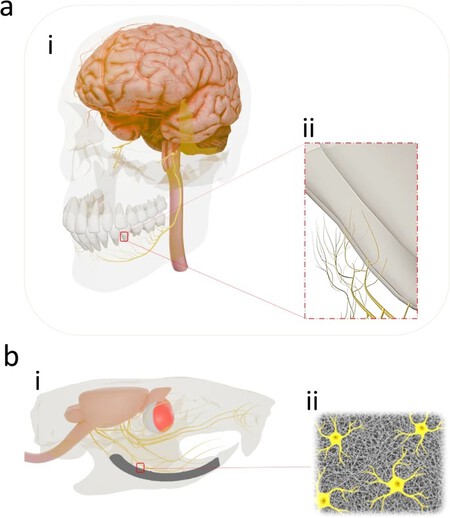
The goal is to restore nerve connections between the lost piece and the brain to feel the tooth again
Testing Phase. While the idea of regaining sensory experiences like temperature and texture in a replacement tooth is exciting, it’s essential to note that this technology is still in its infancy. Initial tests have only been conducted on rodents, yet results indicate promising biocompatibility . In these trials, the new implant functions like a typical tooth just six weeks post-surgery. Researchers are currently monitoring the brain activity of these animals to assess the sensory information relayed from the new tooth.
As for the future, scientists plan to expand testing to other animal subjects before embarking on clinical trials involving humans.

Applications Beyond Dentistry. Dr. Chen notes that if successful, this groundbreaking implant technology could extend beyond dental applications. They foresee potential transformations in other types of bone implants , such as those used in hip replacements or in the repair of fractures.
In conclusion, the ongoing research at Tufts University not only holds the promise of making dental implants feel more like natural teeth but also opens up a realm of possibilities for enhancing other forms of medical technology. The ability to provide sensory feedback from artificial replacements could revolutionize how we think about implants across various fields, leading us toward a future where artificial body parts feel just as real as our own.
Images | Ozkan Guner, Tufts University, Enis Can Ceyhan
In Xataka | The world is obsessed with the “perfect teeth” and is curious because almost everyone who looks in cinema and television is false.