
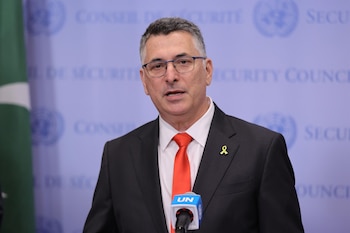
In a recent escalation of diplomatic tensions, Israeli Foreign Minister Gideon Saar has publicly criticized French President Emmanuel Macron for advocating that the United States lift its visa veto against Palestinian officials. This controversy encapsulates ongoing regional disputes and highlights differing international perspectives regarding the Israeli-Palestinian conflict.
Saar, in a statement on his social media platform, noted that Macron seems overly concerned about the visa aspirations of Palestinian officials. He remarked that such interests are indicative of the French president’s disconnect from pressing realities on the ground. Saar remarked, “President Macron is very interested in the visas for the United States of officials of the Palestinian authority. That is what takes away his dream,” underscoring a perceived lack of seriousness in addressing allegations of incitement within the Palestinian educational system, particularly against Israel and Jewish people.
The Israeli diplomat’s critique didn’t stop there. He went on to call out Macron for a perceived failure to oppose the financial support that the Palestinian Authority allegedly provides to individuals involved in acts of terrorism . “He also does not oppose the payments that the Palestinian authority transfers to terrorists and their families,” underscored Saar. Such comments reflect an ongoing debate about the role of financial aid in the cycle of violence within the region.
Saar further asserted that Macron’s actions risk destabilizing the already tenuous balance in the Middle East. He claimed that the French president is attempting to act as an outside mediator in a conflict where he is not directly involved , thus undermining any prospects for genuine peace. The mention of the significant death tolls resulting from the latest Hamas attacks and Israel’s subsequent military responses serves to emphasize the gravity of the situation. Reports state that a staggering approximately 1,200 lives were lost during the initial Hamas assaults, while ensuing Israeli strikes have led to around 63,600 fatalities and 160,000 injuries within the Gaza Strip.
In Saar’s view, Macron’s attempts to influence the situation only contribute to a climate of unilateralism that is detrimental to peace. He specifically objected to Washington’s decision to restrict Palestinian officials, including President Mahmoud Abbas of the Palestinian Authority, from attending the upcoming United Nations General Assembly session in New York. Macron’s call for the U.S. to revoke this restriction demonstrates a divide in international diplomacy surrounding the conflict.
The French president’s recent statement reflects a broader diplomatic push from several nations—such as France, the United Kingdom, Canada , and Australia —to formally recognize a Palestinian State . This initiative has met with staunch opposition from both the United States and Israel, who argue that such moves are detrimental to the already fragile peace talks and represent a capitulation to Hamas’s stance. The chilling effect of these diplomatic maneuvers casts a long shadow over the prospects for resolution , as conflicting narratives and strategies become increasingly entrenched.
This exchange highlights a significant diplomatic rift that not only reflects the intricate interplay of international relations but also underlines the persistent struggle for peace in the Middle East. The stakes remain incredibly high, and the actions of influential leaders like Macron and Saar can reverberate throughout the region, affecting millions. As voices from both sides grow louder and positions harden, the urgent necessity for a comprehensive dialogue that respects the rights and concerns of both Israelis and Palestinians becomes increasingly apparent.
The discord between Macron and Saar emphasizes the complexities surrounding the Israeli-Palestinian conflict. Diplomacy in this sensitive landscape requires a thoughtful and nuanced approach , addressing grievances on both sides while seeking pathways to peace. As international attention remains focused on this tumultuous region, the roles played by government leaders will be pivotal in shaping future dynamics. A delicate balance must be struck to ensure that all parties are heard in the quest for a lasting resolution.