
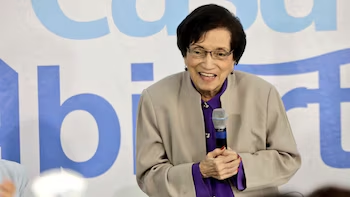
Dr. María Isabel Rodríguez: A Pioneer in Salvadoran Public Health
Breaking Barriers in Medical Education
Every year on March 8, International Women’s Day shines a spotlight on the contributions and struggles of women across various fields. In El Salvador, one figure who exemplifies this spirit is Dr. María Isabel Rodríguez. Her journey through medicine not only highlights her individual accolades but also marks a significant turning point in the history of public health and higher education within the country.
In 1948, Dr. Rodríguez made history as the second woman to graduate from the University of El Salvador’s medical school. At a time when women’s admission to university was rare, her achievement was groundbreaking and a testament to her resolve. Driven by her passion for science, she pursued two postgraduate degrees in cardiology and physiological sciences at the Institute of Cardiology of Mexico, further enhancing her credentials on an international scale.
Academic Leadership and Reforms
Dr. Rodríguez’s impact in academia reached its zenith in 1999, when she was elected as the first female rector of the University of El Salvador. During her tenure, which extended until 2007, she championed significant reforms in medical education and university governance. Under her leadership, the university saw substantial improvements, laying a foundation for future generations of medical professionals.
Contributions to Health and Policy
Dr. Rodríguez has made significant contributions to medical literature, publishing over one hundred articles in both Spanish and English about science and education. This extensive body of work solidifies her status as a thought leader and highlights her influence on public health in the region.
In 2015, the Pan American Health Organization (PAHO) recognized her as a “Public Health Heroine of the Americas”. This accolade reflects her relentless pursuit of health rights and her substantial influence in training healthcare professionals. Throughout her career, she served as a consultant for the World Health Organization (WHO), helping develop health policies in countries such as Mexico, Venezuela, and Cuba.
Transformational Leadership in Health
Dr. Rodríguez made history again when she served as Minister of Health of El Salvador from 2009 to 2014, becoming the first woman to lead this critical department. During her tenure, she transformed the health system into one that is integrated, universal, and equitable, focusing on primary care and a rights-based approach. Her initiatives aimed to provide universal coverage and include traditionally marginalized sectors, making health services accessible to all.
Upon completing her term, she continued to influence health and education as a presidential advisor, advocating for initiatives focused on quality and equity in education.
A Legacy of Commitment
Now at 103 years old, Dr. María Isabel Rodríguez continues to be regarded as a trailblazer in modern medical education in El Salvador. Her lifetime of work has paved the way for countless future professionals and has had a lasting impact on public health equity.
As International Women’s Day is celebrated, figures like Dr. Rodríguez serve as powerful reminders of the strength and resilience of women who have dedicated their lives to the advancement of science, education, and social justice. Her ability to break barriers and transform institutions reflects a legacy that will inspire generations to come.