
The Fascinating Discovery of Blue Babe: A Peek into Prehistoric Life
In the summer of 1979 , an extraordinary event unfolded in the heart of Alaska , which would leave a lasting mark in the realms of paleontology and culinary history. The American paleontologist Dale Guthrie received a call that would ignite the curiosity of fossil lovers everywhere. Miners, while searching for gold near Fairbanks , stumbled upon what appeared to be the well-preserved remains of an Ice Age bison , buried beneath layers of frozen earth.
What they had discovered was not simply a relic from the past; it was a glimpse into a world long gone, a world where clang of ice and snow had long silenced the beasts that roamed the land. The miners, Walter Roman and his family, were astounded as they uncovered hooves, legs, and skin peeking through the icy terrain.
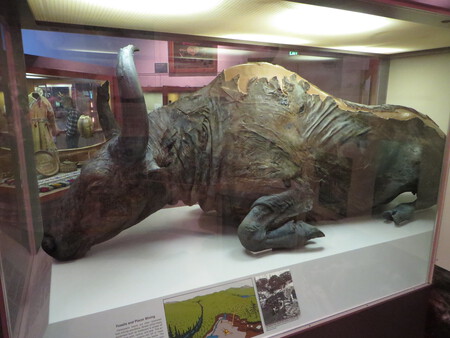
Guthrie, upon hearing the news, drove for nearly an hour down gravel roads to reach the site. What he found was more than just a skeleton; it was the remarkably preserved remains of a Bison Priscus , complete with muscle tissues and hair that had stood the test of time. This was something far more valuable than gold.
The Unfolding Mystery of Blue Babe
As Guthrie examined the site, he realized he was dealing with a mummy —an exceptional find in the field of paleontology. The bison, later named Blue Babe , had been partially revealed by the miners’ water hoses, which removed sections of the frozen mud that encased it. Guthrie, tasked with preserving the integrity of the specimen, made a bold decision: he would take what was salvagable to UAF’s powerful freezers and meticulously excavate the remainder of the bison.
Each step was a dance between preserving the remains and understanding the minute details of the animal’s last moments. The excavation team left no stone unturned; they gathered bones , hairs , and even flora and fauna embedded in the ice around Blue Babe. The meticulous efforts of Guthrie, along with his colleagues—including his wife Mary Lee —culminated in a preservation effort that would allow future generations to learn about life thousands of years ago.

The name “Blue Babe” had its origins in the unique blueish tint the remains took on due to the chemical reactions during excavation, and a playful nod to American folklore’s Blue Babe , the blue ox character that accompanies Paul Bunyan .
Unveiling the Darker Truth
But the story of Blue Babe was not all smiles and culinary delight. Examination of the remains revealed a gruesome truth . Marks from claws and teeth led researchers to conclude that Blue Babe had been the victim of a Panthera Atrox , a now-extinct lion species. Fossil records indicated that this attack occurred approximately 50,000 years ago , giving us insight into the predatory dynamics that once existed.
It also helped scientists understand that Blue Babe likely passed away in a cooler season, allowing the body to freeze rapidly and remain preserved over millennia. Remarkably, upon further investigation, scientists found coagulated blood and even intact muscle tissues , mirroring fresh meat textures.
A Culinary Surprise: The Feast of Blue Babe
In a turn of events that blends science with adventure, Guthrie and his colleagues decided to take a culinary leap . Drawing from stories they had heard of meat from ancient finds being edible, they prepared a stew using a portion of Blue Babe’s neck. This historic gathering took place in 1984 , marking the culmination of their extensive work.
That spring, amidst laughter and storytelling, they diced a piece of the ancient bison and cooked it with broth and vegetables. According to Guthrie, the flavor was unexpected, delicious, and entirely safe. They celebrated not just their scientific endeavor but also a connection to the ancient world through this unique tasting event.
The experiment turned out promising: “The meat was well-cured and had a strong Pleistocene aroma , but it was not unpleasant,” Guthrie later recounted. As for its consumables, all participants remained in good health following the feast, a testament to the extraordinary preservation of Blue Babe.
The Legacy of Blue Babe
Today, Blue Babe is more than just a fossil; it is a testament to the wonders of paleontology and the resilience of life. Preserved in the University of Alaska Fairbanks museum, Blue Babe stands as a crucial link to a world that thrived long before modern civilizations arose. Guthrie’s work has continued to inspire scholars and enthusiasts alike in their quest to understand the past.
Through the story of Blue Babe, we gain insight not just into the species that roamed the earth but also into the intricate web of life, death, and survival over 50,000 years ago. As we savor the tales of discovery and adventure, we are reminded of the fragile yet enduring nature of our planet’s history.