

What is the projected growth of the global artificial intelligence market from 2024 to 2030? How are AI agents influencing the cryptocurrency sector today? Will AI ultimately replace human developers in the crypto industry, according to experts? What role will AI play in augmenting the productivity of crypto developers? What challenges remain in integrating AI with cryptocurrency development?
The global artificial intelligence (AI) market size is projected to grow from $214.6 billion (in 2024) to $1,339.1 billion by 2030, representing a 35.7% compound annual growth rate.
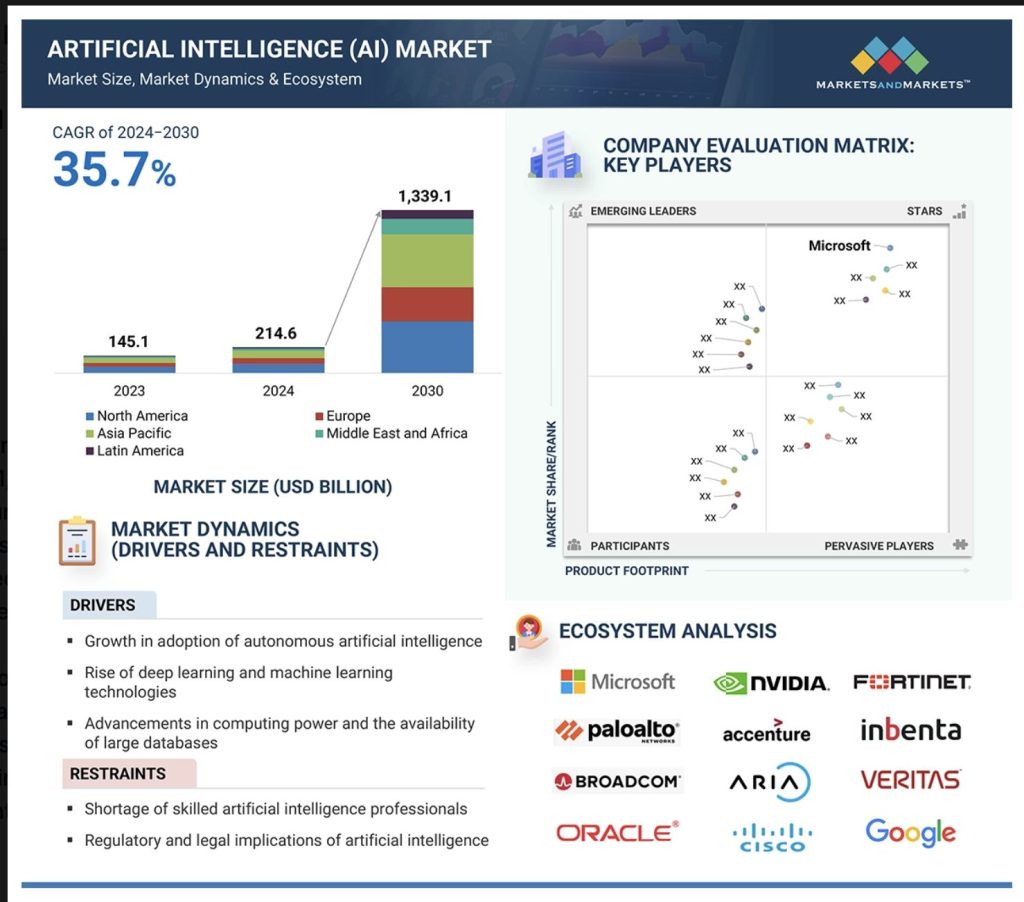
While notable, a number of concerns are being raised about AI’s impact on the job market. For example, AI is capable of writing code, leaving some wondering if AI will eventually replace human developers entirely.
AI’s Impact on The Crypto Sector
The use of AI in crypto has also expanded significantly. AI agents are now participating in trading, executing smart contracts, and managing decentralized autonomous organizations (DAOs).
Additionally, the market capitalization of AI agents continues to surge, with CoinMarketCap reporting a total valuation exceeding $13.5 billion.
AI agents are evolving as well. Level 3 agents have now emerged with enhanced autonomy and advanced learning capabilities, mirroring human cognitive functions.
Will AI Replace Crypto Developers?
Although AI agents are becoming smarter, industry experts believe that crypto developers shouldn’t be concerned about AI replacing humans – at least not anytime soon.
Manthan Dave, co-founder of digital asset custodian Palisade, told Cryptonews that while progress within the AI coding landscape is impressive, much of it is overhyped and misunderstood.
“AI is getting insanely good at building standard web applications. If you need a React component or want to set up a basic CRUD app, AI assistants will save you hours of work. That’s because they’ve been trained on mountains of similar code from GitHub and other sources,” Dave said.
But Dave also mentioned that GitHub data contains questionable patterns that shows AI doesn’t always know the difference between good code and code that just happens to work, regardless of quality.
“I tried using an AI assistant for a simple test web app – it nailed the dashboard UI in minutes, but then gave me an authentication implementation that would make any security expert cringe. You still need to know what you’re looking at,” Dave said.
Moreover, he pointed out that the narrative becomes more complex when it comes to crypto and blockchain projects.
“These projects make up just a small slice of GitHub’s codebase, which creates a fundamental data problem for AI models that thrive on abundant examples,” he said.
That being said, Dave believes there is not nearly as much information needed for AI systems to replace crypto developers anytime soon.
“Try asking an AI to help with a cross-chain bridge implementation or a complex staking contract, and you’ll quickly find yourself in endless cyclic arguments or hallucination territory,” he remarked.
AI Will Help Crypto Developers Advance
Although AI won’t replace crypto developers in the near future, AI will help some advance.
Dr. Alastair Moore, founding partner at Web3 venture studio The Building Blocks and an AI professor at University College London, told Cryptonews that crypto developers will soon see their roles shift towards higher-level oversight, creative architecture, and guiding AI systems.
He added that AI is starting to boost productivity for crypto developers by automating time-consuming tasks.
For example, he mentioned that AI tools like GitHub Copilot and ChatGPT help to quickly generate Solidity code and explain Web3 APIs.
In addition, AI-powered auditors like ChainGPT can rapidly scan smart contracts for vulnerabilities, while large language model-driven (LLM) chatbots streamline developer support and community management.
“The ability to perform detailed analysis of complex on-chain actions will continue to accelerate LLMs,” Moore said. “These advancements have reduced bugs, accelerated code deployment, and have enabled developers to focus more on complex design decisions and innovation.”
Andrew Hill, co-founder and CEO of Recall Network, told Cryptonews that while AI won’t replace crypto developers, it will oust those who don’t use these capabilities from their jobs.
“AI is a tool that multiplies a developer’s intelligence. Crypto development isn’t just code – it’s protocol design, incentives, governance. These are human problems, best tackled by augmented humans, not black-box models,” Hill said.
He added that Recall Network – a decentralized intelligence network designed for autonomous AI agents to store, share, and exchange knowledge on-chain – enables crypto builders to prove their intelligence in the rising era of AI.
For instance, Hill explained that AI agents compete to optimize decentralized finance (DeFi) strategies, identify vulnerabilities, and coordinate multi-agent systems.
Yet he noted that this isn’t just about using AI, but also proving which AI agents actually work.
“That’s where Recall enters, as we are turning open AI performance into a public good for the entire crypto ecosystem,” Hill said.
Challenges Associated With AI and Crypto
While AI will help crypto developers advance, a number of challenges remain.
Matej Janež, head of partnerships at Oasis Protocol, told Cryptonews that one of the biggest challenges is ensuring crypto stays decentralized.
“The first iterations of crypto and AI projects are pushing forward with novel use cases. However, with fast development, they’re also making compromises on the decentralization side of things,” Janež said.
Combating bias is another ongoing challenge. Zac Cheah, co-founder of Pundi AI, told Cryptonews that poorly trained AI models can produce skewed results. If the data used to train AI is limited or unbalanced, the model may reinforce existing biases rather than making fair decisions.
Cheah explained that a potential solution to this problem is using diverse datasets and transparent validation processes to ensure fairness.
“Decentralized approaches can also help mitigate bias,” he said. “For example, at Pundi AI, one of the tools in development is a decentralized AI data annotation platform. This platform allows users to participate in data tagging and rewards them for their contributions.”
Cheah noted that distributing data collection and labeling across a broader, more diverse group helps create more balanced AI models.
Kony Kwong, CEO and co-founder of GAIB, further mentioned that a significant challenge in using AI in the crypto space is the lack of dedicated models for crypto code analysis and development.
“The unique nature of blockchain technology requires specialized AI models that are currently in their infancy,” Kwong said.
Partnership Between AI and Crypto Developers
Given these challenges, Moore believes that AI and crypto developers must evolve toward a collaborative partnership moving forward.
“Developers who effectively leverage AI tools will have significant advantages in efficiency, security, and innovation, reshaping the landscape into one where AI amplifies human creativity rather than replacing it entirely,” he said.
The post AI Won’t Replace Crypto Developers Anytime Soon Says Industry Experts appeared first on Cryptonews.
AI Won’t Replace Crypto Developers Anytime Soon, Say Industry Experts
As artificial intelligence (AI) continues to make significant strides in various sectors, including finance, healthcare, and logistics, one question looms large over the cryptocurrency space: Will AI soon replace crypto developers? While the rapid advancement of AI technologies raises legitimate concerns about job displacement across many professions, leading experts in the crypto industry argue that developers are safe—for now. Here, we explore the reasons why AI isn’t poised to take over the critical role of cryptocurrency developers anytime soon.
The Current State of AI in Crypto Development
To understand the relationship between AI and crypto development, it’s essential to first define what AI can do in this context. Tools powered by AI can assist developers in streamlining workflows, enhancing coding efficiency, and automating repetitive tasks. For instance, AI can analyze large datasets for insights or even generate code snippets based on given parameters. Nevertheless, these capabilities do not equate to full autonomy or a substitution for the nuanced role played by human developers.
The crypto ecosystem is built on complex principles of cryptography, decentralization, and network interactions, which require a profound understanding of both technological and social dynamics. While AI can assist in certain aspects, it lacks the creativity, critical thinking, and adaptability that human developers possess. This complexity makes it difficult for AI to fully replicate the depth of human insight and innovative thinking required in the rapidly evolving crypto space.
The Irreplaceable Human Touch
Industry experts consistently highlight the importance of human involvement in the crypto development process. As one seasoned developer put it, "AI can help us write better code faster, but it can’t determine the best way to leverage technology for the evolving needs of users." The human touch accounts for empathy, ethical considerations, and a strategic vision that machines cannot replicate. Developers are not merely programmers; they are problem solvers who need to consider users’ needs, security implications, and the broader implications of technology adoption.
Moreover, every new blockchain protocol, decentralized application (dApp), or token standard pushes the boundaries of technology. Many of these breakthroughs are the result of human insight, creativity, and collaboration—qualities that AI still struggles to embody. The vision required to push the crypto space forward relies on the human ability to think abstractly and conceptually, acknowledging the social, political, and economic consequences of technological advancements.
Creativity and Innovation
Innovation is at the heart of the crypto industry. New ideas, imaginative solutions, and forward-thinking approaches fuel its evolution. While AI excels in pattern recognition and data processing, it still lacks the imaginative capacity to conceive ground-breaking innovations. Human developers are those visionaries and dreamers who can foresee trends and challenges that AI may overlook.
For instance, when Ethereum was launched, it marked a revolution in how decentralized applications could operate. Such innovation involved speculative thinking, bold ideas, and an understanding of future possibilities—characteristics not inherent in AI systems. The ability to harness societal trends, user experiences, and ethical considerations is something a machine learning algorithm simply cannot replicate.
The Integration of AI and Human Skillsets
Rather than seeing AI as a replacement, many experts underscore the potential for a collaborative synergy between AI tools and human developers. By automating tedious tasks, AI can allow developers to focus more on high-level thinking and strategy. This partnership helps developers harness the full potential of AI technologies while ensuring that human insight and ingenuity remain at the forefront.
For example, by using AI-powered analytics, developers can better understand user behavior on decentralized platforms, allowing them to tailor experiences that align with those needs. The symbiotic relationship between AI tools and human intelligence can enhance productivity and drive innovation, rather than promoting a zero-sum dichotomy.
The Future Landscape of Crypto Development
While it’s clear that AI won’t replace developers anytime soon, the future may hold new dynamics for the crypto world. As blockchain technology continues to mature, we may see a movement towards enhancing the skill sets of developers to work alongside advanced AI tools. Training programs and educational initiatives might focus on integrating AI literacy with blockchain knowledge, cultivating a new breed of developers who can deftly navigate both domains.
Furthermore, with increasing demands for security, compliance, and ethical considerations in the crypto segment, the human role in guarding against potential abuses will continue to be paramount. AI may help identify vulnerabilities, but human intuition and expertise will remain critical in decision-making processes that influence the future of the technology.
Conclusion
In summary, while artificial intelligence is making waves in various fields, the unique complexities and nuances of cryptocurrency development render it irreplaceable in the foreseeable future. Human creativity, ethical considerations, and innovative thinking play indispensable roles in shaping the direction of this rapidly evolving sector. Thus, rather than ushering an era of displacement, the collaboration between AI and crypto developers may very well herald a new chapter of innovation, enhancing the capabilities of humans rather than replacing them. As the crypto landscape continues to shift, embracing this synergy will be essential for progress and security.
The ongoing discussion about the impact of artificial intelligence (AI) on various sectors has sparked debates, especially within the cryptocurrency space. While AI is making strides in various industries, experts in the cryptocurrency field believe that it will not replace crypto developers anytime soon.
Many industry professionals argue that the unique skills and deep understanding required to develop and maintain blockchain technologies cannot be easily replicated by AI. Blockchain development requires not only technical proficiency but also creativity and problem-solving skills, which are inherently human. Developers must navigate complex scenarios, anticipate potential security vulnerabilities, and design user-centric solutions—tasks that AI is not fully equipped to handle.
Additionally, the rapid evolution of cryptocurrency protocols and the dynamics of market behavior require adaptability and innovative thinking. Human developers can respond to changes and new challenges in ways that AI algorithms, which are typically trained on past data, cannot. This adaptability is crucial in a space as volatile and fast-changing as cryptocurrency.
Moreover, the ethical and regulatory considerations surrounding cryptocurrency also demand human oversight. Developers must ensure that their projects align with legal requirements and ethical standards, a level of judgment and moral reasoning that AI lacks.
While AI may assist crypto developers by automating routine tasks, providing data analytics, or improving efficiency in certain areas, the core aspects of developing cryptocurrency technologies are poised to remain in human hands. The collaboration between human developers and AI may evolve, but the necessity of human expertise and insight will continue to play a vital role in the cryptocurrency ecosystem.
In summary, while the integration of AI into various sectors is undeniable, the unique challenges and requirements of cryptocurrency development suggest that human developers will remain indispensable for the foreseeable future.