
The Rise of AI Among Spanish Workers
Artificial intelligence (AI) has firmly transitioned from a futuristic concept to a pivotal tool in the daily routines of many Spanish workers. Once viewed with skepticism, AI is now fully integrated into various job functions, leading to both increased productivity and growing concerns about job security.
Growing Utilization of AI in the Workplace
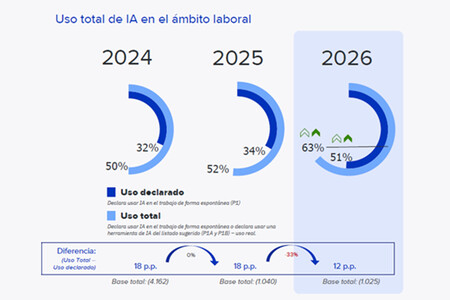
According to the latest IV InfoJobs Artificial Intelligence Report, 63% of professionals in Spain regularly use AI tools in 2026, a significant climb from the 52% reported in 2025 and 50% in 2024. This sharp increase highlights not only the growing adoption of AI but also an enhanced understanding among workers of its utility.
Interestingly, spontaneous use has surged to 51%, up from 34% in the preceding year. Moreover, employees are becoming more adept at identifying the AI tools available to them, as the gap between reported usage and actual utilization has narrowed significantly from 18 points to just 12.
Bridging the Knowledge Gap
In 2025, nearly half (48%) of professionals expressed uncertainty about using AI tools. However, this figure has dramatically decreased to 28% in 2026, illustrating a trend toward greater familiarity with technology. The generational divide is notably pronounced, as 63% of younger professionals (under 35) report using AI, compared to only 47% of their older counterparts.
Mónica Pérez, Director of Communication and Studies at InfoJobs, encapsulated this trend: “Artificial intelligence has gone from being an emerging technology to being progressively integrated into normal work processes.” This indicates a significant cultural shift in how AI is perceived and utilized in the workplace.
The Most Used AI Tools in Spain
Among the various AI tools being employed, ChatGPT-style chatbots have emerged as the most popular, increasing from 37% in 2024 to 52% in 2026. AI is also gaining traction in design and programming assistance, with usage rising to 17% and 16%, respectively.
Conversely, machine translation has seen a decline from 58% to 51%, showcasing an evolving landscape where employees are likely to embrace tools that facilitate creativity and problem-solving over mere translation tasks.
Increasing Anxiety Over Job Security
Despite the advantages AI brings to the workplace, it also breeds apprehension among employees. Approximately 39% of respondents in the InfoJobs report expect some job losses due to AI, up from 30% in 2025. While many believe that specialized roles are less susceptible to replacement, 23% anticipate a wider implementation of AI leading to more significant job substitutions.
Interestingly, those who regularly use AI are more likely to predict specific layoffs, with 46% expressing concerns compared to only 26% of non-users.
The Corporate AI Gap
The integration of AI varies significantly across companies. A UGT study found that only 21.1% of businesses with over ten employees utilized AI in 2025, climbing from just 9.55% the previous year. Larger firms (over 250 employees) showed a more pronounced uptick, with 58.2% now employing AI.
Although Spain’s AI integration has outpaced the OECD and EU averages (20.3%), it still lags behind leaders like Denmark (42%) and Finland (38%). Disturbingly, the proportion of IT specialists in companies has declined from 16.44% to 15.67%, raising concerns about Spain’s future talent pool amidst this technological transformation.
Conclusion
The increasing adoption of AI in the workplace offers both opportunities and challenges for Spanish workers. As AI tools become more prevalent, the need for ongoing education and adaptation is crucial for job security. Recognizing and addressing these concerns will be pivotal for organizations aiming to harness the full potential of AI while fostering a secure and confident work environment.