
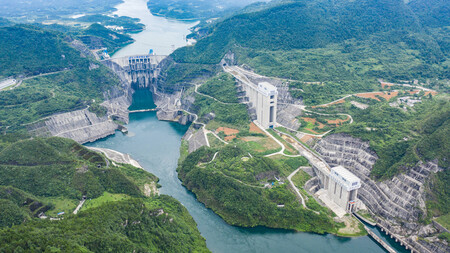
Let’s imagine a ship that, instead of descending through locks, rises up a mountain inside a chamber of water. That’s exactly what happens in Goupitana dam in southwest China where the difference in level between the reservoir and the river reaches almost two hundred meters. To overcome this gap, engineers designed three consecutive elevators capable of transporting boats of five hundred tons. This innovative system combines the scale of a hydroelectric dam with the precision of a clock, transforming the Wu River into a continuous navigable waterway after more than twenty years of interruption.
For years, the Wu River has served as a vital artery for Guizhou. Barges descended from its mountains toward the Yangtze, laden with useful cargo such as minerals, cement, and fertilizers. The bustling river trade came to an abrupt halt with the construction of larger hydroelectric dams in the early 2000s. While these reservoirs generated power, they completely cut off shipping routes. Between 2009 and 2016, the Wu River lacked any continuous navigable passage, forcing cargo to be transferred to trucks for lengthy detours—a costly endeavor that discouraged river transport.
Three elevators, the same river and a mountain in between
Goupitan consists of three sequential boat lifts, allowing navigation to resume across the Wu River. Each lift is designed to overcome sections of the elevation, while a connection channel incorporates tunnels and suspended aqueducts. According to the Guizhou Department of Transportation, this integrated system spans over two kilometers and accommodates standard barges, allowing them to navigate the river again.
This ambitious project represents the world’s first implementation of three consecutive elevators within a single construct, achieving a record elevation of 127 meters. The system was developed at a cost of around three billion yuan (approximately 400 million euros) and is capable of transporting nearly three million tons of cargo annually.
The operational principle of Goupitan revolves around balance. When a ship enters the chamber, it displaces an equivalent amount of water, maintaining a stable weight. This mass is manipulated by counterweights and steel cables that raise and lower the chamber with remarkable precision. Two of the elevators are submersible, submerging to equalize water levels, while the central lift employs a balanced system akin to a traditional elevator but on a monumental scale.
Electric motors drive the lift mechanisms, with real-time monitoring handled by sensors that gauge tension and chamber positioning. Immediate safety protocols ensure that if any discrepancies are detected, the system halts its operation instantly.
After three years of hydroelectric dam operations, construction for navigational works commenced. The following decade saw Goupitan evolve into an engineering marvel, necessitating the excavation of navigation tunnels through rocky terrain and the careful assembly of massive steel caissons. A significant milestone was reached in June 2021 when a five-hundred-ton boat successfully completed the journey through all three elevators. By 2023, the Ministry of Transportation confirmed the system’s operational readiness for commercial use following comprehensive inspections.
Once active, the elevators operate as a synchronized chain. The entire transit through the three levels takes approximately 38 minutes, according to official data. Advanced automation, managed through sensors and cameras, governs everything from gate operations to water pressure management.
Since the system became operational, its impact has been immediate and transformative. A convoy carrying seven thousand tons of phosphate marked the official reopening of navigation on the Wu River in November 2021. This revival enables river transport to provide a realistic alternative to road transit, effectively reducing transportation costs and environmental impacts.
The reactivation of the Wu River holds strategic significance for Guizhou, a landlocked province intricately connected to the Yangtze and, subsequently, the port of Shanghai. This renewed accessibility allows for direct exports of minerals and construction materials while facilitating raw material imports without dependence on highways.
Maintenance is crucial. Daily inspections coupled with regular thorough assessments ensure the lifts operate smoothly. Technicians undergo specialized training to manage this sophisticated machinery. The Goupitan system not only redefined logistics along the river but also shifted the global benchmark for boat lifts. Previously, the Three Gorges Dam elevator was the standard for such technology, with a maximum drop of 113 meters, while Goupitan covers an impressive 199 meters in total elevation.
Nestled amidst breathtaking landscapes, the Goupitan boat lift has drawn attention from curious visitors and tourists. The visual allure of watching ships ascend the mountains against a backdrop of forested hills and valleys has further enhanced its popularity.
As Goupitan continues to function efficiently, it stands as a testament to the possibilities of modern engineering, merging technological advancement with natural landscapes.