

The story dates back to 2015 . With the backing of the then Prince Carlos, an ambitious project was launched through the North Highland Initiative to economically reactivate the remote highlands of northern Scotland. This endeavor led to the creation of the North Coast 500, though the impact of this “old acquaintance” was unforeseen.
The Birth of a Myth
The project had very clear objectives a decade ago. Based on existing roads, a circular route of 830 kilometers was conceived, with Inverness as its starting and ending point, akin to the mythical American Route 66. The promise was twofold: to energize the economy of small, forgotten locations and offer travelers an unforgettable experience amid castles, rugged coastlines, and pristine landscapes.
In its initial years, the statistics confirmed its success : a staggering 26% increase in visitors to tourist information centers and a 30% rise in local attractions. A 2018 study assessed that the route was contributing more than 22 million pounds per year to the local economy.
Mass Tourism Arrives
However, success brought about unintended consequences . The massive influx of caravans, motorhomes, sports cars, and motorcycles overwhelmed the already precarious roads and ill-prepared towns, turning them into a hub of chaos. What began as an economic boon was perceived by many residents as an invasion: grasslands scorched by barbecues, paths converted into makeshift toilets, and fragile ecosystems, like the habitats of Atlantic puffins, ravaged by reckless tourists.
The lack of basic infrastructure—such as parking areas, restrooms, and wastewater discharge points—has led to spills of garbage and human waste on private properties and constant disruptions in those fragile habitats. The increase in accidents was aggravated by visitors unfamiliar with single-lane roads or the fact that they needed to drive on the left. Official data shows a spike in serious collisions caused by American tourists.
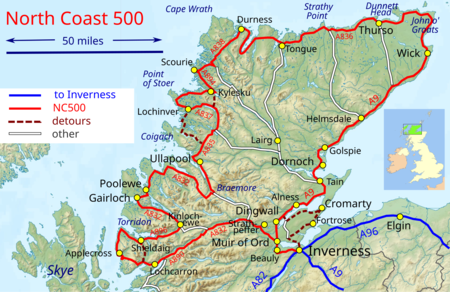
The route
An Unsustainable Situation
The consequences of mass tourism continued to mount. The legendary port of Bealach Na Bà, with its tight turns at elevations over 600 meters, became a risky challenge for oversized motorhomes.
The prosperity provided by the NC500 is undeniable , generating thousands of linked jobs and reviving rural businesses that otherwise might have vanished, especially post-pandemic. Accommodation owners have acknowledged that without the route, their businesses would not have survived.
Yet, this economic boon is accompanied by a perception of becoming a “seasonal invader,” disrupting community life. Daily interactions with caravans parked outside homes, high-speed rallies, and campers damaging trees have fueled rising discontent among locals, crystallized in Facebook groups like NC500 The Dirty Truth. For many, the brand has morphed into a hostage to large corporations that exploit its allure without considering the cultural and environmental repercussions.
Local Responses and Future Implications
The situation has led to NC500 being placed on Fodor’s Travel blacklist , classifying it as unsustainably popular. In response, authorities and promoters have initiated campaigns like Press Pause, prompting communities to dictate their promotional strategies, along with hiring rangers to patrol and educate visitors.
NC500 LTD. has also introduced a “traveler commitment” on its website, receiving over 4,000 signatures aimed at fostering environmental and social respect. However, underlying issues persist: How can one maintain the appeal of a route that has placed northern Scotland on the global map while ensuring the preservation of its identity, nature, and the daily lives of its residents?
The Highlands Dilemma
The NC500 encapsulates a global dilemma—the tension between the economic benefits of mass tourism and the erosion of what makes an area valuable. The risk now is that the “last wild frontier” of Scotland threatens to become a saturated display , unable to support its visitors or its local communities.
Some believe the solution lies in limiting tourist flow and bolstering infrastructure, while others think that Highland culture will inevitably change under the weight of international tourism. Caught between the enthusiasm of businesses and the frustration of local residents, the NC500 stands as an uncomfortable mirror of a rural development dream that risks destroying the serenity of the landscapes that once inspired such aspirations.
Conclusion
If William Wallace were to look up today, he would hardly recognize the land, nor imagine the challenges it faces amid this uncharted path of tourism.
Image credits: Fabian to Scherschel, Lauren Friedman, ThincatNC500 The Dirty Truth