
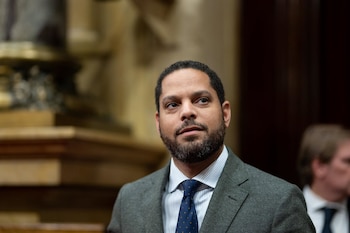
The Rising Tensions in Spanish Politics: Vox’s Ignacio Garriga Takes Aim at Pedro Sánchez
In a heated political landscape, Vox leader Ignacio Garriga has launched a series of fervent critiques against the Spanish Prime Minister Pedro Sánchez, accusing him of deception and undermining the legal system. Garriga’s remarks came shortly after Sánchez’s interview on RTVE on Monday, where the Prime Minister suggested that a minority of judges were “engaging in political activity.”
The Vox general secretary’s response was immediate and pointed. He described Sánchez’s comments as a “lie,” inferring that they constituted an insult not only to the judiciary but to the Police as well. Garriga’s sharp tone underscores his growing frustration with the current administration, which he claims is mired in corruption.
Garriga also criticized the state broadcaster RTVE, claiming it failed to cover pressing issues affecting the Spaniards and instead offered what he termed a “face washing” for Sánchez. His remarks reflect a broader dissatisfaction with the government’s handling of both domestic and constitutional matters.
Sánchez, according to Garriga, is “politically dead,” and his continued presence in office serves as a liability to the nation. Garriga called upon the People’s Party (PP) to sever any ties or agreements with Sánchez, suggesting that the political environment requires a clear break from leadership stained by scandals. He emphasized the ramifications of Sánchez’s agreement regarding the General Judicial Power (CGPJ), pointing to the appointment of individuals whom he views as unworthy for their roles.
Controversial Meetings and Catalan Budget Concerns
One of the most noteworthy points raised by Garriga was the meeting between Salvador Illa, the President of the Catalonia Generalitat, and former Prime Minister Carles Puigdemont. Scheduled in Brussels, this event was characterized by Garriga not as a diplomatic incident but as a meeting that ought to be held in Soto del Real, where Puigdemont is currently facing legal challenges.
Garriga asserted that Illa should be prepared to explain this meeting at the Parliament, ultimately framing it as a sign of allegiance to Puigdemont rather than an act of governance for the benefit of the Catalan people. He criticized Illa’s apparent hypocrisy, recalling Illa’s previous condemnation of Torra for engaging with Puigdemont in a similar fashion.
“Today Illa assumes the role of a delegate from Sánchez,” Garriga stated, calling for transparency in the dealings that affect the future of the Catalan government and Spain as a whole.
As the political vitriol continues, the critical issue of Catalan budgets looms. Garriga pressed Illa to call for immediate elections if he is incapable of securing the necessary budget approvals by 2026. This demand follows expectations for the government to approve the expenditure cap for the upcoming fiscal plans.
Furthermore, Garriga expressed concerns regarding the impending approval of the Autonomous Liquidity Fund (Fla), labeling it as part of Sánchez’s efforts to create an illusion of stability during a time of political turmoil. He dismissed this as a desperate attempt to prolong his time in Moncloa, the seat of the Spanish government.
This convergence of accusations, political maneuvering, and budgetary challenges indicates that Spain’s political environment remains fraught with tension and uncertainty. As the situation unfolds, the effects of these clashes will be critical in shaping not just leadership dynamics, but the governance of issues directly impacting the lives of Spaniards.
With the political stakes higher than ever, it will be crucial for both Sánchez and his opponents to navigate this treacherous landscape carefully.