
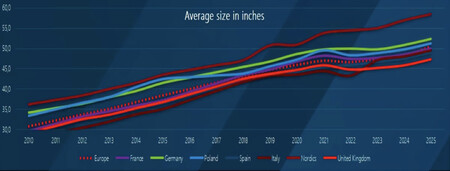
The evolution of television sizes has been nothing short of remarkable over the past decade. Just as smartphone screens have expanded, so too have televisions, inviting the perennial question: how big is too big? The reality is that while smartphones face limitations of handling and portability, televisions are constrained by the space available in our living rooms.
The market speaks clearly. Recent data from GFK reveals a striking trend: on average, television sizes in Europe have grown by 1.2 inches per year. From an average of 32 inches in 2010, this figure is projected to reach approximately 50 inches by 2024. Samsung has indicated that the average size has already surged to 55 inches in 2023, with expectations that by 2025, the standard size could be 65 inches . Such trends unequivocally highlight consumer preferences leaning toward larger screens.
Counterpoint Research has provided compelling insights into the television market’s rapid expansion. In Q1 of 2025, televisions measuring 75 inches or more experienced a stunning growth of 79% compared to the same period in 2024. Revenue has also spiked by 59% , highlighting that a growing number of consumers are opting for larger displays.
The trend is clear for 15 years: televisions grow by 1.2 inches a year. Source: GFK
Interestingly, while the demand for larger televisions rises, the average price for these items is seeing a decline . Despite the escalating sales of giant displays , revenue growth hasn’t kept pace. According to DSCC data, televisions surpassing 80 inches have seen an impressive growth of 29% year-on-year in Q2 of 2024.
Samsung’s foresight is commendable. Back in 2018, the company commissioned an Ipsos study that revealed intriguing insights about Spanish households. Surprisingly, 87% of them could accommodate an 82-inch television—making the minimal recommended viewing distance for this size a key factor for consideration. The findings also illustrated potential consumer ignorance regarding the scalability of television sizes within their living spaces.
The survey results unveiled some startling truths:
- 70% of television buyers expressed interest in purchasing larger models, even though 70% currently only own sets below 50 inches .
- The predominant barriers hindering larger TV purchases were identified as: 50% citing space , 39% citing price , and 16% concerned about viewing distance .
Television prices are plummeting. If history teaches us anything in technology, it is that innovation does typically drive up costs. However, Smart TVs have bucked this trend. The introduction of “mother crystals” and other advancements has allowed manufacturers to lower prices significantly. A compelling example is Telly, offering a free television model funded through advertisements displayed on a secondary screen.

Previously, Juergen Boyny from GFK noted that a 75-77 inch screen size could be the upper limit for mainstream consumers. Recent data, however, contradicts this notion, indicating growing acceptance for larger models.
According to Counterpoint, TV buyers in the European Union spend an average of €536 on their televisions. This contrasts sharply with €20,000 for a 77-inch model recorded less than a decade ago. Exceptional deals can now be found, with Walmart offering 85-inch models for under $600 .
As we consider optimal TV size , it’s clear that size limitations prompted analysts to predict that 75-inch models would fall into a niche category. Reality, however, tells a different story.
The Chinese brands are thriving. Notably, TCL and Hisense stand out as leading players in the television market. Recent data indicates that these brands are outpacing LG in the premium television sector. Furthermore, although Samsung maintains a 16% market share , TCL, Hisense, and even Xiaomi are closing in rapidly.
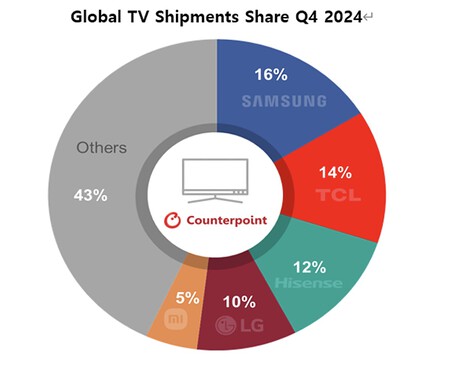
TCL’s aggressive positioning in the large TV market—offering a range of MINI-LED and LCD models upwards of 98 inches —highlights its evolution from a budget option to a formidable competitor in premium markets . The brand continuously innovates to democratize the technology, making it accessible to a broader audience.
Innovation drives competition. By unveiling new technologies, both brands aim to provide products that are not only impressive in size but also economically feasible. The shift towards MINI-LED technologies signifies an ongoing market transformation where more affordable options are continuously rising.
The landscape of consumer preferences. As consumer desires evolve alongside technology, larger televisions are a growing ideal for many households. However, preferences play a crucial role. Even if consumers can afford larger models, size and impact on living spaces can deter them. Alternatives, like virtual reality cinema , offer immersive experiences without needing a colossal television screen.