

As the United States intensifies its search for crucial minerals and rare earth elements that China dominates, concerns are rising globally. With substantial investments from the Pentagon and corporations like Apple , the situation is becoming increasingly tense. Beijing is expanding its maritime empire, causing unease for countries like Japan and Taiwan , who traditionally believed that the seas were safeguarded primarily by Washington.
Maritime Ambition – Amid the escalating strategic rivalry with the United States, China has ramped up its long-range naval operations as a clear indication of its global ambitions.
In recent months, the Chinese aircraft carriers Liaoning and Shandong conducted joint exercises in waters near Japan, pushing beyond the so-called “First Island Chain” and encroaching into the “Second Chain,” which includes the strategic Guam —a critical U.S. military stronghold.
Nerves – The deployment of these two aircraft carriers in the Western Pacific has not only sparked concerns in Japan, but it also showcases the growing scope of the Chinese navy. Beijing is training its units to operate autonomously, far from mainland shores, during both peacetime and wartime.
The capacity to execute air operations from carriers in open seas allows China to conduct up to 90 aircraft landings and takeoffs per day. This operational experience, albeit still in its early stages, indicates a future intention to employ these assets as tools of force projection well beyond their immediate areas of influence.
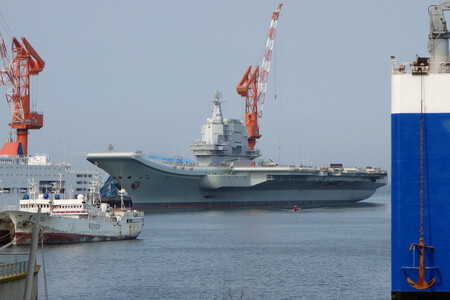
Shandong Inroads under construction, in 2019
Aircraft Carriers as Symbols – Beyond their military functions, Chinese aircraft carriers act as a status symbol of international power. For Xi Jinping’s administration, the possession and operational deployment of these vessels symbolize a departure from regional limitations, portraying China as a global power .
Although China’s current fleet, consisting of the Liaoning, Shandong, and the yet-to-be-activated Fujian , operates with conventional propulsion and lags technologically behind the U.S. Navy ’s eleven nuclear carriers, Chinese state media promote these exercises as an unmistakable signal of their maritime resurgence.
Looking Ahead – Additionally, if the fourth carrier currently under construction employs nuclear propulsion and electromagnetic catapults , as indicated, it will mark a significant technological leap. Furthermore, the recent public showcasing of the Shandong in Hong Kong serves to fuel nationalist sentiments and bolster the legitimacy of Chinese governance through military prowess.
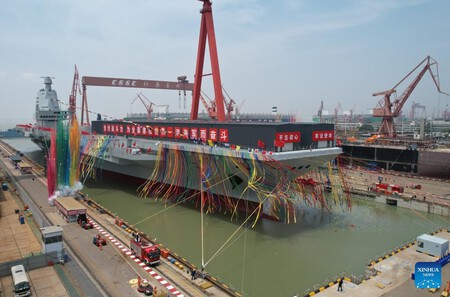
CNS Fujian
Dispute Over the Pacific – China’s carriers not only serve for training or to extend influence but also act as an operational instrument in the context of ongoing territorial disputes in the South China and East China Seas . Analysts suggest that Beijing could leverage these naval assets to bolster its claims against Japan , South Korea , and other Southeast Asian nations, or even apply maritime pressure on Taiwan by creating a blockade to restrict the flow of goods and communications.
While these aircraft carriers would likely be vulnerable to U.S. missiles and torpedoes in a direct conflict, their value lies in their capability to control extensive maritime regions, conduct surveillance, and exert political pressure. They are seen as a hybrid tool for both economic and military coercion, as noted by a Japanese academic in a recent New York Times feature.

Evolutionary Logic – Since the Taiwan Strait crisis in 1996, when the United States dispatched two carrier groups to deter Beijing’s aggressive posture, China recognized the imperative to enhance its naval capabilities . The journey commenced with the acquisition of an aging Soviet aircraft carrier, which was transformed into the Liaoning and incorporated into the fleet in 2012.
Progress has been steady. The Shandong , commissioned in 2017, was the first to be entirely constructed in China, featuring electromagnetic catapults critical for launching advanced and heavily armed aircraft.
A Long Way Ahead – Despite these advancements, experts caution that Chinese naval operations remain primitive, defined by a gradual learning process. Scholars warn that China is keen to avoid costly blunders, aiming to solidify a coherent maritime doctrine enabling it to compete on par with the world’s major naval powers within a few decades.
The Indo-Pacific Theater – The concurrent deployment of the Liaoning and Shandong in deeper waters has significant implications, allowing the Chinese fleet to operate in unfamiliar environments while enhancing its readiness for future interventions in critical areas like the Indian Ocean , Persian Gulf , or even the Mediterranean .
Timothy Heath, a researcher with the Rand Corporation , noted that these aircraft carriers grant China the ability to execute aerial missions in any operational area traversed by their navy, beyond the single foreign base it currently maintains in Djibouti . Controlling vital routes to the Middle East and the Strait of Malacca is likely to be high on China’s list of strategic objectives in the coming years.

A War of Symbols – As highlighted by the New York Times , as China builds more warships and strengthens alliances with African nations while enhancing port diplomacy in Asia and Africa, the Indo-Pacific becomes a stage where a new naval power competition unfolds—aircraft carriers serve as pivotal tools in this geopolitical ambition.
Though these vessels do not ensure maritime supremacy, especially against a rival with interdiction capabilities like the United States, their operational roles and symbolic weight significantly enhance China’s presence on the global stage. Beijing no longer aims merely to defend its coastlines but aspires to chart maritime routes that were once dominated exclusively by its primary competitor.
Image | RHK111, Tyg728, Ministry of National Defense The People’s Republic of China/ Li Gang/ Xinhua
In summary, the maritime ambitions of China, illustrated through its expanding carrier fleet, reflect a strategic objective to assert dominance in the Indo-Pacific region and beyond. This transformation is not merely a function of military capability but is also deeply tied to national identity and global stature, setting the stage for a new era of international relations.