
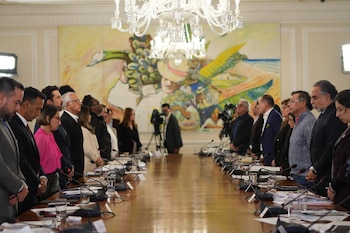
During the Council of Ministers headed by the President of the Republic, Gustavo Petro, on the night of Tuesday, July 15, the president warned that the approval of the Financing Law by Congress is required to prevent a national economic crisis.
“President Gustavo Petro launched a new warning to Congress: if they do not approve a new financing law, the State will break,” reported the magazine Semana. This statement highlights the urgency with which the government views the situation.
Now you can follow us in Facebook and in our WhatsApp Channel
During his speech, the Head of State openly criticized sectors that, according to him, demand more public resources without acknowledging the existing fiscal capacity. His statement was blunt: “They ask us to give more money. They are not vagrants, man! The State will break if the Senate does not approve a financing law,” emphasizing that Colombia’s fiscal future hinges on Congress’s choices.
Repeatedly, the president warned of grave outcomes stemming from fiscal unsustainability: “The State is going to break, all figures say it. And we sink into barbarism and violence—not in this government, but later.” His words reflect the severity of the fiscal situation and its potential ramifications for Colombian society.
Petro made an urgent call to senators, urging them to “think of Colombians.” This appeal encapsulates the increasing frustration of many citizens who feel the weight of governmental inaction. He highlighted Congress’s responsibility to legislate in favor of the people, demanding accountability as the country faces economic challenges.
In this context, the Minister of Finance, Germán Ávila, presented preliminary guidelines and calculations for the national budget projected through 2026. The future budget is expected to reach $551.6 billion, marking an 8% increase compared to the previous year’s budget of $511 billion.
However, at the conclusion of the Council of Ministers, Petro stated that he would refrain from signing the proposal until the necessary adjustments align the budget with the government’s plans. “Social spending must grow. If there are not enough incomes, the financing is termed debt,” explained the president, reiterating the critical link between social spending and the approval of the Financing Law, also known as Tax Reform.
During the official transmission, Ávila detailed an anticipated increase in operational expenses of 13.2% by 2026, rising from $321.8 billion projected for the end of 2025 to $364.6 billion. Notably, transfers, a significant component, are expected to increase from $237.3 billion to $273.9 billion, indicating a 9.08% rise.
The General System of Participations (SGP), essential for guaranteeing resources for foundational sectors like health and education, is projected for sustained growth, possibly reaching $88.3 billion by 2026—a significant rise from $36.7 billion in 2018.
Moreover, payments to the pension system continue to represent substantial pressure on the national budget, which is estimated at $87.4 billion by 2026. This budget will also allocate $51.3 billion for the health sector and $27.5 billion for additional items. Notably, the Executive aims to decrease the total disbursement for debt service from $112.6 billion to $102.5 billion in the coming year, of which $22.1 billion will be assigned to interest payments.
Regarding public investments, the government’s agenda seeks to increase spending from $76.6 billion to $84.5 billion, representing a 10.3% increase. Ávila pointed out that “this is the balance of the government budget appeal,” emphasizing that current restrictions and tax commitments make it crucial to strengthen financing sources through legislative approval of presented tax instruments.