
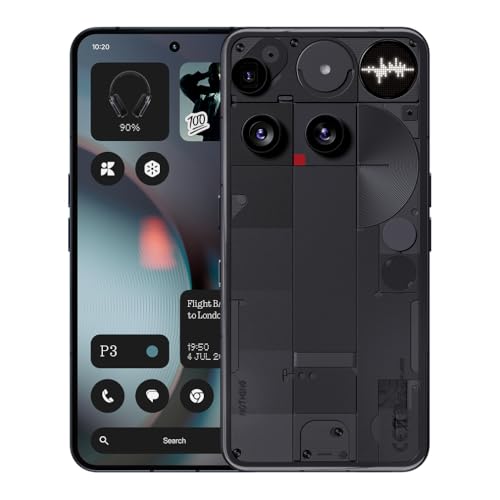
“Make tech fun again”. Beyond any similarity to slogans from certain public figures, Nothing’s message is not merely about marketing: it embodies the philosophy they have applied to each of their products since the inception of this startup. It began with the Nothing Phone (1), navigating the mid-range ocean, and now aims to sail into the most exclusive party with its Nothing Phone (3): the realm of high-end smartphones.
Not yet daring to compete for the excess range of over 1,000 euros, Nothing presents a more solid offering than ever before. This is an opportunity for them to showcase where they stand technologically while adhering to a philosophy that doesn’t target a mass audience. This phone is meant for those seeking something very specific.
Technical Specifications of the Nothing Phone (3)
Nothing Phone (3) | |
|---|---|
Dimensions & Weight | 160.6 x 75.59 x 8.99 mm |
Display | Flexible AMOLED 6.67” |
Processor | Snapdragon 8s Gen 4 |
RAM | 12/16 GB LPDDR5x |
Internal Storage | 256/512 GB UFS 4.0 |
Rear Camera | 50 MP wide, f/1.68, OIS+EIS |
Front Camera | 50 MP, f/2.2, EIS, 81.2° FOV |
Battery | 5150 mAh |
Operating System | Android 15 with NothingOS 3.5 |
Connectivity | Dual nanoSIM+eSIM |
Other Features | IP68 certification |
Price | Starting from 799 euros |
Nothing Phone (3) – Smartphone with Triple 50MP Camera, Long Lasting Carbon Silicon Battery, 6.67″ AMOLED Display with 120Hz & Glyph Matrix, 12GB + 256GB – Black
* Some prices may have changed since the last revision
Design, Display, and Sound
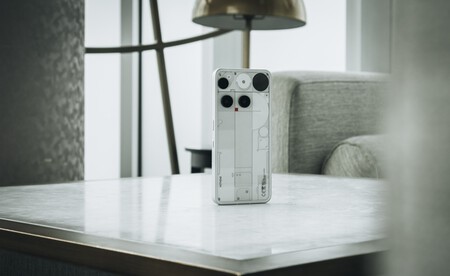
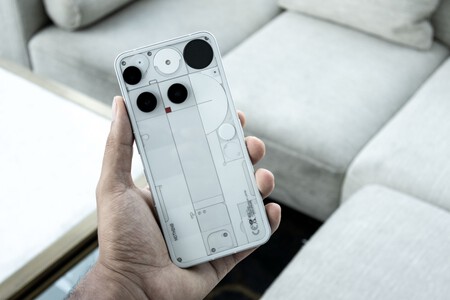
The Nothing Phone (3) features a design that only truly makes sense when held in person. I’ll be honest: when I first saw the leaked renders (which accurately reflected the final design), I didn’t understand it. It appeared to break the harmony of the previous two models, and chaos as a central element didn’t seem to work.
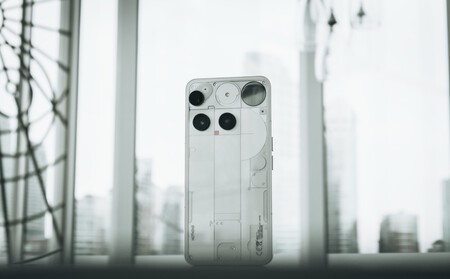
The perception changes entirely when you have the phone in hand. The cameras aren’t aligned, the Glyph Matrix (the circular LED display) seems to serve no purpose, and the LED flash is focused oddly. At first glance, nothing seems to make sense, but when you see it in person, it works.
It’s a very personal observation, but in an era of clone phones, the design of the Nothing Phone (3) is stunning.
This phone is distinct, possessing significant personality, with build quality comparable to nearly any other high-end phone. The button layout, materials (Gorilla Glass Victus back, aluminum), and perceived quality are meticulously crafted, as Nothing has always prioritized the finish of its devices.
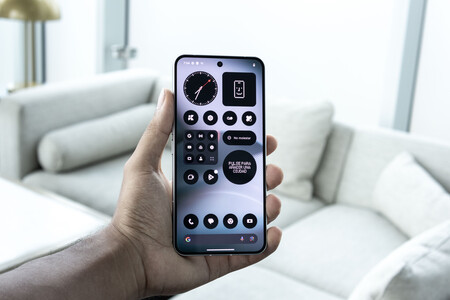
The panel meets the standards expected of a high-end model in 2025: AMOLED, higher than FHD+ resolution, HDR10+ compatibility, and peak brightness of 4,500 nits (HBM of 1,600 nits). It’s precisely what one would expect—a very good panel, slightly below the best on the market.
Sound quality is less impressive. It has dual stereo speakers and produces loud sound, but both distortion and lack of bass are common drawbacks often found in lower-end mobiles. This phone, however, aims to stand in the premium category.
The Glyph Matrix
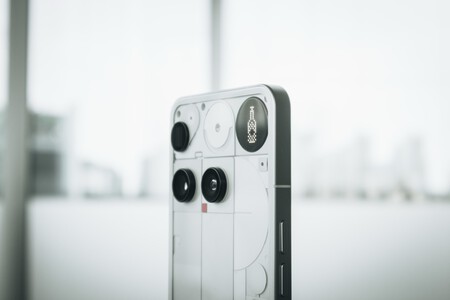
Never expected to see a spinning bottle on the back of a phone.
One of the distinguishing features of the Nothing Phone (1) and (2) was its notification system via LEDs on the back. This has vanished in the third iteration in favor of the Glyph Matrix, a small screen made up of tiny LEDs on the back of the device. Based on my experience with the previous models, this is a clear improvement.
Why? Because it goes beyond the visual spectacle of its predecessors, providing practical utilities. Knowing the exact battery percentage, the time, which app has notifications, or activating the timer are quite useful when the phone lies face down. I don’t find it powerful enough to be a primary selling point, but having an energy-efficient option to understand what’s happening on the phone while it’s locked is a definite plus.
The Glyph Matrix is controlled by a small button located mid-right on the phone. Pressing it activates the selected Glyph mode, and holding it down gives you access to that function.
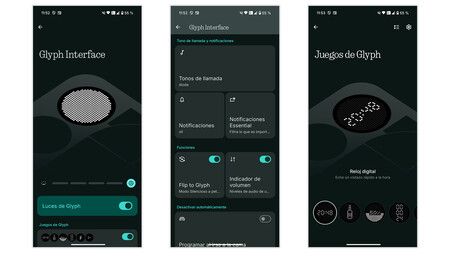
The various functions include:
- Glyph Games (clock, bottle spinning game, battery percentage, timer, mirror, sundial, rock paper scissors)
- Notification indicator (through an icon)
- Call indicator
- Essential notifications (custom rules down to notifications containing specific keywords)
- Volume indicator
The level of customization is simply extraordinary, and best of all, developers can access it. In my opinion, this is one of the most innovative features I’ve ever encountered.
Performance, Software, and Battery Life
Nothing considers the Phone (3) a true flagship, though it doesn’t have the most powerful processor on the market. The reasons are clear:
- Thermal performance
- Energy efficiency
- User experience
According to Nothing, the Qualcomm Snapdragon 8s Gen 4 is the best processor for this phone, and I find this to be a reasonable claim. In benchmark tests, this processor lags somewhat behind the Snapdragon 8 Elite and performs slightly below the Snapdragon 8 Gen 3. In other words, it’s a 2025 mobile operating at 2024 specs. Am I concerned? Not in the slightest.
Nothing Phone (3) | Vivo X200 FE | POCO F7 | Realme GT 7 | Realme GT7 Pro | |
|---|---|---|---|---|---|
Processor | Snapdragon 8s Gen 4 | MediaTek Dimensity 9300+ | Snapdragon 8s Gen 4 | MediaTek Dimensity 9400e | Snapdragon 8 Elite |
RAM | 16 GB | 12 GB | 12 GB | 12 GB | 16 GB |
Geekbench 6 (Single/Multi) | 2,091 / 6,654 | 2,112 / 6,650 | 2,028 / 6,271 | 2,239 / 7,209 | 3,150 / 9,664 |
3D MARK Wild Life Unlimited | – | 12,334 | 16,889 | 18,231 | 24,987 |
PCMARK WORK | 14,347 | 13,485 | 15,181 | 12,806 | 25,431 |
No matter the game, video recording applications, exporting 4K files, multitasking, or opening times, the Nothing Phone (3) performs exceptionally well, offering a highly satisfying user experience.
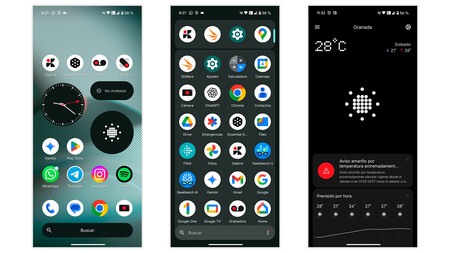
Software-wise, if you are a fan of the old-school (Nexus, CyanogenMOD, Pixel, very “stock” ROMs), this ROM will bring you joy. If you are new to this world, what you’ll find is quite different from what most of the market offers now. NothingOS 3.5 is a ROM that draws from the purest Android experience, layering a playful customization with glitch sounds and a pixel-art design.
Pros:
- It’s different
- There’s no bloatware
- It is extremely fast
Cons:
- It’s not the most customizable
- It doesn’t offer the most value in proprietary apps
- The AI integration is too understated
Nothing has agreements with OpenAI and Google to integrate both ChatGPT and Gemini into the device, though it still lags behind in the race for the best AI mobile. Carl Pei mentioned to me that “there’s a lot of hype” surrounding AI today, and they prefer to focus on practical features. However, incorporating AI into automatic translation, image editing, or noise reduction in videos is effective, and none of that is present here.
Instead, there are three pillars: Essential Space (an app that allows you to store screenshots or voice recordings with notes), Flip to Translate, and Essential Search.
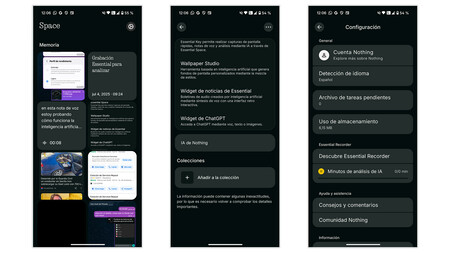
Essential Space.
Essential Space is something we have seen in devices like the Nothing Phone (3) or the CMF Phone. Personally, it’s a function that doesn’t convince me. It’s a storage space for screenshots and ideas, but neither the AI implementation is particularly strong, nor have I found useful situations for employing it.
Flip to Translate is remarkable. If we lock the phone and press the Essential Key, it starts recording immediately. It’s quite seamless because the Glyph Matrix activates, showing the recording wave. Pressing the button again marks a key moment in the interview, which is saved by pressing it once more.
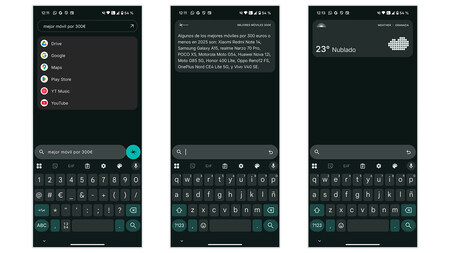
Finally, there’s Essential Search. Here, Nothing completely revamps traditional search by offering AI-generated summaries through Gemini. I’m not a huge fan of replacing traditional search (which leads to more complete results) with a summary, but there’s no denying its utility for being quicker and more practical.
As for battery life, it is adequate but doesn’t excel. I found it challenging to exceed six hours of screen time, and though it manages a full day, with heavy use, the battery percentage tends to drop rapidly.
Camera
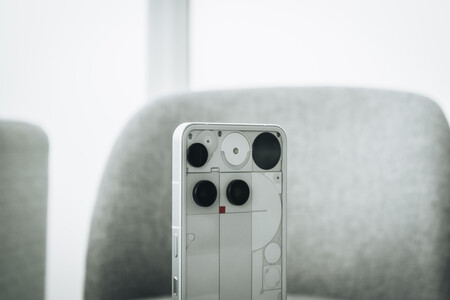
The crucial distinguishing factor for a phone genuinely aiming to compete with top market offerings lies not in processing power, but in the camera quality. If the camera is on par with the top three, potential shortcomings in other areas diminish. Nothing has faced the challenge of improving camera quality across two generations, and sadly, this third iteration does not change that.
- Main camera: 50 MP, f/1.7, 24mm (wide), PDAF, OIS.
- Telephoto camera: 50 MP, f/2.7, (periscope), PDAF, 3x zoom, OIS.
- Ultra-wide camera: 50 MP, f/2.2, 114° (ultra-wide).
The hardware is satisfactory for the main sensor, but the telephoto and ultra-wide sensors are somewhat lacking in size. The camera app is familiar territory. While I have no strong feelings about it, it’s worth noting that the preview quality (what you see before you take a photo) isn’t particularly impressive.
Photographs Taken with the Main Camera
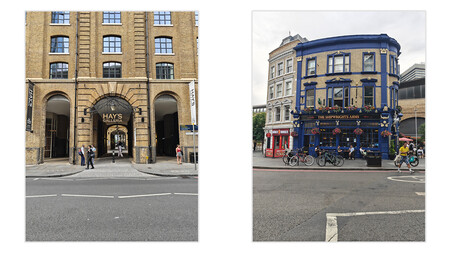
The camera on the Nothing Phone (3) is closer to what is typically found in mid-range phones than what one would expect from a true high-end product. Strengths include decent results in good lighting conditions, where oversaturation is limited, making it suitable for capturing most scenes.

However, it exhibits serious dynamic range issues in shadows, excessive contrast, and a blandness that compromises the natural quality this sensor could achieve.
Photographs Taken with the Telephoto Camera

The telephoto camera produces somewhat odd processing results. I am confident it possesses more potential, as the textures appear quite soft and could be easily corrected through software. However, it is a camera that still requires significant improvement, just like the main camera.
Photographs Taken with the Ultra-Wide Camera

Generally, ultra-wide sensors tend to be weaker, and this case doesn’t fall too far behind what one might expect. The detail is somewhat less than what is found in the main camera, and shadowy areas appear even more subdued. Nonetheless, this is still a fairly decent camera given its nature.
Video
Video recording aligns well with the photographic results. I find it lacks a bit more stabilization, and the processing is somewhat aggressive. It supports recording up to 4K 60p, and does not heat excessively during the process.
Opinion on the Nothing Phone (3) by Xataka
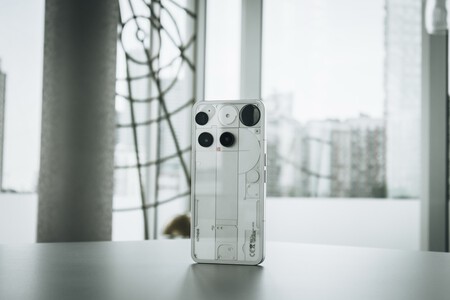
The Nothing Phone (3) stands out as one of the most unique phones in the industry. It’s important not only for being the cool, odd one in the high-end sector, but also signifies that Nothing is in a position to challenge big manufacturers. The Phone (3) unabashedly competes against devices priced close to 1,000 euros, and while this is commendable, it also places it at a significant disadvantage.
This is a well-designed phone with a great display, admirable performance, and a decent battery. However, it falls short in the crucial area that defines high-end devices: the camera. It is, unfortunately, common for phones under 1,000 euros to come closer to mid-range camera performance than what one would expect from a flagship experience.
I appreciated the telephoto lens and the versatility of the camera system, but it requires several updates before reaching the processing standard that a phone of this caliber deserves. If this does not present a significant handicap, this phone is wonderful. It’s enjoyable, fun, and will draw all possible attention.
8.2
Design
9.25
Display
8
Performance
8
Camera
7.5
Software
8.5
Battery
8
Pros
- The design is subjective, but its uniqueness, premium finish, and rear display function are amazing.
- The performance of the phone is excellent.
- The balance of the phone is commendable.
Cons
- The camera doesn’t live up to the standards of a true flagship.
- The AI approach from Nothing is very understated.
Image | Xataka
In Xataka | Nothing Phone (3) Pro Review: Looks Can Be Deceiving … even with the Nothing Phone
This device was loaned for testing by Nothing. You can consult how we conduct reviews at Xataka and our policy regarding relationships with companies.