

The Silent Leader: Huawei’s Quiet Expansion in the Tech World
Huawei, the Chinese tech behemoth, has long preferred to fly under the radar. Since the U.S. government imposed sanctions in 2019, limiting its access to key technologies, Huawei has adopted a more subdued narrative, opting for low-key operations while quietly expanding its influence in the tech landscape. Despite the challenges, Huawei has solidified its position as a critical player in global technology markets.
Ren Zhengfei: The Man Behind the Curtain
Founder of Huawei in 1987, Ren Zhengfei isn’t just the company’s CEO; he is often viewed as its spiritual leader. However, he perceives his role differently, likening himself to a “puppet leader.” He believes his influence is largely symbolic, emphasizing that his presence or absence would hardly affect Huawei’s realities. "Without me, the temple would seem empty, but the idol does nothing… My absence wouldn’t change much," he stated.
This self-effacing attitude is also reflected in his personal desires. Zhengfei harbors dreams of anonymity, hoping to enjoy a cup of coffee in peace without recognition. Known for his reserved persona, he has fostered a corporate culture that values discretion and modesty.
The Chip Challenge
One of the most revealing statements from Zhengfei came during an interview in the state media outlet People’s Daily. He acknowledged the adversity posed by U.S. sanctions, stating, "Our chips are a generation behind those of the U.S." This admittance highlights the ongoing challenges Huawei faces in the semiconductor domain, emphasizing the critical gaps in their technology stack.
While the U.S. sanctions limit Huawei’s progress, the company continues to invest heavily in research and development (R&D). Reports indicate that Huawei is now spending approximately $25 billion annually on R&D, striving to innovate and find alternate pathways in technology.
Humble Beginnings and Growth
Interestingly, Ren Zhengfei prefers to stay out of public attention. In 2000, he was allegedly the third-richest man in China but made attempts to avoid appearing on the list compiled by Forbes, even offering a factory tour to the list’s creator to ensure his omission. In a rare interview with Forbes in 2015, he reiterated his belief that the media often exaggerates Huawei’s achievements, stating, "We have many weaknesses."
Huawei is employee-owned, which slightly changes its corporate dynamics. Additionally, Ren’s connections with the People’s Liberation Army add layers of complexity to the company’s public perception, further necessitating a low profile amid rising geopolitical tensions.
Innovation in Silence
Despite its outward caution, Huawei is continuously advancing its technological capabilities. For instance, the CloudMatrix 384, equipped with 384 Ascend 910C GPUs, demonstrates Huawei’s strength in cluster computing. The CloudMatrix 384 competes directly with NVIDIA’s offerings, boasting superior interconnect speeds and significantly higher performance metrics, such as 300 PFLOPS of computing power. This innovation underscores Huawei’s potential to challenge established tech giants, even as it navigates external pressures.
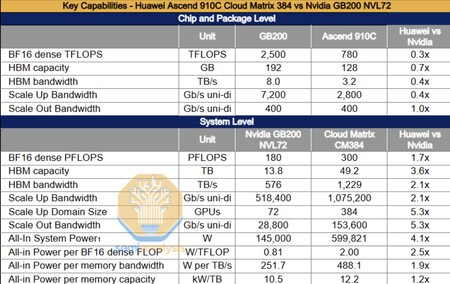
Critics may argue that Huawei’s chips are not as advanced as their competitors’, but evidence of their ongoing development and ambitious projects proves otherwise.
Challenges in Semiconductor Manufacturing
Recently, speculation arose surrounding the Kirin X90 chip being used in Huawei’s MateBook Fold, reportedly fabricated by SMIC (Semiconductor Manufacturing International Corp.). While initially rumored to use a 5nm node, it was later confirmed that the Kirin X90 operates on a 7nm node similar to previous models. Despite these setbacks, there are reports that SMIC is diligently working towards obtaining 5nm capabilities, indicating progress in the Chinese semiconductor industry amid strict sanctions.
The Big Picture: A Strategic Vision
Huawei’s strategy seems to involve patience and perseverance. While it may appear as a “wolf in sheep’s clothing,” analysts suggest that this deliberate strategy allows Huawei to bypass scrutiny while it continues to innovate without drawing unwanted attention. As Huawei focuses on long-term goals rather than short-term financial gains, its commitment to scaling operations is evident.
In a world where corporate visibility brings both pressure and scrutiny, Huawei’s quiet growth is noteworthy. Even as the tech landscape evolves, the company cautiously works behind the scenes, developing new technologies and strengthening its presence in a challenging global environment.
While the future remains uncertain due to geopolitical factors, Huawei’s silent yet determined approach suggests that it has plans to remain a key player in the ever-competitive tech landscape, regardless of the obstacles that lie ahead.