
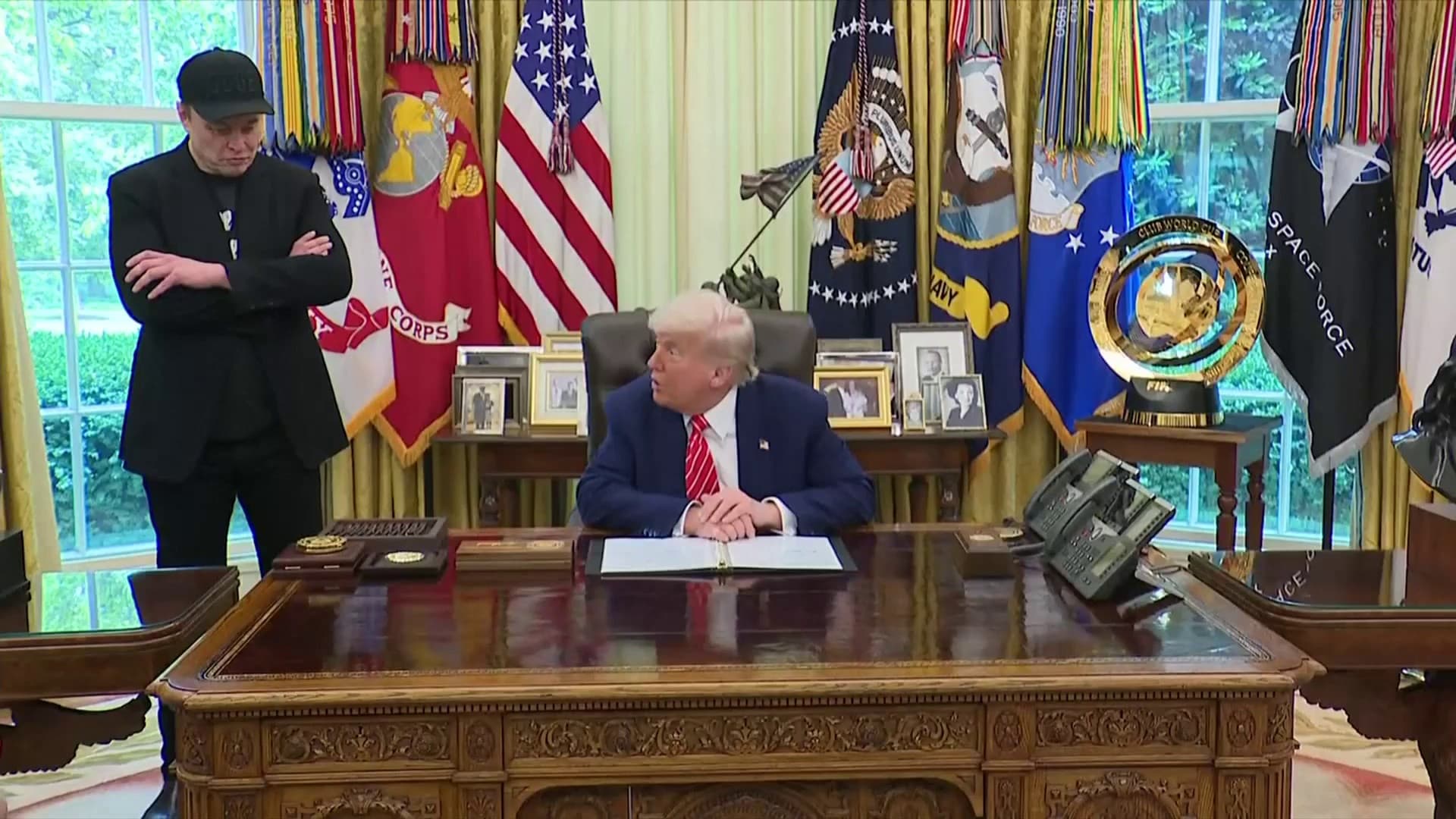
The discord between American President Donald Trump and SpaceX CEO Elon Musk poses a significant risk to both the aerospace industry and upcoming space missions. Musk’s rockets are crucial for transporting NASA astronauts to space, serving sensitive missions from the Pentagon , and are set to play a pivotal role in the highly-anticipated return of Americans to the Moon.
In recent years, Elon Musk has become an indispensable figure in the space sector, having been entrusted with numerous critical missions by Washington. However, the future of this partnership now hangs in the balance following an explosive fallout with Trump. This unprecedented rift has raised numerous questions about the implications for their collaborations.
The dispute escalated when both parties took to their respective social media platforms, resulting in Trump threatening to “cancel government subsidies and contracts” with Musk. In a dramatic retort, Musk countered that he would “decommission the Dragon spacecraft,” which NASA relies upon for manned missions, only to retract his statement hours later. This confrontation reveals the interdependence of the U.S. government and Musk’s private enterprise, stirring apprehensions among experts about the possible ramifications of their feud.
“A Bullet in the Foot”
Founded in 2002, SpaceX has rapidly established itself as a one-of-a-kind player in the space industry , excelling in both commercial and governmental endeavors. Its unmatched launch frequency and cost-efficiency have earned it billions of dollars in contracts with U.S. federal agencies for a variety of missions, including both scientific exploration and national security, such as hypersonic missile detection.
“If you take SpaceX out of the equation, there would be a massive disruption in NASA and Pentagon missions,” explains Clayton Swope from the Center for Strategic and International Studies (CSIS).
One of the immediate consequences of a potential split is that “the U.S. and its partners, including the European Space Agency , Japan , and Canada , would have to depend on Russia for transporting personnel to and from the International Space Station (ISS) ,” notes this space and defense specialist. Given the current geopolitical climate, this scenario would be less than ideal.
SpaceX’s Dragon capsule is currently the only U.S.-certified spacecraft for transporting astronauts. Its competitor, Boeing’s Starliner, has faced significant delays and failures during its test flights. Therefore, a definitive break with SpaceX would be a “catastrophic scenario” for both the U.S. government and Elon Musk, considering the astronomical sums at stake. According to Swope, “everyone is basically shooting themselves in the foot.”
General Disadvantage
Given these risks and shared dependencies, experts predict that Trump and Musk are likely to “overcome their differences and resume business.” Yet, the U.S. president, who values loyalty above all else, has demonstrated in recent months that he will not hesitate to leverage government powers against various institutions and corporations, as seen in his actions against Harvard University and Apple.
In a sign of a possible cooling relationship with SpaceX, NASA recently announced its intention to evaluate “the feasibility of a Starliner flight to the ISS in early 2026.” This public acknowledgment can be seen as a shift towards potential competitors like Blue Origin, another space venture launched by billionaire Jeff Bezos , thus escalating the rivalry within the private space sector.
“It might make people think twice about placing too much trust in these companies for sensitive operations,” analyzes Swope.
Laura Forczyk resonates with this sentiment, stating that the ongoing disputes could damage the broader space industry . She cautions against the potential reduction of Trump’s space ambitions, which could hinder NASA’s long-term plans that are already under crisis. With the agency threatened by significant budget cuts and lacking a confirmed administrator—after the withdrawal of Trump’s appointee, who was closely tied to Musk—the stakes could not be higher.
As the complex relationship between government and private enterprises in the space sector unfolds, the stakes are high for all parties involved. The consequences of this feud could shape not only the future of American space exploration but also the trajectory of the global aerospace industry.