
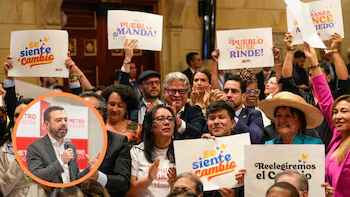
Historical Pact Declines Meeting with Bogotá Mayor on Criminal Policy
The ongoing discourse around criminal policy in Bogotá has stirred significant political tension. Mayor Carlos Fernando Galán recently proposed a critical meeting aimed at reshaping the city’s criminal justice framework, but the response from the Historical Pact bench has been clear: they will not attend.
Mayor Galán’s Proposal
Mayor Galán’s initiative seeks to revisit criminal policy, emphasizing the need for a more effective justice system. He articulated a pressing concern: “Of every 100 people we capture, 95 remain free.” This stark statistic underscores his call for a comprehensive reassessment of current strategies surrounding crime and justice within the city.
In his remarks, Galán pointed out a disconnect between governmental narratives and the realities faced by authorities on the ground. He criticized the romanticization of criminal behavior by national figures, urging a more pragmatic approach to law enforcement that prioritizes public safety, especially for vulnerable youth.
The Historical Pact’s Stance
Scheduled for March 16, 2026, the meeting aimed at discussing security measures was met with resistance from the Historical Pact. They issued a public statement reflecting their decision not to participate, citing the meeting’s closed nature as a pivotal reason:
“Our decision responds to the fact that said meeting was called as a closed-door space.”
The Historical Pact advocates for a more inclusive dialogue that incorporates voices from various sectors, including citizens and social organizations. Their argument centers on the belief that real conversations about security must be participatory and transparent.
Interpretations of the Meeting’s Purpose
The Historical Pact conveyed that attending the meeting could be misinterpreted as endorsing the current administration’s approach. They indicated that their presence might imply a legitimization of policies that, they argue, have frequently disregarded broader community input:
“Our presence…could be interpreted as a legitimization of an alleged willingness to negotiate that this administration has not demonstrated in reality.”
According to them, there has been a tendency for unilateral decision-making rather than collaborative engagement with various stakeholders in Bogotá.
Concerns Over Last-Minute Invitations
The Historical Pact has voiced concerns regarding last-minute invitations, framing them as impositions rather than invitations for genuine dialogue. They pointed to instances where their contributions to the District Development Plan were ignored, expressing frustration over a recurring pattern of neglect toward cooperative governance.
“Dialogue cannot be invoked at the last minute when the government practice has been, time and again, imposition,” they stated.
Vision for a Comprehensive Security Policy
Moving beyond immediate political disputes, the Historical Pact has articulated a vision for Bogotá that advocates for an expansive and democratic approach to security. They called for strategies focused on:
- Prevention and addressing social causes of violence
- Strengthening institutional responses
- Guaranteeing citizens’ rights and opportunities for youth
Their message emphasizes that Bogotá should not be bound by punitive frameworks but instead should strive towards holistic solutions that includes community input.
Openness to Dialogue
Despite their refusal to engage in the upcoming meeting, the Historical Pact remains open to future dialogues. They believe that a broader conversation could commence once election processes conclude, asserting the need for legitimacy and transparency in interactions with the public.
“We consider that this is a moment that requires prudence, institutional respect, and political responsibility,” they concluded.
In essence, the refusal of the Historical Pact to attend Mayor Galán’s meeting signals a deeper issue within Bogotá’s political climate—one that calls for genuinely collaborative efforts to address pressing security concerns in the capital.