
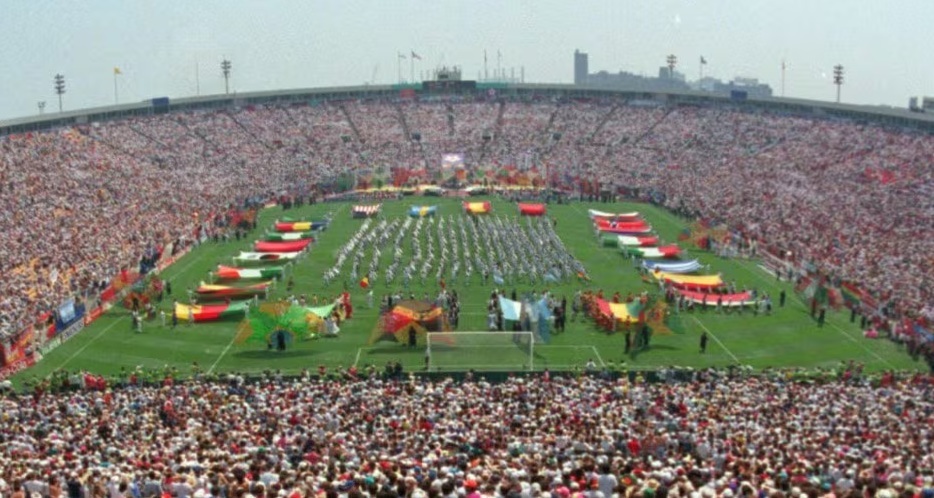
By the end of the last century, soccer had conquered nearly every corner of the globe, with notable exceptions like India, China, and the United States. In the latter country, Henry Kissinger, a former Secretary of Defense and later Secretary of State, dedicated his spare time—when he wasn’t brokering peace in the Middle East or orchestrating coups in Latin America—to promoting soccer in the United States. His efforts culminated in America hosting the 1994 World Cup, a feat accomplished against skepticism both domestically and abroad.
Kissinger’s Early Life and Love for Soccer
Kissinger was born in Fürth, Bavaria, in 1923, to a Jewish schoolteacher and a homemaker. The rise of Nazism forced the family to emigrate to the US when he was just 15. This new world presented new opportunities, but his childhood and early adolescence in Europe had already instilled in him a passion for soccer, which he described as “a complexity disguised as simplicity.” Throughout his political career, aides would regularly provide him with clippings of European soccer news, indicating his steadfast interest in the sport.
Attempts to Promote Soccer in the 1970s and 1980s
By the late 1970s, Kissinger was instrumental in the North American Soccer League (NASL), an ambitious yet somewhat artificial attempt to bring soccer into the American spotlight, featuring aging legends like Pelé, Beckenbauer, and Cruyff. Although the league enjoyed a brief flurry of popularity until 1984, it ultimately failed to secure long-lasting appeal. Nonetheless, it sparked an interest in soccer at schools and universities, particularly among elite youth, leading to the impressive growth of women’s soccer in the USA, where they have been world leaders for years.
The ‘Learning’ Experience of 1986
Kissinger attempted to secure the 1986 World Cup, which was initially awarded to Colombia. However, Colombia withdrew after facing unprecedented demands from FIFA, making it increasingly implausible to host the tournament. These demands included extensive stadium requirements and significant financial commitments. After Colombia’s withdrawal, Kissinger rallied support for the United States to bid for the event, competing against rivals such as Brazil and Mexico, which ultimately won the bid.
Reflecting on the political machinations surrounding the 1986 World Cup, Kissinger remarked, “The complications and conspiracies over the 1986 World Cup made me nostalgic for peace talks in the Middle East.” He later published an insightful article titled “Soccer and Attitudes,” discussing how each country plays soccer in accordance with its lifestyle and approach to warfare.
Success in 1994
Kissinger eventually succeeded in bringing the World Cup to the U.S. in 1994, overcoming stiff competition from Morocco and Brazil. FIFA President João Havelange supported this decision, believing the U.S. could offer lucrative sponsorships and marketing opportunities. Despite criticism from Europe and South America, and lukewarm enthusiasm in the U.S., Kissinger remained undeterred.
The tournament faced early skepticism; in fact, The Washington Post stated, “Soccer is a game that we teach our children until they are old enough to do something interesting.” Yet Kissinger took a hands-on role as the vice-chairman of the organizing committee, despite rumors suggesting he was the real power behind the scenes.
The Impact of the 1994 World Cup
In preparation for the World Cup, the United States needed a competitive team. Kissinger, taking advice from Beckenbauer, appointed Bora Milutinovic as head coach. Under Milutinovic’s guidance, the U.S. team gained valuable experience through various international matches, ultimately improving their chances in a tournament that featured 24 teams. The country held its first matches in aging NFL stadiums, which witnessed various spectacles—a stark contrast to the newly built or refurbished venues in 1990’s Italy.
Memorable Matches and Outcomes
The opening match on June 17 saw Germany, the reigning champion, face Bolivia amid a sensational police chase involving O.J. Simpson, which distracted many spectators. However, as the tournament progressed, interest steadily grew. The U.S. team managed to build momentum, even shocking fans with a win over Colombia, leading them to face Brazil in the knockout stage.
That U.S.-Brazil match attracted a staggering 86,016 spectators and shattered viewership records on ABC, signifying soccer’s newfound holding in American popular culture. Although Brazil won the game 1-0, the U.S. team’s performance was seen as respectable, accomplishing what the NASL failed to do.
Concluding Thoughts on Soccer’s Growth in the U.S.
The 1994 World Cup became a resounding success, attracting 3,587,538 fans over 52 matches, setting an average attendance record of 68,991. It marked a significant milestone in soccer’s journey in the United States. With Kissinger’s unwavering commitment, soccer began embedding itself into American sports culture. Since that World Cup, the U.S. has consistently qualified for subsequent tournaments, gearing up for another World Cup on home soil alongside Canada and Mexico.
While Kissinger’s hands may no longer guide American soccer, the momentum he helped create continues to resonate, shaping the future of the sport in the nation.