

The Energy Cost of Generative Artificial Intelligence
Generative artificial intelligence (AI) is revolutionizing the tech landscape, offering unprecedented capabilities across various sectors. Nevertheless, along with this innovation comes a significant energy demand . Google’s recent comprehensive analysis presents the energy consumption and environmental impacts associated with using its Gemini AI for the first time, bringing to light figures that offer both clarity and concern.
Let’s get straight to the facts. According to the Google Technical Report published in May 2025, an average text consultation using the Gemini AI consumes approximately 0.24 watts of electricity. To put this into perspective, it’s roughly equivalent to watching nine seconds of television on a standard 100 W TV.
Additionally, the report highlights that the water consumption required for cooling servers stands at 0.26 milliliters per consultation—equivalent to just five drops of water. The carbon footprint of the entire inference process is estimated at only 0.03 grams of CO2 equivalent .
Miscalculations Unveiled. Just a year prior, third-party analyses suggested that a single query made through the Google search engine could consume about 3 watt-hours (Wh), ten times more than a traditional search. This inflated estimate led to projections suggesting that deploying AI in search could use enough energy to charge seven electric cars per second .
With Google’s official data now available, we see that previous estimates were off by a staggering factor of 12.5 . Enhanced software techniques—such as speculative decoding —and more efficient model architectures like the Mixture-of-Experts approach have completely changed the landscape of energy consumption.
Inference versus Training. The figures provided are the most precise to date, focusing solely on Gemini’s consumption during the inference stage, which relates to user interactions. The much more energy-intensive process of training the expansive language models that power these systems remains undisclosed. However, Google argues that the widespread adoption of generative AI, even within its search engine, has drawn focus toward inference.
In the realm of user interaction, tech companies are making significant efficiency strides . Google reports that in the last year, energy consumption has reduced by 33 times , while the carbon footprint of each Gemini consultation has decreased by 44 times . This decrease can be attributed not only to more efficient models but also to improvements in their AI hardware—specifically, TPUs and GPUs that Google manufactures internally.
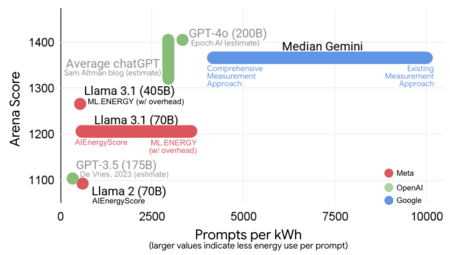
The amount of prompts processed per kWh by different AI models
Comparative Analysis. Google is not the only entity shedding light on energy consumption; Sam Altman , CEO of OpenAI, also provided insights on the energy used by ChatGPT. In a June 2025 publication, Altman stated that a typical ChatGPT query consumes approximately 0.34 Wh of energy and about 0.3 ml of water .
Although this figure is slightly higher than Gemini’s energy consumption, a direct comparison is challenging due to Altman’s lack of methodological detail. We still do not know if his calculations account for all variables considered by Google, such as electricity used for cooling systems and idle machinery that needs to be prepared for quick surges in demand.
Both companies draw analogies with television energy consumption : “An hour of Netflix uses 100 times more electricity than ChatGPT,” says a presentation from OpenAI. It also claims that the total impact of AI on U.S. carbon emissions is approximately 0.5% .
Images | Google
In conclusion, understanding the energy consumption associated with generative AI is crucial as its use continues to expand across various industries. While Google’s data points to significant efficiency improvements, the broader implications of energy use and environmental impact remain areas of keen interest and scrutiny.