
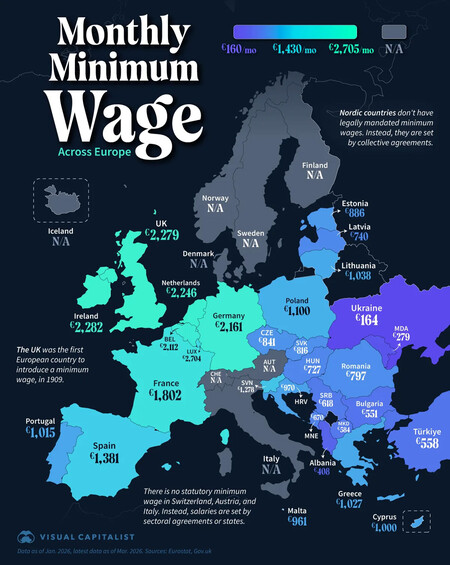
There is something that draws powerful attention when examining the minimum wage in all European countries: the disparity is not just a crack; it’s an abyss.
Two workers on the same continent, working the same day, can end the month with vastly different paychecks. Eurostat’s data from 2026 confirms this staggering reality.
The portal Visual Capitalist has compiled these figures into a map, making it easy to visualize the Minimum Interprofessional Wage across Europe, highlighting the continent’s salary and economic variety.
What is the Minimum Wage and Why Does it Matter?
The minimum wage is the legal lowest remuneration that an employer can pay workers. This law aims to ensure employees receive a decent standard of living, preventing labor exploitation. According to the European Labor Authority (EURES), the minimum wage plays a crucial role in reducing economic inequality and boosting domestic consumption, as lower-paid workers tend to spend a more significant share of their income.
Different countries have various approaches to establishing minimum wages. For example, Austria, Denmark, Finland, Italy, and Sweden do not have national minimum wages, relying instead on collective bargaining between unions and employers.
Switzerland, too, lacks a federal minimum wage, with each canton determining its own rate. In Geneva, for instance, the minimum wage in 2024 was around 4,640 euros per month. However, given that rent in Geneva can range from 1,580 to 2,630 euros and mandatory health insurance costs over 370 euros per adult, a significant portion of this salary vanishes into fixed expenses. This contrasts sharply with other European countries where these basic costs might be more manageable.
The Cost of Living Factor
When comparing minimum wage figures across countries, it’s vital to consider the cost of living. For example, a salary of 1,139 euros in Poland can equate to over 1,800 euros in purchasing power in higher-cost countries like Germany or France.
Those Who Earn the Most: Western Europe at the Forefront
Inside the European Union, Luxembourg boasts the highest minimum wage at 2,704 euros per month, followed by Ireland at 2,391 euros, Germany at 2,343 euros, and the Netherlands at 2,295 euros.
For non-EU neighbors, the United Kingdom has a minimum wage dependent on age, with workers over 21 earning 12.71 pounds per hour (approximately 15.20 euros), translating to about 2,279 euros monthly for a typical 37.5-hour workweek.
Eastern Europe: Struggling Economies
In contrast, the eastern half of Europe features significantly lower minimum wages, with Bulgaria holding the record as the EU country with the lowest rate at 551 euros per month. This is followed by Hungary at 727 euros, Latvia at 740 euros, and Romania at 797 euros.
The wage gap between Luxembourg and Bulgaria is drastic, exceeding 2,150 euros despite both countries sharing the same currency and single market.
Outside the EU, Ukraine sets an alarming record with a minimum wage of just 164 euros per month according to Eurostat, meaning that a minimum wage worker in Luxembourg earns more than 16 times that of a worker in Ukraine.
Spain: A Reflection of Low Salaries
In Spain, the latest minimum wage increase occurred in February 2026, resulting in a gross salary of 1,221 euros per month in 14 payments (or 1,424.50 euros gross across 12 payments). This places Spain in the tenth position in Europe, trailing behind France’s 1,802 euros and just ahead of Slovenia’s 1,278 euros.
Spain has significantly upped its minimum wage, raising it from 735 euros in 2018 to 1,381 euros by 2025, according to Eurostat data.
However, the problem arises as the minimum wage has become the most common salary in Spain, straying from its intended role as a floor for lower-skilled jobs. The latest hikes in the minimum wage have mainly boosted the lowest salaries, creating a salary pyramid with an excessively wide base and stagnant intermediate pay.
As the European landscape continues to evolve, addressing the disparities in minimum wages becomes increasingly crucial for equitable economic growth across nations.