
Apple M5: A Revolutionary Leap in Chip Technology
It was “sung” that Apple would present its new Apple M5 sooner rather than later, and we already have it with us. The chip represents a notable qualitative leap judging by its specification sheet, and there are improvements in all sections. The real surprise lies in its GPU, which is significantly more powerful and is clearly prepared to handle AI models in a much more efficient way.
Apple M5. Apple’s new System on Chip (SoC) employs third-generation 3nm photolithography. While there are no drastic changes in the manufacturing process, which is more efficient and reliable, the enhancements in the chip are remarkable across the board. The CPU now consists of six high-efficiency cores and four high-performance cores. As Apple claims, this CPU offers a 15% boost in multicore performance compared to the M4.
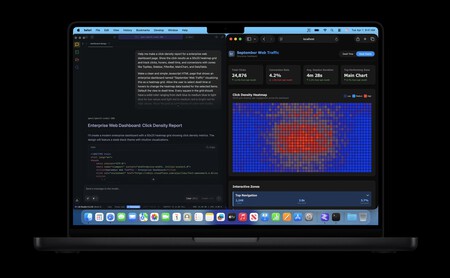
Working with local AI models thanks to apps like LM Studio is now much more feasible with the Apple M5.
A GPU with Incredible Potential for AI. If there is a standout feature in this SoC, it is the GPU, which now has 10 cores, each equipped with a Neural Accelerator. According to Apple, this allows AI workloads to execute “dramatically faster,” boasting performance that is more than four times that of the Apple M4. Additionally, the unified memory bandwidth has improved by 30%, reaching an impressive 153 GB/s, which is particularly crucial when working with AI models locally. Although configurations can accommodate up to 32 GB of unified memory, it is expected that we will see an M5 Pro and an M5 Max with more memory options in the future.
Enhanced Gaming Experience. The improvements in the GPU are not solely for AI; there are notable advancements for gaming as well. Graphics performance has seen an increase of up to 45% over the M4 GPUs, along with the introduction of third-generation ray tracing technology. This enhancement makes the M5 an exciting option for gamers eager for enhanced performance.
A Strengthened Neural Engine. The new Neural Engine now has 16 cores that blend efficiency with performance. This upgrade enables devices like the new Vision Pro, which also incorporates this chip, to quickly transform 2D photos into spatial images in the Photos application.

Ready for the Future of Apple Intelligence. While Apple’s AI capabilities may not currently be noteworthy, the company is evidently equipping its devices for a future where running AI models locally and privately becomes standard. The recent launch of the iPhone 17 further underscores this trend, featuring the A19/A19 Pro chips, and the M5 seems to follow the same trajectory, focusing intently on AI functionalities.
Anticipating M5 Pro/Max/Ultra? The initial products utilizing the M5 chip have already hit the market, including the new 14-inch MacBook Pro, the iPad Pro, and the Vision Pro (2025). It is reasonable to expect that Apple will soon introduce more powerful versions of the M5, as has been its pattern in previous generations.
- Last year, Apple launched the Apple M4 in May, followed by the M4 Pro/Max in late October. This means only a five-month interval.
- In the case of the M3 generation, the M3, M3 Pro, and M3 Max were launched in October 2023, with the M3 Ultra appearing much later, in March 2025.
While the M4 has yet to see an Ultra variant, Apple may replicate its past approach with the M3s. If history repeats itself, we could see the M5 Pro/Max announced in February or early March, with a potential M4 Ultra emerging around the same time, despite rumors indicating a later release in mid-2026.
Future Devices on the Horizon. In the meantime, consumers can begin enjoying devices that feature the M5 chip. Apple is expected to introduce additional products equipped with the M5 in mid-2026, including updates for the Mac mini, iMac, Mac Studio, and MacBook Pro with M5 Pro/Max configurations.
The Apple M5 marks a significant step forward in chip technology, emphasizing the company’s intent to dominate both the AI and gaming markets. With improved performance metrics, enhanced graphics capabilities, and a focus on local AI processing, it is clear that Apple is not simply keeping pace with competitors, but is setting a new standard in technology.