
Collision of Iryo and Alvia Trains in Adamuz
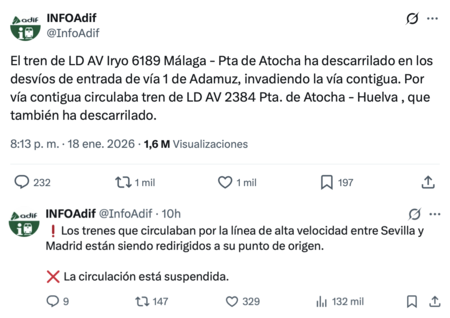
On January 18, 2026, at 7:40 p.m., a catastrophic collision between an Iryo train and an Alvia train occurred in Adamuz, Córdoba. This incident marks one of the most severe railway accidents in Spain since the infamous Santiago de Compostela derailment, known as the A Grandeira curve. The ongoing rescue operations have confirmed 39 fatalities, with the number likely to change as investigations continue.
The Incident Details
The accident unfolded shortly after 6:40 p.m., when an Iryo train departed Malaga heading to Madrid. After passing through Adamuz, the train derailed on a straight section of the track, affecting the last three cars. Moments later, an Alvia train traveling from Madrid to Huelva collided with the derailed Iryo cars. The force of the impact caused the Alvia train to be knocked off the track, ultimately ending up at the base of an embankment. Emergency services were deployed promptly, setting up operations 800 meters from the scene.
The Casualties
According to emergency service reports from EFE, the incident resulted in 39 confirmed deaths and 73 individuals requiring hospitalization, with 25 suffering serious injuries. Additionally, 173 passengers sustained minor injuries. The total number of passengers included approximately 100 on the Alvia and 317 on the Iryo train, emphasizing the scale of the tragedy.
In response to the accident, Renfe has established a dedicated helpline for affected families: 900 10 10 20. Both Iryo and Renfe have created support spaces at various major stations, including Atocha, Seville, and Córdoba, to assist families during this challenging time.
Emergency Response
The regional and municipal emergency services mobilized quickly, supplemented by the Junta de Andalucía, which dispatched 16 forensic experts. Furthermore, the Military Emergency Unit (UME) sent 37 soldiers and 15 vehicles for additional support.
Investigation Status
Currently, the specifics surrounding the cause of the collision remain ambiguous. Transport Minister Óscar Puente described the incident as “rare and difficult to explain.” Investigators are working to determine why the Iryo train derailed on a straight track. Early reports suggest that while the Iryo was slowing down, the Alvia was traveling at a speed of around 200 km/h.
The railway infrastructure had recently undergone a substantial renovation, costing approximately 700 million euros, completed just months prior in May. Investigators are also examining the relatively new design of the Iryo train, which has been operational in Spain since 2022.
About the Trains Involved
Iryo trains, operated by an Italian company backed by Air Nostrum, Globalvía, and Trenitalia, utilize Hitachi ETR1000 cars, renowned for their advanced technology and capacity to reach speeds of up to 300 km/h in Spain. The Alvia train, from Renfe’s 120 series, is designed for variable gauge capacity and can travel at a maximum speed of 220 km/h on Iberian gauge tracks. At the time of the accident, it was speculated that the Alvia was running at approximately 200 km/h.
Service Disruptions
In the aftermath, traffic on the southern high-speed corridor has been halted indefinitely, affecting routes between Madrid, Córdoba, Seville, Málaga, Huelva, Cádiz, Algeciras, and Granada. Passengers are advised to claim refunds for canceled services.
For further updates, please refer to the respective rail service providers.