
Although it is immersed in a deep crisis of competitiveness, it is no secret that The automobile industry is one of the driving forces of the European Union. Responsible for approximately 8% of its GDP and employing around 13 million people, the industry showcases both direct and indirect job creation. However, the geographical distribution of factories across the EU reveals significant disparities. Understanding these dynamics is crucial for grasping which countries truly steer the industry’s momentum.
The European Automobile Manufacturers Association has developed an interactive map that illustrates this distribution in both quantitative and qualitative terms. For those particularly interested in passenger cars, a more focused map provided by World Wide Mobility proves useful. While traditional maps can be overwhelming due to dense iconography, this particular resource clarifies production volumes and the market share of different brands.
Which Countries Are the Engines of Europe in the Automobile Industry?
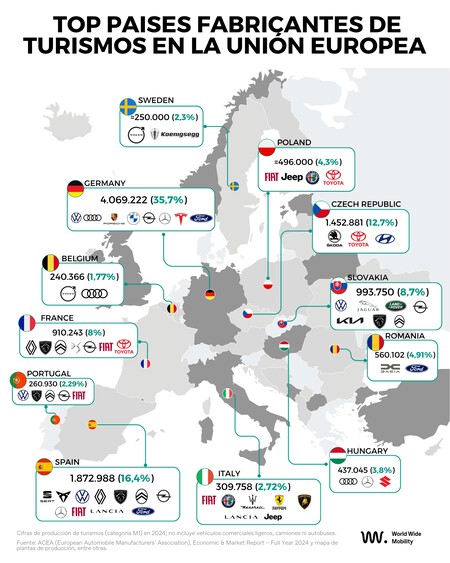
The data on the map from 2024 reveals that the European Union produced 11.4 million passenger cars, predominantly concentrated in three countries: Germany, Spain, and the Czech Republic.
World Wide Mobility
Germany: The Titan of Automotive Production
Leading the charge is Germany, which produces over four million passenger cars annually, representing a substantial 35.7% of the EU’s total output. This country boasts a dense network of advanced manufacturing facilities. Major brands such as Volkswagen, BMW, Mercedes-Benz, and Audi dominate the landscape, augmented by foreign manufacturers like Ford and Tesla, both operating factories within Germany.
Spain: The Silver Medalist
Following Germany, Spain stands out with a 16.4% share, nearly equating to two million cars assembled. Despite having fewer native brands, Spain serves as a strategic hub for foreign carmakers. Notable production sites include SEAT/Cupra in Martorell, Volkswagen in Navarra, and various plants owned by Stellantis and Renault. An exciting prospect is the reactivation of an old Nissan facility for the Chery/Ebro electric vehicle.
The Czech Republic: Central Europe’s Automotive Hub
Taking the third spot is the Czech Republic, producing 1.5 million cars, which is 12.7% of the EU’s total. Together with Slovakia, which ranks fourth, these countries are often referred to as “the Detroit of Central Europe.” Their automotive boom is largely fueled by the presence of brands like Škoda, Hyundai, and Toyota, indicating a vibrant production environment.
The Role of Slovakia and Other European Players
Slovakia, with the highest car production per capita globally, manufactures premium large SUVs for the Volkswagen group and engages in producing vehicles for Kia and Jaguar Land Rover. Below the Czech Republic, Romania and Hungary further illustrate the strength of Central Europe in automotive manufacturing.
France: A Legacy of Automotive Excellence
France merits a special mention, housing famous brands like Renault while still engaging in production for brands like Stellantis and Fiat. Despite historical shifts in manufacturing locations, the French automobile industry remains robust. Italy and Sweden continue to thrive in the luxury vehicle market, with iconic manufacturers such as Ferrari and Koenigsegg adding flair to the European automotive landscape.
As revealed by the data, the European automobile industry signifies not just a pivotal economic sector, but also an enduring cultural touchstone across the continent. By understanding the geographical and industrial nuances, one can appreciate how these countries drive Europe’s automotive engine.