
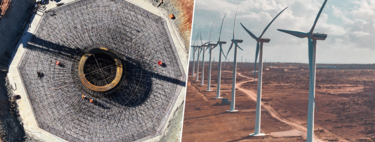
In the picturesque parish of Pentes , nestled within the Ourense municipality of A Gudiña , earth movers have begun their work as the Swedish mining company Eurobattery Minerals AB sets its sights on extracting tungsten—a crucial resource for Europe’s energy and technological transition. By doing so, Galicia joins a select group of regions across the continent where the active exploitation of this critical mineral is taking place. This marks a significant step toward bolstering the region’s economic prospects and Germany’s industrial capability.
A strategic mine for Europe. Under its Galician subsidiary, Tungsten San Juan , Eurobattery Minerals has rolled out its ambitious San Juan project . The company is also gearing up to apply for the second round of Strategic Projects under the European Regulation of Critical Raw Materials (CRMA) , set to open in January 2026. This strategic move aims not only to bolster local economies but also to sustain European industry with home-grown resources.
Initial earthworks and the construction of a service warehouse have already taken shape, as reported by the Vigo Lighthouse . Once operational at full capacity, this will be Spain’s second active tungsten mine, following the established site in Barruecopardo , Salamanca . The San Juan project represents a pivotal point in Spain’s mining sector and EU’s ambitions to establish a sustainable supply chain for critical minerals.
More in depth. The San Juan project is designed to be an open-pit mine , aiming to supply tungsten for Europe’s evolving industrial ecosystem. The company has initiated construction on a pilot plant utilizing gravimetric technology while estimating the reserves to be around 60,000 tons of ore at a grade of 1.3% WO₃ . Although these figures may seem modest globally, they hold considerable significance for Europe, a continent eager to lessen its reliance on Chinese imports of this strategic metal.
It has not been a short road. The road to this point began in 2016, featuring geological studies, environmental surveys, and construction of access routes, all under the watchful eye of the Xunta de Galicia . “Our goal is to produce tungsten responsibly and efficiently within Europe,” explained Agne Ahlenius , the general director of Tungsten San Juan and a former head of the Barruecopardo mine. “This project reinforces Galicia’s and Spain’s role in the European supply chain of critical raw materials.”
The metal that supports the energy transition. Few materials carry as much strategic value as tungsten . Known for its density, durability, and exceptional melting point, it is vital for modern industries ranging from wind turbines to semiconductors and electric vehicles . Yet, this seemingly marvelous metal comes with geopolitical complexities. China currently dominates more than 80% of tungsten production and has restricted its exports recently, leading to skyrocketing prices and heightened market uncertainty.
To combat this dependency, the European Union has launched the Critical Raw Materials Act (CRMA) , designed to secure access to such minerals within European borders. According to the European Commission, these initiatives seek not just economic stability, but also independence from external sources, thereby reducing vulnerability to geopolitical strains.
Spain, a mining window. The commencement of the San Juan project reflects a larger trend: the revival of Spain’s mining potential. The country boasts promising resources including copper, tungsten, vanadium , graphite, and cobalt, along with emerging deposits of rare earths in Extremadura and Gran Canaria .
The EU has set specific targets. By 2030 , at least 10% of critical minerals must be extracted within Europe, 40% processed on EU soil, and 15% sourced from recycling efforts. Additionally, no single country should account for more than 65% of supply. Spain stands poised to be a valuable player in this framework, with regions like Galicia , Castilla y León , Andalusia , and Extremadura positioned as key contributors to Europe’s new industrial landscape.
European autonomy is in Galicia. The rumble of excavators in A Gudiña not only signifies the launch of a new mine but also symbolizes a broader transition. Europe is striving to shift away from decades of dependence, aiming for a more sovereign and sustainable industrial economy. From this Galician hillside, the small tungsten mine at Pentes may play a crucial role in reshaping Europe’s energy and technological landscape.
As the plans unfold and the project progresses, the San Juan endeavor represents a turning point for both the region and the European mining sector. This small mining operation has the potential to significantly impact Europe’s effort to secure its resource supply and independence, establishing a new paradigm in the energy transition narrative.
Image | Unsplash