
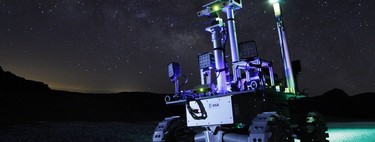
A Breakthrough in Astronomy: The Artificial Solar Eclipse by Proba-3
For the first time in history , two satellites have successfully maneuvered into a perfect formation to create an artificial solar eclipse in Earth’s orbit. This unprecedented advancement offers images of the Sun’s corona with a level of detail that natural solar eclipses seldom provide.
The images from the artificial eclipse are astonishing. The European Space Agency (ESA) has just released the first photos from the Proba-3 mission , marking the culmination of a decade-long project aimed at validating new precision flight technologies.
The vital advantage of Proba-3 is its ability to generate these artificial eclipses for up to six hours during each 19.6-hour orbit. In contrast, a natural solar eclipse occurs only a couple of times a year and lasts just a few minutes. This continuous observation capability opens a new window for unraveling some of the Sun’s secrets.
Spain’s Role in Proba-3. The mission, costing €200 million, involves the participation of 29 companies from 14 different countries , with Spain playing a significant role. Spain contributed 40% of the budget and key technologies through Sener , GMV (which is responsible for the software and flight algorithms), and Airbus Defence and Space in Spain. This collaboration highlights Spain’s expanding influence in space technology .
Two Synced Satellites. The mission consists of two spacecraft: the Occulter and the Coronagraph . In March, they achieved what no previous mission has done: autonomously flying exactly 150 meters apart , maintaining this formation with millimeter precision for hours. To put this in perspective, it is akin to two cars on a highway maintaining a fixed distance with the precision of a human fingernail , all while in an elliptical orbit extending up to 60,000 km from Earth . As they fly in this perfect formation, they align with the Sun.
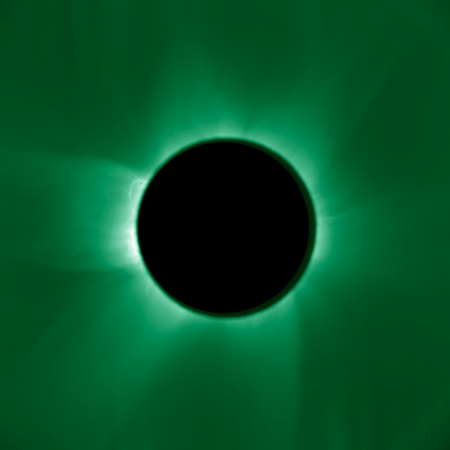
What We Are Seeing in These Photos. To capture these images, the Occulter , equipped with a 1.4-meter diameter disk , blocks the Sun’s direct light, projecting a shadow of only 8 centimeters onto the optical instrument of the second satellite, the Coronagraph . When the 5 cm opening of its telescope (known as ASPIICS ) is covered by this tiny shadow, it can photograph the solar corona without being dazzled. This process is similar to what occurs during a total solar eclipse, but allows for observing the Sun’s atmosphere for hours .
The Purpose of Tailored Eclipses. Understanding solar mysteries drives our interest in these eclipses. The first question is why the solar corona (which reaches temperatures of one million degrees Celsius ) is much hotter than the Sun’s surface (which is around 5,500 °C ). This phenomenon, known as thermal inversion, is one of astrophysics’ greatest puzzles , and Proba-3’s close observation capabilities will provide crucial data to address this enigma.
The second mystery revolves around the formation of solar storms that pose threats to our technology. The corona serves as the cradle for solar wind and coronal mass ejections , massive bursts of particles the Sun expels into space. While these events contribute to beautiful auroras , they can also wreak havoc on satellites, transformers, and other electrical devices on Earth.
A Resounding Success. The success of Proba-3 lies not just in the scientific images produced, but also in demonstrating that precision formation flying is indeed possible. This success paves the way for future missions that could feature giant virtual telescopes , composed of multiple spacecraft working as one. The next milestone is to achieve total autonomy , allowing the system to operate with such confidence that it will need no routine monitoring from Earth.
Images | ESA
In Xataka | We have two hours to protect the electrical grid from an extreme solar storm. The May auroras proved this.