
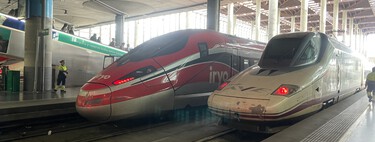
There are investments and investments. More or less necessary. More or less large. But there are also more or less viable ones. And, of course, the Ministry of Transport considers that the European Commission’s proposal to change all roads from Iberian gauge to international gauge is anything but viable. And they have a good reason: 30,000 million euros.
What Does Europe Want?
In October 2025, the European Commission presented its project to cement, once and for all, the connection between Madrid and Lisbon with high-speed trains. After many delays, if the plans are fulfilled, both cities could be united by a single train by 2030, effectively arriving two decades late in terms of high-speed rail implementation.
The proposal highlights the necessity of integrating the Lisbon–Madrid high-speed rail connection into the broader high-speed network encompassing Spain and France. It emphasizes adopting the European standard nominal gauge of 1,435 mm as a crucial step. This integration is intended to boost the competitiveness of long-distance passenger traffic while reinforcing the cross-border dimension of the connection.
Spain’s Clear Response
The answer from Spain is clear and unequivocal: no. According to The Country, internal documents from the Ministry of Transportation reveal that the government is firmly opposed to migrating the railway network to the international gauge due to a projected cost of 30,000 million euros and potential construction timelines stretching to 30 years.
Spain’s Ministry of Transportation communicated that all options to adapt the railway networks have been deemed non-viable, whether in full or in part. This includes the consideration of a mixed width system, which was also ruled out for its complexity and elevated maintenance costs.
The Track Width Dilemma
Since the 19th century, Spain has existed in an Iberian exceptionalism alongside Portugal. Unlike much of Europe, which adopted the standard gauge of 1,435 mm, Spain opted for a wider track of 1,672 mm. This decision was based on the belief that a wider track allows for more powerful locomotives, a critical advantage in Spain’s mountainous terrain.
Consequences of the Decision
The ramifications of this gauge divergence were felt almost immediately. As early as the mid-19th century, Portugal expressed concern to Spain about the potential isolation from Europe due to Spain’s unique rail decision. The issue was compounded for Portugal, given its reliance on Spanish infrastructure.
Today, Spain operates a complex railway system that includes three different gauges: the international gauge used for approximately 4,000 km of high-speed rail, the Iberian gauge responsible for 13,000 km of local services, and the metric width used in topographically challenging areas.
Operational Advantages for Renfe
The existing gauge discrepancies may pose challenges, yet they also create unique operational advantages for Renfe, Spain’s state-owned railway company. Only Renfe can operate trains capable of traversing the different gauge tracks, effectively eliminating competition in specific routes like Madrid to Galicia.
The ongoing development of the Madrid-Lisbon route aims to unify rail connections, but the Portuguese high-speed line operating on an Iberian gauge complicates matters. This scenario places Renfe in a favorable position, as it remains the only operator that can directly connect Madrid and Porto without necessitating a transfer.
Future Perspectives
With the significant financial implications of switching to an international gauge, ongoing investment focus seems to favor enhancing Renfe’s capabilities in the Iberian gauge system. There is growing potential for Renfe to solidify its foothold not just in Spain but also in the Portuguese market.
As Renfe prepares to convert fixed-gauge trains into variable-gauge models, the outlook for regional rail connections is shaping up to harness these unique national gauges strategically.
Photo | Falk2