

A Cosmic Showcase: August 12, 2026
The solar eclipse happening on August 12, 2026, promises to be an extraordinary event for astronomy enthusiasts. This eclipse is not a standalone spectacle; it coincides with the peak of the Perseid meteor shower and a remarkable planetary alignment. As dawn breaks on the day of the eclipse, enthusiasts can look forward to witnessing the planets Mercury, Mars, Jupiter, Saturn, Uranus, and Neptune lined up in the sky. While not all of these planets will be visible to the naked eye, those equipped with telescopes and binoculars can indulge in this celestial marvel.
Observing the Eclipse: West to East
The solar eclipse will occur close to sunset, making it vital to find a vantage point in the west, where the Sun will be dipping toward the horizon, still partially obscured. To catch the breathtaking planetary alignment the following morning, however, viewers will need to turn their gaze toward the east, where the planets will rise alongside the Sun.
Planetary Alignment: What to Expect
For those hoping to spot planets, Mars, Saturn, and Mercury are expected to be the easiest to observe with the naked eye. Jupiter will shine brightly but may be difficult to see due to its low position on the horizon, which could be obscured by the Sun’s light. Neptune and Uranus, on the other hand, will likely require binoculars or telescopes for their visibility. Fortunately, numerous public sky-watching events will coincide with the eclipse, providing opportunities to use telescopes and possibly catch a glimpse of these distant worlds.
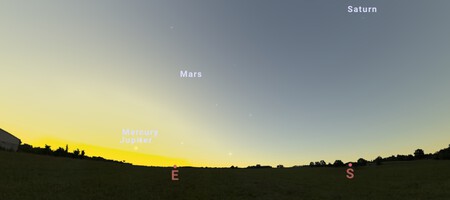
Neptune and Uranus are in the alignment, but will not be seen with the naked eye.
Perseids Meteor Shower
On the same night as the eclipse, the Perseids will peak, providing a dazzling display of meteors. However, during the brief period of totality, darkness may not allow for an adequate adjustment of the eyes to catch sight of any shooting stars. Nevertheless, as night turns to dawn, enthusiasts can continue their celestial observations, enjoying the Perseids as they light up the sky. Some towns, including Borobia in Soria, are organizing events with activities centered around the eclipse that also include meteor observation.
Making the Most of August 12
If you plan to watch the Perseids throughout the night, it may just be the ideal conclusion to the celestial events of August 12. This date is certainly worthy of a spot on every astronomy fan’s calendar. For those who might not usually have an interest in astronomy, this day may ignite a passion for the wonders of the night sky.