
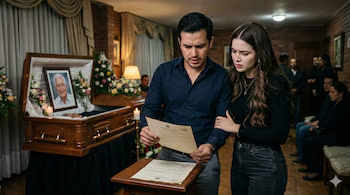
The death of a loved one often brings sorrow and also complications regarding inheritance, particularly in families where one child has taken care of the parents. This situation poses the question: does the child who provided care have a greater right to inherit? In Mexico, this issue is governed by specific legal principles.
Equal Shares in Inheritance
Under Mexican law, when a person dies without a will, all children are entitled to inherit equal shares of the estate, regardless of who took on caregiving responsibilities or paid family expenses. The Supreme Court of Justice of the Nation (SCJN) consistently upholds the principle of equality among heirs in its decisions, as mandated by both federal law and state civil codes.
This legal framework often leads to familial tensions, particularly when one child feels their personal and financial sacrifices should lead to a more substantial inheritance, especially concerning the family home.
The Caregiver Child’s Legal Standing
Mexican law does not provide automatic recognition of rights for the child who acted as a caregiver. Unless explicitly mentioned in a will, there is no legal requirement to allocate a larger share of the inheritance to this child. The distribution follows either the terms outlined in a valid will or, in its absence, the established rules of legitimate succession.
The deceased is allowed to distribute their assets according to their wishes, provided they respect the legitimate shares of forced heirs, typically their children and spouse.
Inheritance Without a Will
According to the Federal Civil Code, if someone passes away without a will, children inherit the estate equally. This ruling includes all assets, with the family home often being the most significant. Actions taken by a child, such as paying property taxes or covering medical expenses, do not grant them a greater claim over the estate.
During the inheritance process, claims for reimbursable expenses can be included as debts against the estate. However, these expenses do not alter how the estate’s assets are divided among the heirs.
Conditions for a Caregiver Child to Inherit More
A child can receive a larger inheritance share only if the deceased parents stated this clearly in a legally valid will or a formal agreement. Unfortunately, data from the National Autonomous University of Mexico (UNAM) suggests that only about 8% of older adults formalize a will, and less than 1% include specific directives regarding major assets.
Experts recommend that families address these concerns in advance by drafting a will, ensuring that their wishes are honored and reducing potential disputes among heirs.
The Obligation to Care for Elderly Parents
Mexican legislation stipulates that all children are obligated to care for their elderly parents, particularly when the parents can no longer care for themselves, according to Article 301 of the Federal Civil Code and the Law on the Rights of Older Persons.
This obligation not only covers necessities such as food but also extends to housing, clothing, medical care, and medications. Furthermore, this care duty is reciprocal; just as parents support their children, adult children are expected to assist their aging parents based on their economic capabilities and the nature of their dependency.