
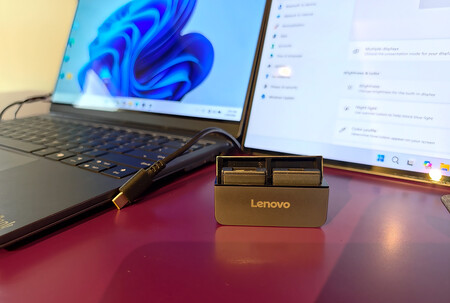
The MWC hasn’t started yet, but the Lenovo ThinkBook Modular AI PC has already generated considerable buzz. This innovative device embodies modular technology by allowing users to disassemble it into pieces, making it easy to update and customize as needed. Its all-in-one design adds to its allure, positioning it as a versatile tool in Lenovo’s lineup.
Lenovo has unveiled a range of updates for its Yoga, ThinkPad, Legion, and ThinkBook families of laptops and tablets. Among these upgrades, the standout feature is its modular design, which enables users to expand their workspace simply by separating various components.
Lenovo ThinkBook Modular AI PC Data Sheet
Lenovo ThinkBook Modular AI PC Concept | |
|---|---|
SCREEN | 2x 14-inch 16:10 OLED panels Resolution: 3,840 x 2,400 pixels 120Hz refresh 500 nits Touch screen |
DIMENSIONS AND WEIGHT | 313 x 233 x 16-23.9 mm 1.15 kg (single screen) 1.41 kg (dual screen) |
PROCESSOR | Intel Core Ultra 7 255H |
GRAPHIC CARD | Intel Integrated |
RAM | 32GB |
STORAGE | 1TB M.2 PCIe SSD |
CAMERA | 8MP |
BATTERY | 33Wh |
OPERATING SYSTEM | Windows 11 |
CONNECTIVITY | Wi-Fi 7 |
PORTS | 1x USB-C 2x USB-A 1x HDMI 2x Magic Bay Pogo Pin 1x Audio combo jack |
OTHERS | Harman Kardon 2+2 Speakers 4 microphone array Dolby Atmos Smart Amplifier Color: Moon Gray |
PRICE | Unspecified |
A Compact Laptop that Disassembles into Modules
During the presentation, I was astonished by the laptop’s modularity. Initially, it resembles a standard ThinkBook device but unfolds to reveal a secondary screen that attaches to the back of the main display. This design enables dual projection capabilities, perfect for collaborative tasks or gaming sessions.
Lenovo has ingeniously created a double workspace. The secondary screen can be positioned with a magnetic leg, and both screens are touch-sensitive and configurable to extend or duplicate the workspace.
The modularity extends to the detachable keyboard, allowing users to type remotely while projecting content on the screens. Furthermore, additional ports can be added or swapped as needed, enhancing the versatility of the ThinkBook Modular AI PC.
Dozens of Uses for a Single Device
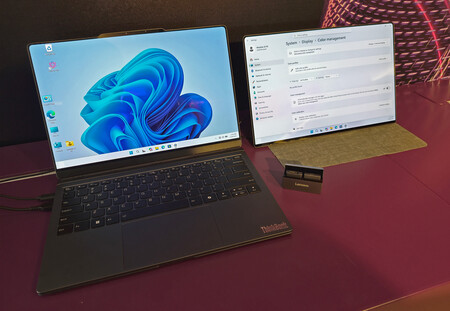
Disassembling the device reveals a myriad of formats based on its modular mechanics:
- Traditional laptop with touch screen.
- Laptop with front and rear touch screen.
- Laptop with secondary screen in parallel.
- Panel included for presentations.
- Laptop with full screen surface and split in two.
This flexibility makes it perfect for a range of scenarios, whether for work or entertainment, while simplifying potential repairs and upgrades.
Great as a Concept, Yet Some Fragility in Practice
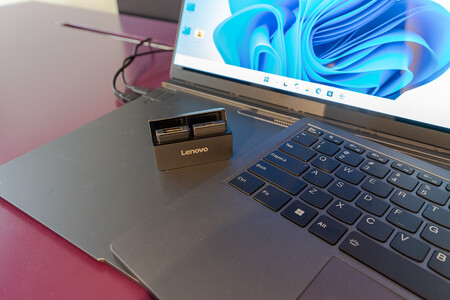
Despite its potential, I noticed a few limitations during testing. The secondary panel lacked brightness adjustment, and the device presented some instability, particularly with the kickstand. These challenges are typical for a prototype and indicate areas for improvement as Lenovo refines the product.
Conclusion
Lenovo’s modular approach represents a groundbreaking shift in the laptop industry, offering unparalleled expansion, upgrading, and repairability possibilities. While it faces challenges in practicality, the concept is undoubtedly impressive. Although it remains uncertain when—or if—it will hit the market, there’s a strong likelihood that elements of this innovative design will influence future Lenovo products.
Images | Ivan Linares