

Revolutionary Insight: Dogs’ Ability to Understand Beyond Basic Commands
For many dog owners, their pets’ ability to comprehend words like ‘ball’ , ‘walk’ , or ‘treat’ can be astonishing. Recent research has unveiled that dogs have advanced their understanding, evolving beyond simple associations of sounds with specific objects. A recent study published in *Current Biology* reveals that dogs possess communication abilities previously thought to be exclusive to humans.
The Investigation
The study, spearheaded by Claudia Fugazza and her talented team, focused on an extraordinary group of dogs known as the ‘Gifted Word Learners’ . These dogs are anything but ordinary; they exhibit remarkable talent in learning the names of various objects, with vocabularies ranging from 29 to over 200 words . This unique skill enables them to acquire new words quickly during playful interactions with their owners.
Learning the Rules
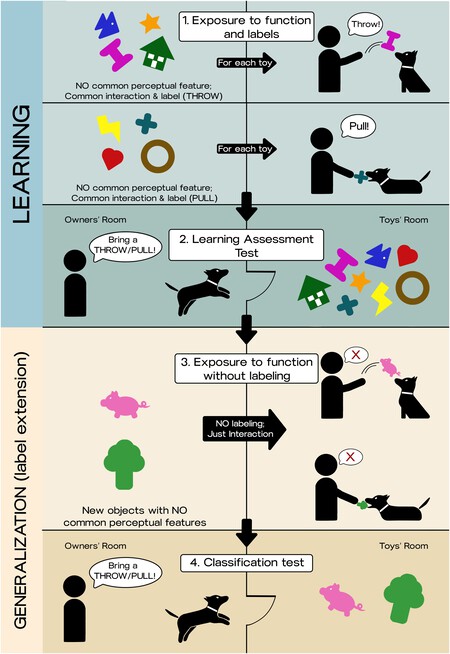
To explore if dogs could surpass mere visual recognition, researchers devised a four-phase experiment . The initial phase involved teaching the dogs two verbal labels for different toy groups. For example, one set of toys was labeled as ‘fetch’ , while a different group was designated as ‘throw’ . The dogs engaged in specific play behaviors associated with each label.
In this experiment, it was crucial that toys within each category lacked any systematic physical characteristics. The only commonality was the label and the method of engagement, emphasizing the dogs’ understanding of the rules tied to each term.
The Exam
The second phase assessed the dogs’ grasp of the rules. Remarkably, eight dogs excelled, retrieving the correct toy in 12 out of 16 attempts . This performance indicated a clear understanding of the verbal cues given to them.
Introducing New Toys
In the third phase, new toys were introduced to the dogs while adhering to a strict rule: verbal labels for ‘fetch’ or ‘throw’ were omitted. For a week, the dogs interacted solely with these new toys, reinforcing their understanding through experiential learning, unbound by verbal labels.
The Final Test
Upon completing these phases, only the new toys remained available— played with in the previous phase without explicit naming. Owners then instructed their dogs to “bring me a fetch/toy throw ” from another room, leaving no visual cues. The dogs were required to deduce which toy the owner referred to based solely on its previously recognized function.
Results
The dogs successfully identified the correct new toy based on their prior experiences, achieving a rate exceeding random chance. On average, out of 48 attempts , they successfully selected the correct toy 31 times . This pronounced success illustrates that dogs are not just passively learning names; they categorize objects based on their intended use rather than mere appearance.
The Importance of the Findings
This groundbreaking study challenges the longstanding belief that dogs primarily learn through perception, asserting instead that they fundamentally classify the world based on an object’s planned utility . The findings suggest that these Gifted Word Learners could serve as a model for studying cognitive functions related to language in natural settings, drawing comparisons to how children learn.
Opening New Avenues for Research
Importantly, researchers caution that this ability is currently exclusive to the *’Gifted Word Learners’* and cannot be generalized to all dogs. However, it opens new avenues for exploration into whether this latent capacity resides within other canine populations, potentially transforming our understanding of dog cognition.
The implications of this research resonate beyond just the understanding of canine intelligence. By highlighting the unique capabilities of dogs in processing language-like categorization, it paves the way for further studies into animal cognition, leading to a deeper understanding of how non-human species interpret and interact with their environment.