
Milei’s Commitment to a More Respectful Discourse: A Reflection from Julio Cobos
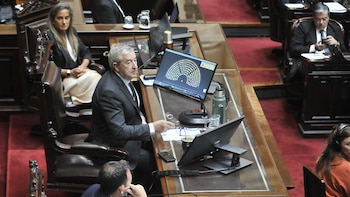
In a recent speech delivered at the Faro Foundation, President Javier Milei made a bold commitment to temper his language and engage in more productive discussions, a statement that has sparked varied reactions across the political spectrum. Julio Cleto Cobos, a prominent legislator from Mendoza and former vice president, expressed cautious optimism regarding Milei’s pledge. “The president had promised to moderate his language; I sincerely hope this is the case,” Cobos stated, highlighting the need for a more respectful exchange of ideas, particularly in a divided Congress.
Milei’s declaration came with a challenge: “Let’s see who has the intellectual capacity to discuss ideas.” His recent pronouncements raised questions about the nature of dialogue in Argentine politics, an area where many feel improvement is essential. Cobos, reflecting on this, emphasized the need for Milei to repair the dialogue not only with Congress but also with the segments of society that hold differing opinions.
The Debate on University Financing: A Legislative Crucible
On the legislative front, the discussion centered around the University Financing Law, where the challenging dynamics of funding public universities came into sharp focus. The debate was marked by Cobos’s support for the project, urging the government to consider societal needs alongside fiscal surpluses in public accounts. Cobos stressed, “We have heard that the fiscal balance must not be broken. However, the institutional and social balances must also be preserved.” This sentiment echoed through the Assembly as various representatives articulated their concerns about the dire budgetary conditions affecting public education.
Among the opposition, Ricardo López Murphy, a deputy from the United Republicans, expressed skepticism about increasing university funding without specifying the sources for such expenditures. “Our system is not parliamentary, and we cannot operate on whims when discussing financial initiatives,” he cautioned. López Murphy’s criticism highlighted a historical failure to pass a budget for two consecutive years, underscoring his point that the issue stems from irregular budget practices.
The urgency of the matter was unmistakable as the Left Front’s deputies, particularly Christian Castillo and Mercedes de Mendieta, argued that “there is money” available, albeit misallocated. Castillo pointed to the extraordinary profits from the agricultural sector, asserting, “The argument that there is no money is increasingly untenable.” He lamented the disparity in funding for different sectors, emphasizing societal inequity over the government’s fiscal claims.
Prioritizing Educational Budgets amid Cuts
Deputy Danya Tavela, representing Democracy Forever, took the floor to advocate for the necessity of stable funding for universities, citing historical budget cuts that have placed immense strain on educational institutions. “We are witnessing an unprecedented adjustment in our education system,” Tavela remarked, emphasizing that half of the teaching and non-teaching staff now live below the poverty line. The context of her argument spoke volumes about the rapidly deteriorating conditions within the public university system.
In stark contrast to the supposed fiscal surplus touted by the government, Tavela noted that the benefits of this surplus largely favored large corporations and foreign arms companies, while essential public services and higher education continue to suffer. With student scholarships grossly inadequate, she called for a significant increase in funding to meet the urgent needs of the university ecosystem.
Political Tensions and Legislative Maneuvers
As the debate intensified, political theater unfolded in the Assembly. Esteban Paulón, a Santa Fe deputy, ingeniously showcased an image of former President Mauricio Macri accompanied by the caption “Karina Driving,” referring to Milei’s sister, who serves as the general secretary of the Presidency. This stunt was a pointed critique of the increasingly cozy relationship between Milei’s Freedom Advances party and Macri’s PRO.
Amid the energetic discussions, the opposition managed to gather the necessary quorum to initiate the legislative session, which signaled progress in advancing critical projects that had been sidelined. Pablo Juliano, the leader of the Democracy Forever bloc, articulated the frustration felt by many legislators regarding the ruling party’s tactics aimed at delaying crucial discussions. “The government desires to prolong the session’s treatment of projects, which undermines our democratic processes,” he claimed.
A Reflective Closing
With high stakes surrounding the discussions on university funding and broader fiscal policies, the legislative body is at a crucial juncture. The ramifications of these debates will not only affect educational institutions but will also have repercussions throughout Argentine society. Cobos’s hope for Milei to embody a more respectful political discourse is not merely an individual desire but a collective need for healing and constructive engagement in a fractured political landscape. The outcomes of these legislative efforts will ultimately define the future of not only public education but also social equity in Argentina.