
There was a day that Depseek surprised half the world by demonstrating that you could go far with less. [Today returns with V3.1](https://mp.weixin.qq.com/s/WUbmBSapVyvxZe6HobD5Qw) and a message that does not go unnoticed: the model has prepared for the next Chinese chip batch. We are not talking about an automatic market overturn, but a concrete bet that points in an awkward direction for Nvidia and similar companies. If that technical tune with the Chinese hardware translates into performance, the conversation about who feeds AI in China is going to sound very different.
[According to the company’s own note](https://mp.weixin.qq.com/s/WUbmBSapVyvxZe6HobD5Qw), V3.1 opens a hybrid inference in the purest GPT-5 style: the same system with two routes, *Think* (deep reasoning) and *Non-Think* (quick response), Sygons from your website and app. The formulation is clear: “Hybrid Inference: Think & Non-Think, a model, two models.” The company also underlines that the version *Think* “reaches answers in less time” than its predecessor. That is, not only do the weights change, the inference modes that are already in service also change.
The Phrase That Frames Everything: An FP8 “Thought for National Chips”
In a comment set in his latest publication on Wechat , Depseek writes: “EU8M0 FP8 is for the next generation of national chips.” That is the point that tenses the rope: it suggests that the company has adjusted the data format, apparently a [FP8](https://docs.nvidia.com/deeplearning/transformer-engine/user-guide/examples/fp8_primer.html) which it labels as EU8M0, for the next wave of Chinese processors . [Bloomberg and Reuters](https://www.bloomberg.com/news/articles/2025-08-21/deepseek-touts-model-that-outdoes-flagship-in-agentic-ai-step) collect that message and synthesize it: V3.1 is “personalized to function with next-generation AI chips Chinese.” In other words, optimization is oriented toward the local ecosystem.
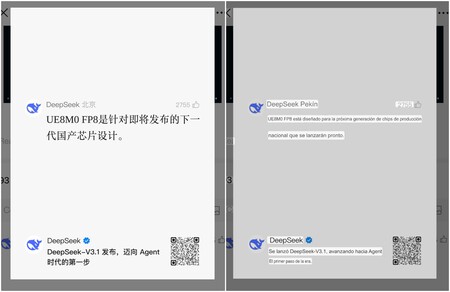
The original comment in Chinese (left) and its Spanish translation with Google Translate (right)
FP8 is an 8-bit format that weighs half that of FP16/BF16. With native support, it allows greater yield per cycle and less memory, provided that the climb is well calibrated. [In the official Model Card of Hugging Face](https://huggingface.co/deepseek-ai/DeepSeek-V3.1-Base), it is noted that Depseek-V3.1 “has trained using the EU8M0 FP8 scale format,” which indicates that it is not only a packaging of weights but that training and execution have been expressly adapted to that precision. The delicate part—and it is convenient to be prudent—is that everything points to a chips’ remittance that will be displayed in the future, since they can take advantage of this scheme natively.
So is this bad news for Nvidia? The data from the fiscal year that expired on January 26 indicates that China represented approximately 13% of the company’s revenues led by Jensen Huang. If part of the computation of AI in China Classic duo mutates from GPU NVIDIA + CUDA ecosystem to domestic solutions that work with the EU8M0 FP8 format and yield good results (presumably chips from Huawei), the demand for Western solutions could be eroded over time.
China represented approximately 13% of Nvidia’s income in the last fiscal year
All this occurs on the U.S. export controls board: restrictions that sought to halt China’s access to leading chips and that have also accelerated their commitment to self-sufficiency . This year, the Trump administration rehabilitated the export of the H20, a chip designed for China. Since then, the status of the H20 has fluctuated: among permits, Chinese regulatory pressures, and Nvidia’s plans to present Blackwell-based alternatives. The background message is that the framework is political and changing, and any route that allows China to utilize these opportunities becomes a strategic value .

You must remember another fact that helps to calibrate expectations. According to the [Financial Times](https://www.ft.com/content/eb984646-6320-4bfe-a78d-a1da2274b092), Deepseek attempted to train its future R2 model with Huawei chips but ran into persistent technical problems. He ended up returning to Nvidia for training, while still working on the compatibility for inference . That episode does not invalidate the current strategy, but sets the bar: to completely migrate its processes is not simple; it requires, among other things, months of engineering. V3.1, therefore, should be viewed as an iteration. Now the company claims to have prepared its model for the next Chinese chips.
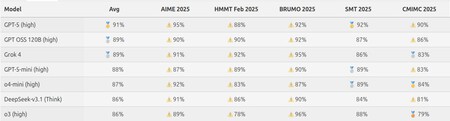
Matherena models scores
And here we have another interesting fact. [Matharena](https://matharena.ai/), a platform linked to [Zurich Federal Polytechnic School](https://ethz.ch/en.html), evaluates models in real and recent mathematical competitions. It places GPT-5 as a leader, with 90% in final response tests , while Deepseek-V3.1 (Think) is noted to be lagging, although it is among the best models of the moment. This helps contextualize V3.1 as a competitive model that pushes the boundaries.
Images | Xataka with Gemini 2.5 | Matharena and Deepseek screenshots