
The Chinese startup Moonshot AI has introduced Kimi K2, an open-source artificial intelligence model that boasts exceptional programming capabilities and autonomous functionalities. This ambitious launch comes at a crucial time for the AI sector, as Chinese firms strive to replicate the disruptive success of Deepseek with alternative models that are both potent and more affordable than current market offerings.
Kimi K2 doesn’t arise in a vacuum. Moonshot AI has emerged as one of the most promising startups within the Chinese AI landscape, significantly backed by investments from major players like Alibaba . Kimi, their chatbot, managed to secure the third position in terms of monthly active users in August 2024, but has since slipped to seventh place by June 2025 following the emergence of Deepseek R1 . To reclaim its competitive edge, Moonshot AI is adopting a strategy that combines open-source accessibility and aggressive pricing, mirroring the successful formula that propelled Deepseek to prominence.
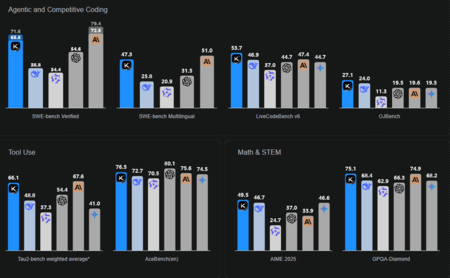
<span>Image: MoNshot AI</span>What Kimi K2 Brings to the Table. The model features 1 billion total parameters with 32 billion activated parameters, employing the well-regarded Mixture-Of-Experts architecture for optimal computational efficiency. Two versions are available: a base version for researchers and developers, and another optimized version aimed at enhancing conversational capabilities and performing autonomous tasks. Consequently, Kimi K2 becomes Moonshot AI’s solution designed to function as an intelligent agent for diverse tasks including coding, workflow completion, and conversational interactions.
Kimi K2’s Exceptional Performance. In performance tests, Kimi K2 has achieved an impressive 65.8% accuracy on the Swe-Bench Verified , a benchmark recognized for its rigour in software engineering. It performed equally well in the LiveCodeBench, where it secured 53.7% , surpassing both Deepseek V3 (46.9%) and GPT-4.1 (44.7%). Moreover, it recorded a staggering 97.4% on the Math-500 , outperforming GPT-4.1’s 92.4%, indicating substantial progress in mathematical reasoning capabilities.
<img alt="Developers anticipate AI to enhance productivity" width="375" height="142" src="https://i.blogs.es/31aec0/programacion-ia-portada/375_142.jpeg"/>Competitive Pricing. Moonshot AI charges $0.15 per million input tokens and $2.50 per million tokens for developers utilizing their API. In comparison, competitors like Claude Opus 4 demand approximately $15 for initial input (100 times more) and $75 for outputs (30 times more), while GPT-4.1 charges $2 for input and $8 for output . Additionally, users can access Kimi K2 for free through web applications and the Kimi mobile app, eliminating the monthly subscription fees associated with many advanced models offered by ChatGPT or Claude.
Groundbreaking Technology. Moonshot has conceived the MuCanclip optimizer , which enables the training of models with 1 billion parameters “with zero training instability.” This revolutionary technology could drastically lower the training costs for extensive models, solving a significant hurdle that has often marginalized AI advancements to resource-rich companies.
A Dual Strategy. The startup offers both free access to the code and a paid API using competitive pricing. This dual approach allows businesses to begin with the API for immediate implementation before transitioning to self-hosted versions—either for cost-effectiveness or compliance with regulatory standards. Each developer downloading Kimi K2 also becomes a potential business client.
A Pivotal Moment. Kimi K2 signifies a crossroads where open-source models and proprietary alternatives unite. Moonshot AI aspires to make Kimi a versatile tool while providing its open-source model, capitalizing on API usage for varied implementations.
The Future Ahead. The launch of Kimi K2 arrives at a decisive moment, prompting reactions from tech giants such as OpenAI, Google, and Anthropic as they face the challenge of affordable and high-quality language models. The focal point has shifted from whether open-source models can rival their proprietary counterparts, to whether major tech companies can adapt their business strategies swiftly enough to engage in this evolving landscape. As the race towards GPT-5 and other industry breakthroughs accelerates, all eyes remain keenly observing the industry’s next moves.
Cover image | Xataka with Mockuuuups Studio and Kimi AI
In Xataka | Grok 4 surpasses tests, aiming to claim the title of the most advanced AI model, though challenges persist due to Elon Musk’s interventions.