
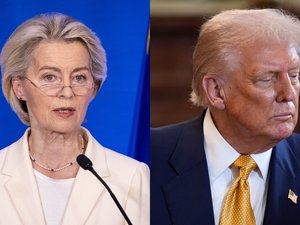
Donald Trump and Ursula von der Leyen concluded a significant trade agreement on July 27 in Turnberry, Scotland. This agreement introduces customs duties of 15% on European imports, while the European Union commits to $750 billion in energy purchases and $600 billion in investments within the United States. This decisive moment marks a notable shift in transatlantic trade relationships, raising questions about the future of global commerce.
Key Takeaways
Trump and von der Leyen finalized a trade agreement that imposes 15% customs duties on European products while establishing a commitment from the EU for $750 billion in energy purchases.
This deal averts a 30% surcharge that Trump had threatened to impose on August 1, marking a significant protective measure in transatlantic relations.
The EU must still validate the agreement, although Trump aims to bolster his image despite controversies surrounding him.
On Sunday, U.S. President Donald Trump and European Commission President Ursula von der Leyen engaged in a swift and productive meeting that lasted just over an hour. Prior to this session, journalists were informed that the chances for a positive outcome were “50%”. Yet, when they re-entered the sumptuous ballroom of the Trump Turnberry Golf Complex, they were met with the exciting announcement from Trump that they had successfully reached an agreement. He described it as the “biggest” trade deal ever, emphasizing the “unity and friendship” that the agreement represents. Von der Leyen echoed this sentiment, referring to it as a “good agreement” that would bring “stability” to the relationship between the EU and the U.S.
Details of the Trade Agreement
In outlining the agreement, Trump highlighted the imposition of 15% customs duties on European imports while the EU promised to commit $750 billion in energy purchases and an additional $600 billion in investments in the U.S. This agreement forestalls a dramatic increase in customs duties, which Trump had previously threatened, initially announcing plans for a 30% surcharge on European products entering the United States post-August 1. Ursula von der Leyen emphasized the necessity to rebalance the commercial dynamics between the two regions, crediting Trump’s negotiation skills during their discussions.
Though the precise details of the agreement are still being clarified, it must be validated by EU member states. During a meeting in Greenland, ambassadors were briefed on the latest negotiations, but they will require further consultations before formal validation can proceed. Turnberry’s agreement essentially signals a new phase in transatlantic exchanges, moving toward a more protectionist stance led by the U.S. Historically, American customs duties had averaged 4.8% ; this new arrangement significantly raises the stakes in U.S.-EU trade relations.
Potential Repercussions and Responses
While Trump and von der Leyen orchestrated what they framed as a moment of compromise, the political landscape remains fraught with tension. Should negotiations falter again, Brussels is prepared to retaliate with its own suite of tariffs targeting American goods and services. The European Union, particularly under the leadership of France and other member states, has indicated readiness to employ measures that could limit American access to European public contracts or hinder certain investments.
The prospect of using a so-called “bazooka” —known as the “AnticoCition” instrument in EU parlance—could elevate tensions further, prompting an intense diplomatic and economic standoff between Europe and America. Although Trump claims he is negotiating from a position of strength, recent polls suggest that a subset of Americans remain skeptical of his strategies and overall business conduct.
Amidst broader scandals, including controversies stemming from his past associations—most notably with Jeffrey Epstein—Trump’s diplomatic maneuvers raise questions about transparency and motivations. While skeptics wonder whether the agreement is part of a diversion from mounting legal troubles, Trump dismissed such allegations during the announcement, asserting that it reflects nothing but good prospects for both the American and European economies.
As Trump redirects attention to negotiations with China in the coming days, the implications of the Turnberry agreement will reverberate throughout global markets, reshaping trade dynamics as they evolve. The future remains uncertain with many eyes watching how EU leadership will react and whether this agreement will indeed lay the groundwork for robust transatlantic relations in an age of increasing protectionism.