

What events led to the so-called “Black Monday” in cryptocurrency markets? How much did Bitcoin fall during this correction, and what was the total liquidation amount across the crypto market? Which cryptocurrency traders experienced the highest losses in liquidations, and what factors contributed to this downturn? What impact did U.S. stock futures experience alongside the cryptocurrency crash, and what does this indicate about the broader market sentiments? How did retail investors react during this period of market turmoil?
Cryptocurrency markets faced a brutal correction on what’s being dubbed “Black Monday,” with total liquidations exceeding $1.36 billion in the past 24 hours. The crypto market is falling along with global stock markets following Trump’s ‘Liberation Day’ tariffs. The crash was led by Bitcoin (BTC), which fell to nearly $75,000, triggering a cascade of forced liquidations across the board. The entire crypto market is down nearly 13% in the last 24 hours. According to data from CoinGlass, long-positioned futures traders bore the brunt of the market turmoil. Over $1.2 billion of long bets were wiped out, with Bitcoin longs accounting for more than $392 million in losses.
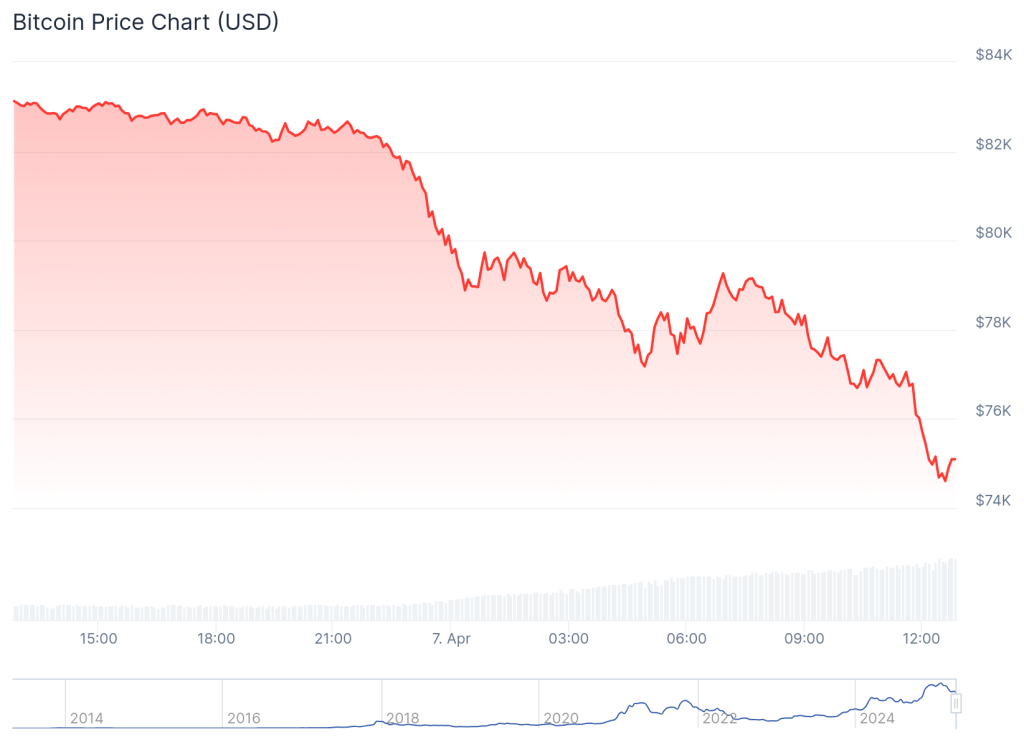
ETH, SOL, and XRP Traders Suffer Nearly $730M in Liquidations Amid Market Crash
Ether (ETH) traders lost close to $328 million, while altcoins—including Solana (SOL) and XRP—contributed nearly $400 million to the total, with each seeing about $60 million in liquidations. ETH plunged 20% to $1,449 while major altcoins like SOL, XRP, and Dogecoin (DOGE) dropped by as much as 20% in the last 24 hours. BNB also dropped nearly 10%. Mid-cap and low-cap tokens were also swept up in the selloff, falling between 10% and 20%, per CoinGecko data. Nearly 86% of all futures traders had bet on a price rally, anticipating short-term relief in the market. However, the violent downturn forced exchanges to liquidate leveraged positions en masse, as traders failed to meet margin calls. Liquidations of this scale are often signs of extreme market stress. Forced selling during a downturn can accelerate price declines, while potentially setting the stage for a sharp rebound once the excess leverage is flushed out.
Crypto Crash Mirrors U.S. Stock Futures Slump
Crypto wasn’t alone in the selloff. U.S. stock futures also plunged Sunday night, heightening fears of a broader market crash. S&P 500 futures fell 5.98%, Nasdaq 100 futures slid 6.2%, and Dow futures dropped 5.5%, all pointing to a chaotic start to the trading week. The sharp selloff follows growing macroeconomic uncertainty, intensifying trade tensions, and investor jitters over President Donald Trump’s sweeping tariff order. CNBC’s Jim Cramer referenced the 1987 crash in a post on Saturday, warning that a “Black Monday” could weigh heavily on the administration’s legacy.
Markets in Asia mirrored the panic. Japan’s Nikkei 225 tumbled 8.9% early Monday, while Taiwan’s Taiex index plunged nearly 10%, triggering circuit breakers on heavyweights like TSMC and Foxconn. Authorities responded by temporarily banning short-selling to curb further volatility. Meanwhile, retail investors pulled a record $1.5 billion from equities in just 2.5 hours on Friday, underscoring the depth of fear in the market. Institutional capital continued its exodus, making March 2025 one of the sharpest withdrawal periods in recent history. As reported, U.S. stock markets have experienced a staggering $11 trillion wipeout since February 19, with losses accelerating on April 4 following heightened concerns over President Donald Trump’s sweeping tariff measures. The single-day market loss amounted to $3.25 trillion—exceeding the total valuation of the global cryptocurrency market, which stood at $2.68 trillion at the time. Among major tech players, dubbed the “Magnificent 7,” Tesla led the plunge, falling 10.42%. Nvidia and Apple also saw steep losses, dropping 7.36% and 7.29% respectively.
The post Crypto Liquidations Surpass $1.3B as Markets Continue to Crash on ‘Black Monday’ appeared first on Cryptonews.
Crypto Liquidations Surpass $1.3B as Markets Continue to Crash on ‘Black Monday’
In a dramatic turn of events on what is now being referred to as "Black Monday," the cryptocurrency market experienced a catastrophic plunge that saw liquidations surpassing $1.3 billion. This staggering figure underscores the volatility and unpredictability that characterize the cryptocurrency ecosystem. As bearish sentiment takes hold, traders and investors are left grappling with the aftermath, and questions about the future trajectory of digital assets loom large.
The Catalyst for the Crash
Several factors have coalesced to precipitate this dramatic market reaction. A combination of macroeconomic pressures, regulatory uncertainties, and escalating concerns regarding inflation has set the stage for an avalanche of sell-offs. Recent high-profile events, including warnings from central banks about tightening monetary policies, have compounded investor fears. The impact of these external economic conditions is felt more acutely in the crypto markets, where speculation and rapid trading often lead to amplified reactions.
Additionally, factors specific to the cryptocurrency space, such as ongoing debates surrounding regulatory frameworks and the integrity of various blockchain projects, have stirred further unease among traders. Lack of clear guidelines from regulators in key markets, including the United States and Europe, has led to uncertainty about the legality and future of many cryptocurrencies. This uncertainty, combined with a broader risk-off sentiment in financial markets, has led many to liquidate their positions rather than face potential further losses.
The Liquidation Phenomenon
Liquidation in the crypto market occurs when traders who use margin or leveraged trading fail to meet their margin calls, forcing exchanges to sell their positions to cover losses. This process creates a cascading effect, as forced selling drives prices down, leading to further liquidations in a vicious cycle. In the early hours of what became known as "Black Monday," data revealed that liquidations soared across multiple exchanges, with over $1 billion worth of positions liquidated in a matter of hours.
The magnitude of these liquidations is unprecedented and accentuates the risks involved in leveraged trading. Many investors, including retail traders, often underestimate the potential for significant market corrections. As panic sets in, traders rush to minimize their losses, further exacerbating the downturn. The $1.3 billion figure doesn’t just reflect financial loss; it also represents the erasure of confidence in the market for thousands of participants.
Market Response and Reactions
In the wake of the crash, reactions have varied widely within the cryptocurrency community. Some investors remain optimistic, viewing this downturn as a necessary correction following an extended bullish phase. They argue that the fundamentals of various blockchain technologies remain strong and that the current bearish sentiment will eventually give way to a recovery.
However, a prevailing sense of caution lingers as market participants process the enormity of the losses. Many traders are left questioning their strategies and contemplating the long-term viability of their holdings. For some, the liquidation events have underscored the necessity for better risk management practices, particularly in an environment where price volatility can swing dramatically in a short period.
Institutional Impact
Interestingly, institutional investors, who have increasingly entered the crypto space in recent years, appear to be taking a more measured approach. Many firms are reportedly utilizing this downturn as an opportunity to accumulate assets at lower prices. This perspective aligns with a long-term view that sees digital currencies as vehicles for growth despite short-term fluctuations.
The growing participation of institutional players has sparked discussions about the maturation of the crypto market. If large-scale investors can weather significant downturns, it may encourage more stability and professional management in the sector. However, the current crash raises questions about the resilience of institutional buyers to short-term volatility and market manipulation.
The Path Ahead
Moving forward, the cryptocurrency market faces a myriad of challenges. As regulatory bodies across the globe tighten their focus, the need for clear guidelines will be paramount. Enhanced regulation could serve to stabilize the market, fostering a safer environment for investors. However, too-stringent measures may stifle innovation and push traders towards less regulated platforms.
As market participants sift through the wreckage of "Black Monday," the key takeaway is clear: the cryptocurrency landscape remains fraught with risks. Continued education on market dynamics, risk management, and regulatory developments will be crucial for investors looking to navigate these turbulent waters.
In conclusion, as liquidations surpass $1.3 billion and uncertainty shadows the market, the crypto community finds itself at a crossroads. Whether to believe in the long-term potential of digital currencies or to remain wary of the inherent risks will shape the market’s recovery in the months ahead. Investing in cryptocurrencies demands a judicious balance between innovation, speculation, and caution—a lesson that has never been more pronounced than in the aftermath of this tumultuous trading day.
On a day dubbed ‘Black Monday’ for the crypto market, liquidations surged past $1.3 billion as traders faced significant losses due to a sharp decline in prices. The downturn was precipitated by a mix of factors, including macroeconomic concerns, regulatory news, and heightened volatility, leading to heavy selling pressure across various digital assets.
The liquidations involved numerous leveraged positions, where investors attempting to capitalize on rising prices were caught off guard by the rapid market reversal. As prices dropped, many had to exit their positions, triggering a cascade effect that further exacerbated the decline.
Throughout the crypto ecosystem, major assets experienced steep drops: Bitcoin, Ethereum, and several altcoins plummeted, contributing to the overall financial turmoil. The situation reflects the inherent risks associated with trading in leveraged positions and highlights the vulnerability of the market to sudden shifts in sentiment.
Market analysts are monitoring the situation closely, assessing whether this crash will lead to a prolonged bear market or if stabilization can be achieved in the near future. Reactions from various stakeholders, including exchanges, regulatory bodies, and the investor community, will likely shape the next steps for the crypto market in the aftermath of this significant event.