
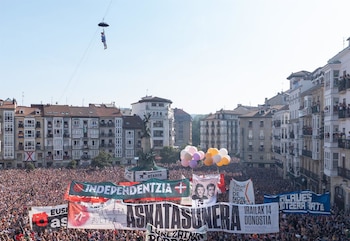
In a disturbing turn of events , Covite, a victims’ association, has expressed its indignation regarding what it perceives as the “total institutional passivity” towards the public exaltation of ETA (Euskadi Ta Askatasuna) during summer festivities in the Basque Country and Navarra. The organization warns that this trend of celebrating a group responsible for numerous atrocities is not only an affront to victims but also a serious irresponsibility on the part of public institutions.
Social media platforms have become a vocal outlet for Covite, as they criticized the ongoing public celebrations that highlight the terrorist organization responsible for widespread violence and murder in Spain. The leadership of Covite, headed by Consuelo Ordóñez , questioned how long victims would have to endure such public displays of sympathy towards ETA.
A Pattern of Public Exaltation
Throughout the summer, different municipalities have witnessed a dramatic rise in the public exhibition of ETA propaganda during local festivities. Covite, alongside organizations such as the Fernando Buesa Foundation , has criticized the use of images, banners, and posters featuring ETA members, particularly during celebrations in Vitoria. Notably, figures like Txiki and Otaegi have become focal points in these public displays. Ordóñez expressed her disdain, remarking, “Those who romanticize violence continue to commandeer public spaces, advocating for impunity for the terrorists.”
Not only is this phenomenon limited to Vitoria. Other towns such as Oiartzun , Villabona (both in Gipuzkoa ), and Doneztebe (in Navarra ) have also displayed similar content at their patron saint festivals. In Oiartzun, for instance, a banner featuring the face of Joanes Larretxea , convicted for the murder of businessman Inaxio Uria , was hung from the City Hall. The town has a dark history; a total of nine people lost their lives due to ETA’s actions, yet the local government permits tributes to individuals who incited this wave of terror .
The Impact on Victims and Society
In Doneztebe, another banner showcasing Larretxea was on display, while Villabona made headlines for featuring individuals like Óscar Cerain and Juan Carlos Besance in its Pasquines (a local festival publication). Cerain was sentenced for horrifying crimes, including the murder of six-year-old Silvia Martínez and another victim, Cecilio Gallego , in a car bomb attack aimed at a Civil Guard barrage. Besance was linked to the murder of José Javier Múgica , a local politician.
Covite has been a staunch advocate for the rights of victims, emphasizing that “The victims deserve memory , not tributes to their murderers.” They argue that glorifying convicted murderers during public festivities is a humiliation for those who have suffered due to ETA’s actions. Such displays erode the collective memory of the victims, distorting the narrative surrounding terrorism and its consequences.
The association’s consistent pushback emphasizes the need for acknowledgment of the victims’ experiences rather than rehabilitative displays for their abusers. It aims to bring awareness not only to the social implications of glorifying terror but also to the roles of public institutions that silently observe these trends.
As the conversation surrounding the exaltation of ETA during festive gatherings gains traction, it inevitably raises vital questions about how society remembers its past. The ongoing scrutiny reflects a broader challenge in reconciling with historical injustices and the necessity to recognize the pain and sacrifice of the victims. With Covite and similar organizations bringing these issues to the forefront, it is critical for public discourse to evolve toward a more meaningful engagement with both remembrance and accountability.