
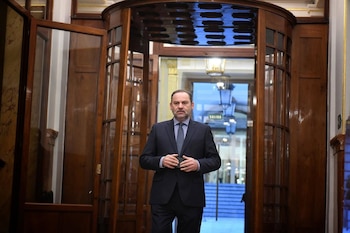
Exploring the Controversy Around José Luis Ábalos’ Payments: A Deep Dive into the Congressional Investigation
The political landscape in Spain has recently been stirred by the controversial investigation surrounding José Luis Ábalos, the former Minister of Transportation. The Supreme Court has taken a critical step by requesting detailed information from Congress on his payments made between 2014 and 2024. This scrutiny is not merely procedural; it raises questions about transparency and accountability within political finance in the country.
According to reports from Europa Press , the Congress has yet to receive the formal application from the Supreme Court. However, once it arrives, the expectation is that the legislative body will respond promptly. The goal is to gather all necessary information to address the inquiries surrounding Ábalos’ financial records.
Judge Leopoldo Puente , who is overseeing the investigation, has specifically asked Congress to clarify the payments made to Ábalos and to gather data from the PSOE , the political party he represented, regarding any donations he made during the same time frame. The inquiry comes in response to what has been termed as an “apparent lack of tune” in the information received.
The Central Operational Unit (UCO) of the Civil Guard has presented a significant finding: they suggest that the total payments made to José Luis Ábalos by Congress amounts to €751,421.57 . In stark contrast, Ábalos himself has only reported income of €79,841.74 during the same period. This discrepancy has raised eyebrows and ignited further investigation into how smoothly financial records are maintained within Spain’s political framework.
To provide some context, between 2014 and 2024, José Luis Ábalos did not serve continuously as a deputy. He vacated his parliamentary seat in June 2018 when he was appointed as Minister of Transportation, only to reclaim it after the April 2019 elections. This timeline is crucial in understanding the context of the payments and their legitimacy.
The Impact on Political Accountability
The ongoing probe into Ábalos’ financial dealings highlights a broader issue of political accountability in Spain. The discrepancies between what has been reported by the UCO and what Ábalos claims raises questions about how well financial transactions are overseen at a legislative level. It also points to potential gaps in the systems that monitor and report political expenditures.
Moreover, this investigation touches on public sentiment regarding corruption and transparency in politics. Citizens are increasingly demanding that elected officials maintain high levels of accountability, and any indication of financial misconduct can significantly affect public trust in political institutions.
The actions taken by Judge Puente and the Supreme Court serve as a reminder that no one is above the law, regardless of their political connections or status. Ensuring that politicians are held accountable for their financial dealings is essential for maintaining a healthy democracy, one in which citizens can trust that their representatives are acting in their best interest, rather than for personal gain.
Next Steps in the Investigation
As the probe continues, it is essential to monitor how Congress responds to the requests from the Supreme Court. Will they comply fully, and how quickly can they gather the necessary documentation ? The forthcoming actions will likely define the trajectory of the investigation and could set a precedent for how similar cases are handled in the future.
Moreover, this incident could spark a more extensive review of the financial practices of public officials in Spain. Calls for reforms could emerge, aiming to enhance transparency and oversight in political financing.
In retrospect, the ongoing investigation into José Luis Ábalos, encompassing an examination of both Congress and the PSOE, represents a significant moment for democratic accountability in Spain. The nexus of politics and finance requires meticulous scrutiny, not only for the sake of transparency but to foster public trust in political institutions. As the situation unfolds, it will be vital for all stakeholders — including citizens, politicians, and governing bodies — to engage in discussions about reforming practices to ensure a more transparent and accountable system.
General News – 2