
The Tension Before the World Cup 2026
With just 12 days to go before the commencement of the World Cup 2026, President Claudia Sheinbaum has expressed optimism regarding ongoing negotiations with the National Coordinator of Education Workers (CNTE). The situation has escalated as protests and mobilizations from teachers continue to challenge the government’s efforts to find a resolution.
Updates from the Morning Conference
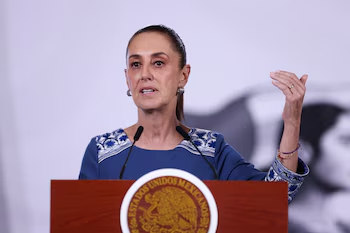
During a recent morning conference held on June 1, Sheinbaum conveyed her confidence in the dialogue facilitated by the Ministry of the Interior (Segob) and the Ministry of Public Education (SEP). These discussions aim to address the demands of the dissident teachers.
“We are going to trust that the talks go ahead,” Sheinbaum stated in response to concerns about whether a resolution could be reached in time for the World Cup’s inauguration.
Current State of Mobilizations
As of Sunday, protests were primarily led by members of Section 22 of Oaxaca, and other teachers from different states have begun joining the demonstrations. Sheinbaum reassured the public that the federal government is committed to meeting the demands deemed viable based on the current budgetary constraints.
“There are some demands that the budget does not allow to be resolved in their entirety, but there are others that can,” she explained.
Historical Context and Key Issues
The president highlighted that many demands from the CNTE have been longstanding. These include the call for a full repeal of the educational reform initiated during Enrique Peña Nieto’s administration, which educators view as punitive. Sheinbaum noted that crucial aspects of this reform have since been overturned under Andrés Manuel López Obrador’s government.
In the past, teacher permanence was evaluated based on assessments that focused more on punishment than professional growth, leading to widespread dissatisfaction among educators.
Commitment to Change
One of the contentious issues still affecting negotiations is the System Unit for the Career of Teachers (USICAMM), which manages teacher appointments, promotions, and mobility. Despite teachers’ opposition, Sheinbaum remains committed to abolishing the system, stressing that any modifications should be collaboratively agreed upon with teachers.
“My commitment was the disappearance of the USICAMM,” she said, indicating that new measures for easier teacher mobility are already being implemented.
Future Consultations and Conclusion
Additionally, Sheinbaum proposed a national consultation aimed at allowing teachers to specify how teacher evaluations should be structured, originally planned for this year but now postponed to 2027. This initiative aims to improve understanding of educators’ perspectives on USICAMM-related issues and seek alternative solutions.
While the situation remains fluid, and protests might escalate given the governmental response, Claudia Sheinbaum has asserted the federal government’s dedication to dialogue and hopes for resolution by the World Cup’s start. As the event approaches, the eyes of the nation will be on these ongoing discussions as they aim to balance educational reform and public sentiments with the celebratory spirit surrounding the World Cup.