
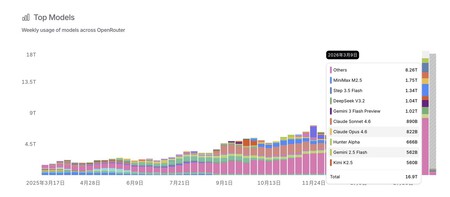
In recent developments, Chinese AI models have significantly outpaced their American counterparts, particularly on platforms like OpenRouter. This trend signals that despite U.S. attempts to curb competition through tariffs and sanctions, China is successfully employing a strategy termed “token export” to maintain its position in the global AI market.
Useless Tariffs and Economic Strategy
The U.S. government’s aggressive tariff policy, initiated during the trade war with China, has prompted a shift in how exports are managed. While these tariffs have undeniably impacted Chinese exports, they have inadvertently opened a pathway for Chinese AI to flourish by circumventing these obstacles. The affordability of Chinese AI models has made them a compelling choice, offering reasonable performance at significantly lower costs.
The Phenomenon of Token Export
In the realm of AI, usage is quantified in tokens rather than traditional energy units. Chinese AI models like Minimax M2.5 and Step 3.5 Flash are outperforming their U.S. rivals such as Gemini 3 and Claude Opus on the OpenRouter platform due to their competitive pricing. The key advantage is that these tokens bypass tariffs, allowing developers globally to harness their capabilities without incurring additional costs associated with traditional exports.
Devastating Price Differences
Premium American models often charge exorbitant rates, with Claude Opus 4.6 costing $5 per million tokens, while Chinese models can be accessed for as little as $0.10. Such a price difference—up to 50 times lower—offers a significant incentive for users, especially for applications that do not require top-tier performance.
A Shift Toward Cost-Effectiveness
As AI applications grow, so does the demand for cost-effective solutions. Systems like OpenClaw leverage AI agents to execute tasks more rapidly, often requiring a high volume of tokens. Although the best models promise superior results, many simpler tasks can be effectively managed by more affordable Chinese alternatives.
The Subscription Trap
With the emergence of AI agents, established companies like Anthropic and Google are reacting to the growing popularity of these low-cost models. Their subscription plans have begun to face criticism as users seek alternatives that offer greater flexibility and fewer restrictions. As a result, many are gravitating toward Chinese models, which are perceived as hassle-free and economically viable.
Factors Behind China’s Low Costs
Several elements contribute to the low costs of Chinese AI models. The price of industrial energy in China is approximately 40% lower than in the United States, and innovative architectures, such as Mixture of Experts (MoE), enhance efficiency by activating only the necessary components of a model at any given time.
The Irony of Chip Restrictions
In an unexpected twist, U.S. restrictions on advanced semiconductor exports have pushed Chinese companies to optimize their model efficiency. This unintended consequence has allowed them to become more competitive in the AI inference market, marking a significant turning point in the ongoing economic rivalry.
Challenges Ahead
Despite the success of China’s “token export” strategy, significant challenges remain. Issues related to data sovereignty and latency could deter companies from utilizing Chinese AI solutions, as sending sensitive data overseas raises substantial privacy concerns. Future measures from Washington targeting these AI models may also complicate the landscape, though such actions may prove more complex than past attempts.