
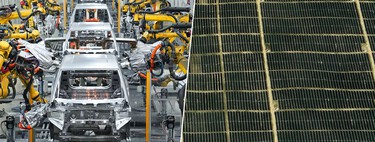
The Rise of Talatan: China’s Solar Power Revolution
A year ago, Xataka reported on a remarkable ecological experiment occurring in the Talatan Solar Park located in the Chinese province of Qinghai, high in the Tibetan plateau. This vast installation not only promised renewable energy but also created a unique environment where shade from solar panels contributed to vegetation growth in an otherwise arid desert.
The Largest Solar Facility in the World
Today, Talatan Solar Park has transformed dramatically. Covering an astounding 600 square kilometers, it now holds the title of the largest clean energy facility globally. Operating at 3,000 meters above sea level, it exemplifies an innovative approach by China to harness solar energy.
Initially conceived as a 1 gigawatt solar park, the project has skyrocketed to a staggering 15,600 to 16,900 megawatts—an increase in scale that is unprecedented. To put this in perspective, its size is anywhere from seven times the area of Manhattan. Not just reliant on solar, the park synergizes with 4,700 megawatts of wind energy and 7,380 megawatts of hydroelectric power, creating a hybrid energy ecosystem that has no parallel elsewhere.
Meeting Energy Needs
The implications of this transformation are immense. Qinghai’s renewable energy now nearly fulfills all energy demands across the plateau, including powering data centers essential for China’s artificial intelligence initiatives. According to CleanTechnica, China’s solar energy expansion is so aggressive that it installs as many solar panels every three weeks as the entire capacity of the Three Gorges Dam, historically the largest hydroelectric project in the world.
A Laboratory for Renewable Energy
High-altitude locations like the Tibetan plateau lend themselves to efficient solar energy production. The region’s clean, cold air creates an optimal setting for generating electricity, which is crucial for high-speed trains, electric vehicles, and various manufacturing facilities. Furthermore, the use of waste heat from server farms aids in heating buildings, thereby further reducing coal dependence, as noted by Zhang Jingang, vice provincial governor.
As highlighted by Professor Ningrong Liu in the South China Morning Post, “China is not only leading the transition to green energy; it is building the 21st-century energy scaffolding that sustains its industrial leadership.”
Three Sources of Energy in Harmony
This ambitious project’s success attributes mainly to centralized planning that integrates three primary energy sources: solar, wind, and hydroelectric power. During the day, Talatan’s solar panels harness intense solar radiation, while at night wind turbines capitalize on the cold breezes sweeping across the plains. When fluctuations occur, hydroelectric dams stabilize the energy grid. The New York Times explains a reversible pumping system, which utilizes surplus solar energy to elevate water to reservoirs at night, releasing it for electricity generation.
Reviving the Desert Ecosystem
Beneath the solar panels, life is revitalizing. The shade reduces evaporation and soil erosion, resulting in an 80% recovery of vegetation this year. 173 villages have benefitted from enhanced local livestock farming. For instance, a local shepherd, Zhao Guofu, shares, “My flock has grown to 800 sheep, and my income has doubled since I grazed between the panels.”
A Unique Geography for Solar Power
Qinghai’s high altitude plays a crucial role in solar efficiency. At 3,000 meters, the thinner atmosphere allows more sunlight to penetrate, while cooler temperatures minimize thermal losses in solar panels. Interestingly, this region also has expansive plain areas that enable large-scale construction, unlike many mountainous terrains.
The previously barren Talatan Desert has now become an energy jewel, complete with infrastructure like roads and high-voltage lines that connect this remote location to industrial hubs over 1,600 kilometers away.
A Global Leader in Clean Energy
China is at the forefront of renewable energy production, generating and consuming more than any other nation. In 2024, China accounted for 61% of new solar installations and 70% of global wind power. By mid-2025, the nation added 212 GW of solar and 51 GW of wind, marking a significant milestone in its efforts to reduce carbon emissions.
The Talatan Solar Park serves not only as a symbol but also as a strategic infrastructure in China’s quest for clean energy. The successful implementation of this model reflects an ambition to export renewable technology globally, as part of the Belt and Road Initiative.
The Underbelly of Progress
However, the clean energy narrative is not devoid of challenges. Reports indicate that access to Tibet is tightly controlled, and local communities experience concerns regarding the electromagnetic fields generated by high-voltage lines. Even as fears grow, many residents voice subdued support, recognizing the importance of national projects.
China is ambitiously redefining its energy landscape through the development of the Talatan Solar Park. What was once barren is now a source of energy that powers both industry and innovation thousands of miles away. The park illustrates a paradox: as the world’s largest CO₂ emitter, China is simultaneously spearheading efforts to transition toward a clean energy future. In quiet corners of the Tibetan plateau, plans for an energy-efficient planet are being conceived, offering a glimpse into the future of global energy.