
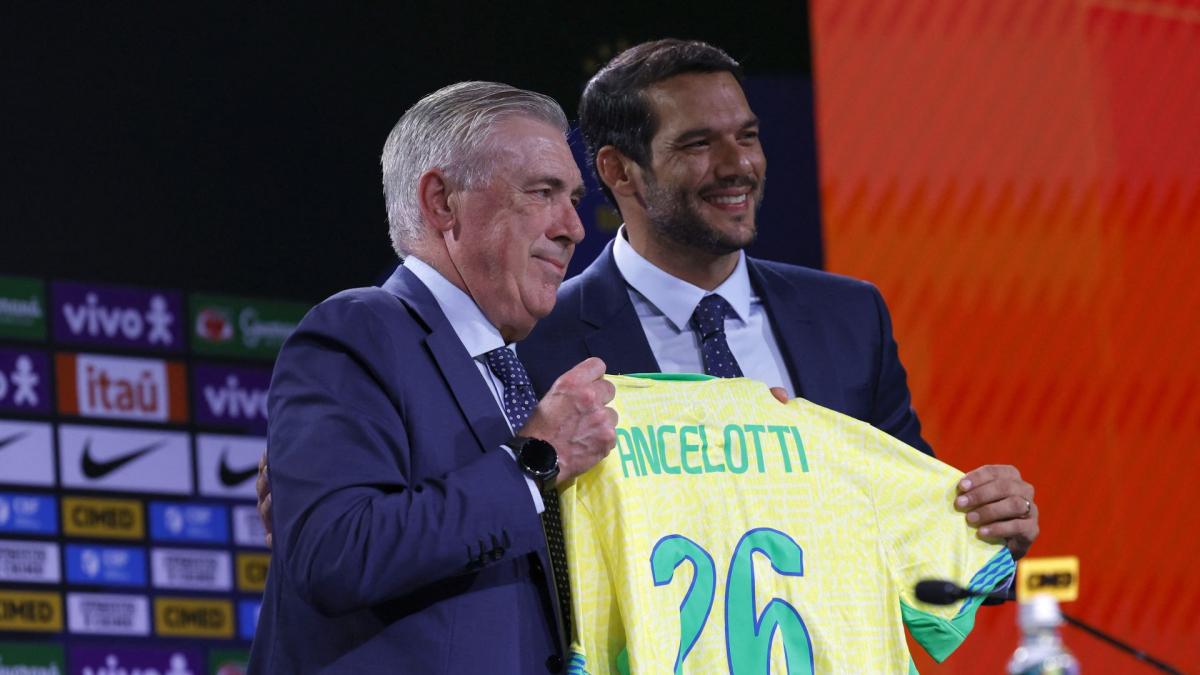
Carlo Ancelotti’s New Chapter with Brazil’s National Team
Carlo Ancelotti, a name synonymous with footballing excellence, officially took over as the head coach of the Brazilian national football team in late May 2025. This appointment comes at a pivotal moment, aiming to restore the proud Seleção after a tumultuous period following Tite’s departure at the end of 2022. Ancelotti’s first test came with the early matches of the 2026 World Cup qualifiers, and his journey began with a 0-0 draw against Ecuador before securing a crucial 1-0 victory against Paraguay in São Paulo, solidifying Brazil’s qualification for next summer’s World Cup.
Despite this achievement, doubts lingered over Ancelotti’s squad, especially after a heavy 4-1 defeat to Argentina in March. Recently, Brazil faced mixed results during the September international break, winning 3-0 against Chile but faltering with a disappointing 1-0 loss to Bolivia in El Alto. Ancelotti’s tenure, while promising, reflects the growing challenges of modern football and reveals the complexities he must navigate.
A New Environment
Expressing his enthusiasm, Ancelotti conveyed his appreciation for the welcoming atmosphere in Brazil, saying, “This is another rhythm. I have to soak up the culture of the country, that’s why I settled in Rio. I found a very well-organized federation here.” His comments reflect not just his professional ambitions but also his commitment to connecting with the local footballing culture.
Under the stewardship of Samir Xaud, president of the Brazilian Football Confederation (CBF), and director Rodrigo Caetano, Ancelotti has noted an environment rich in enthusiasm and support. He stated, “From the first day, the Brazilian public showed me a lot of affection. So yes, I really hope that we will win the World Cup. Brazil is the heart. It is an honor.” His emotions resonate with many in Brazil, a nation that views football as interwoven into its national identity.
The Challenges of Modern Football
In a revealing interview with L’Équipe, Ancelotti voiced concern over the frantic pace of the modern football calendar, highlighting the potential impacts on players’ health and the significance of national teams. He articulated that the increased number of matches, longer league seasons, and travel demands are deteriorating the intrinsic value of national selections. “Today is the problem of football: there are too many matches,” he lamented.
FIFA and UEFA’s relentless pursuit of expanded competitions has raised alarm among coaches and players alike. Ancelotti emphasized the need for clubs to collaborate more closely with national teams: “We regularly inform the clubs about our players’ training and physical states, and we expect mutual communication in return.”
Player Workload and Mental Health
Data from FIFPro indicates that an alarming proportion of elite athletes are facing excessive workloads. Many players in the 2023-24 season reported playing over 55 matches, leading to heightened risks of physical injuries and mental exhaustion. Ancelotti echoed these findings, emphasizing the importance of addressing this growing concern. “Selection football has seen its importance dilute a little. But the World Cup remains the only competition that will be viewed by the entire world,” he stated.
His remarks are corroborated by FIFPro’s “Player Workload Flash Report 2022,” which indicated that roughly 54% of 1,500 athletes monitored were experiencing high workload levels. Furthermore, around 17% played more than 55 games that season, an unsustainable figure. The cumulative effect not only impacts players’ physical well-being but has also escalated issues related to mental health—including sleep disorders, fatigue, and burnout.
Looking to the Future
Ancelotti’s comments come at a crucial time when the balance between club commitments and national duties is under scrutiny. He highlighted the need for urgent reforms within the footballing landscape to ensure players can manage their physical and mental health effectively. The overwhelming focus on club competitions has indeed led to a concerning dilution of the significance of national teams.
As Ancelotti continues to settle into his role with Brazil, the world will be watching closely to see how he manages these challenges. His experience, coupled with a clear vision for the future, may very well determine not just Brazil’s success in the upcoming World Cup but also the overall landscape of football on a global scale. The road ahead is marked by uncertainties, but the potential for success is boundless as Ancelotti looks to make his mark on this illustrious national team.